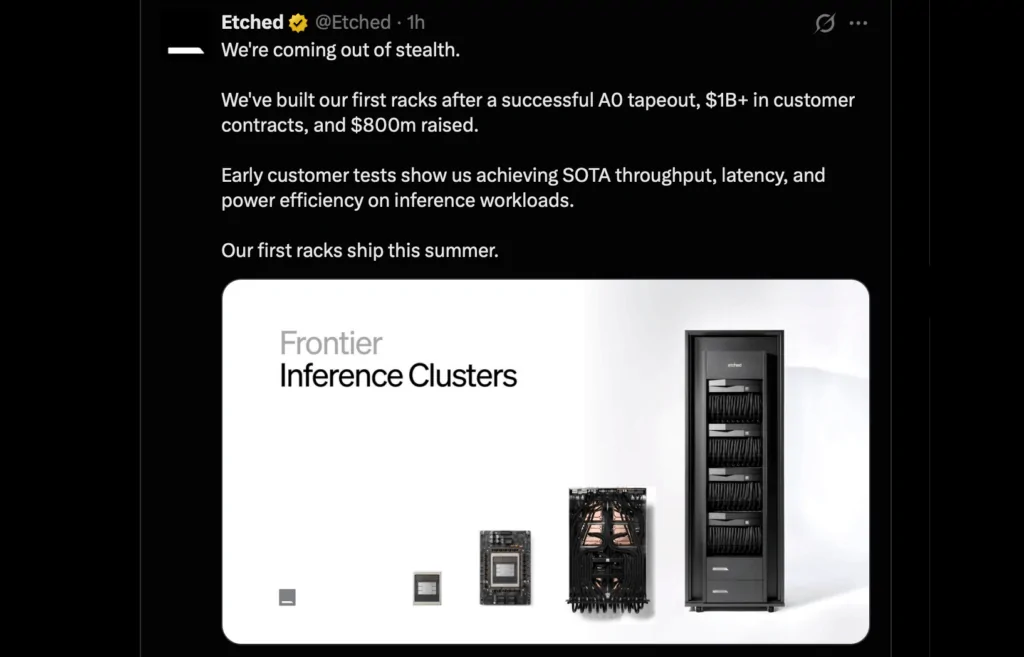
Etched emerged from stealth mode, announcing a working AI inference chip, more than $1 billion in signed customer contracts, and $800 million raised across multiple previously undisclosed financing rounds. The latest financing closed in December 2025, raising $500 million at a $5 billion post-money valuation. Investors include VentureTech Alliance, Peter Thiel, Jane Street, Hudson River Trading, Jump Trading, Two Sigma, Stripes, Ribbit Capital, Radical Ventures, Primary VC, Positive Sum, and several prominent AI researchers and entrepreneurs. The company said it achieved first-pass (A0) silicon success on the TSMC N4P process and plans to begin shipping its first rack-scale inference systems this summer.
Founded less than three years ago, Etched is developing vertically integrated AI inference infrastructure that combines custom silicon, racks, networking, cooling, software, and manufacturing. The company says its systems are already running production AI models including DeepSeek, Qwen, Mamba, and Llama, and are designed to support models ranging from dense architectures to large mixture-of-experts (MoE) systems with arbitrarily large parameter counts. To support manufacturing, Etched has opened a Taiwan factory while building a 2 MW data center, test house, and new product introduction (NPI) prototyping lab at its San Jose headquarters, with a stated goal of enabling gigawatt-scale deployments beginning in 2027.
Etched also disclosed two architectural technologies intended to differentiate its platform. The first, Low Voltage Inference (LVI), operates the chip’s compute arrays at less than half the voltage of conventional AI accelerators, which the company says enables sustained utilization above 80% of peak FLOPs without thermal throttling during trillion-parameter sparse MoE inference. The second, Cluster Scale Memory (CSM), combines HBM with a shared low-latency memory architecture connected through a proprietary interconnect to reduce inference latency while maintaining high throughput. According to Etched, early customer testing has demonstrated state-of-the-art throughput, latency, and power efficiency on inference workloads, with additional performance data expected later this summer.
• Raised $800 million across multiple previously undisclosed financing rounds.
• Latest financing: $500 million in December 2025 at a $5 billion post-money valuation.
• More than $1 billion in signed customer contracts.
• Achieved first-pass (A0) silicon success on TSMC’s N4P process.
• First rack-scale inference systems scheduled to ship in summer 2026.
• Systems currently running DeepSeek, Qwen, Mamba, and Llama models.
• Built a 2 MW data center, test facility, and NPI prototyping lab in San Jose.
• Opened a Taiwan engineering and manufacturing facility.
• Team of more than 400 engineers from NVIDIA, Google TPU, Broadcom, SK hynix, TSMC, and quantitative trading firms.
• Introduced Low Voltage Inference (LVI) architecture for sustained compute utilization.
• Introduced Cluster Scale Memory (CSM) architecture combining HBM with shared low-latency memory.
• Targeting gigawatt-scale AI inference infrastructure by 2027.
“We recognized early on that frontier AI would become one of the most economically significant technologies ever created, but that the infrastructure needed to serve those models in a sustainable and economically viable way simply did not exist,” said Gavin Uberti, co-founder and CEO of Etched.
🌐 Analysis: Etched enters an increasingly competitive market for AI inference infrastructure, joining companies such as Groq, Cerebras Systems, SambaNova Systems, d-Matrix, and established GPU suppliers led by NVIDIA. Unlike vendors focused primarily on accelerator silicon, Etched is positioning itself as a supplier of complete rack-scale inference systems, combining custom chips, interconnects, cooling, software, manufacturing, and deployment into a vertically integrated platform.
Several of the disclosed figures are noteworthy. A first-pass A0 tapeout on TSMC N4P is a meaningful semiconductor milestone, while $1 billion in signed customer contracts suggests substantial commercial interest before general availability. At the same time, many of the company’s performance claims—including state-of-the-art throughput, latency, and power efficiency—remain based on internal customer testing. Broader industry evaluation will likely follow once production systems ship and customers publish independent benchmarking results.
🌐 We’re tracking the latest developments in AI infrastructure. Follow our ongoing coverage at: https://convergedigest.com/category/ai-infra/
🏢 Etched AI Transformer-Specific AI Inference Silicon Updated: June 30, 2026 | |
| Etched AI is a private semiconductor startup building vertically integrated AI inference systems. Its rack-scale platform combines custom transformer-specific silicon, networking, memory, cooling and software to accelerate large language model inference with higher throughput, lower latency and improved power efficiency than conventional GPU-based systems. | |
| Why It Matters | Rather than selling standalone AI accelerators, Etched is designing complete inference clusters optimized for frontier AI models. The company’s vertically integrated approach reflects a broader industry shift toward co-designing chips, interconnects, memory, cooling and software as AI infrastructure scales toward gigawatt-class deployments. |
| Founded | 2022 |
| Headquarters | San Jose, California, USA |
| Leadership | Gavin Uberti, Co-founder & CEO Rob Wachen, Co-founder |
| Company Type | Private semiconductor startup |
| Funding | Reported total funding of approximately $800 million, including a $500 million financing completed in December 2025 at a reported $5 billion post-money valuation. |
| Commercial Traction | Etched reports more than $1 billion in signed customer contracts, with rack-scale inference systems currently undergoing customer validation ahead of production shipments. |
| Technology Status | First-pass (A0) silicon on TSMC’s N4P process is operational. Etched says its rack-scale systems are validating with customers and running DeepSeek, Qwen, Mamba and Llama models ahead of production shipments planned for Summer 2026. |
| Key Technology | Sohu Transformer ASIC • Low Voltage Inference (LVI) • Cluster Scale Memory (CSM) • Rack-Scale AI Inference • Custom Interconnect • Transformer-Specific Architecture |
| Roadmap | First production racks ship in Summer 2026. The company is targeting gigawatt-scale AI inference deployments beginning in 2027 while expanding manufacturing and validation capabilities. |
| Team | More than 400 engineers with experience from NVIDIA, Google TPU, Broadcom, SK hynix, TSMC, quantitative trading firms and other AI infrastructure organizations. |
| Editorial Coverage | Converge Digest tracks Etched across AI infrastructure, custom silicon, inference acceleration, rack-scale AI systems, semiconductor startups, transformer architectures and next-generation AI data center platforms. |
| Explore More | AI Infrastructure • Semiconductors • Inference • Custom Silicon • Data Centers |