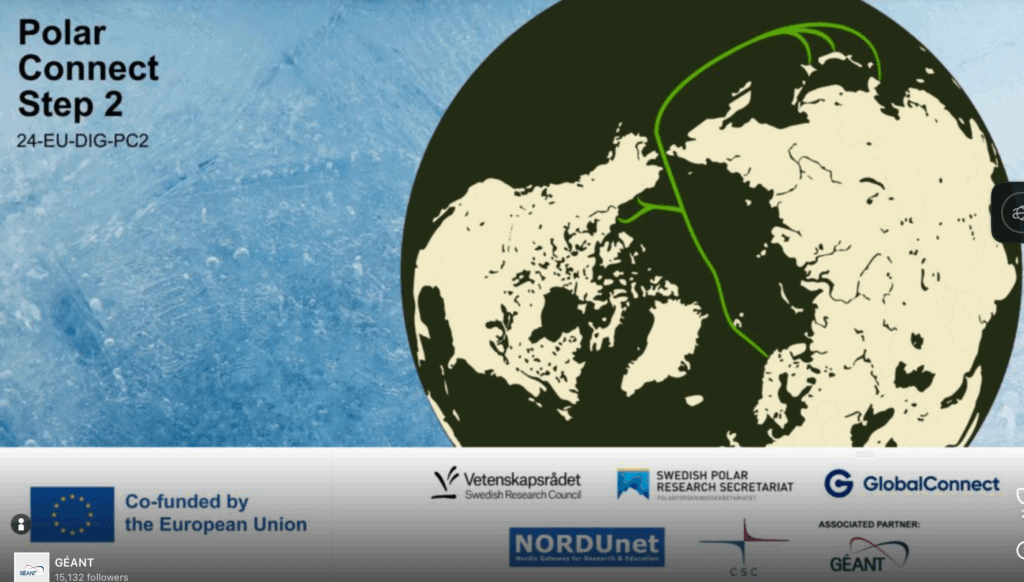
Polar Connect has cleared another milestone with the signing of the Grant Agreement for Polar Connect Step 2 (PC2), securing fresh support from the European Commission under the CEF Digital 2 programme. The initiative brings together research agencies, Nordic network operators, and global partners to advance a resilient Arctic submarine cable system linking Europe, North America, and East Asia. GÉANT has joined as an Associated Partner, reinforcing the academic and research networking community’s role in the project.
PC2 now transitions Polar Connect from concept development toward implementation. The new phase funds a comprehensive Cable Route Study, expanded seabed mapping missions, and detailed Arctic route simulations—work needed for manufacturers to complete final marine surveys and prepare for cable production and deployment. This phase also focuses on financial planning, ownership models, and operational readiness, including strategies for cable repair and maintenance in severe Arctic conditions.
The consortium includes the Swedish Polar Research Secretariat, NORDUnet, GlobalConnect, CSC, and the Swedish Research Council, with GÉANT adding technical and coordination support. The project aligns with the EU’s priorities to diversify global connectivity paths, enhance digital autonomy, and build secure international links under European control. If realized, Polar Connect would deliver a robust trans-Arctic path that supports research, innovation, and digital trade for decades.
• PC2 funded under CEF Digital 2 to strengthen EU-led international connectivity
• Focus areas include Cable Route Study, Arctic seabed mapping, and operational modeling
• Work supports final marine survey, cable manufacturing, and long-haul deployment
• Project partners: Swedish Polar Research Secretariat, NORDUnet, GlobalConnect, CSC, Swedish Research Council
• GÉANT joins as Associated Partner to support coordination and route planning
• EU aims to ensure digital autonomy through secure fiber links with third countries
“The funding awarded to PC2 supports continued progress towards establishing a secure and strategically important Arctic route for international connectivity,” the consortium stated.
🌐 Analysis: The additional CEF Digital 2 funding signals EU intent to accelerate alternative long-haul routes that reduce dependence on existing transatlantic and transpacific corridors. Polar Connect joins other Arctic cable proposals but remains one of the few advancing with both political and research-network backing. GÉANT’s involvement highlights the academic sector’s growing role in strategic infrastructure planning, paralleling similar efforts in Canada, Japan, and the U.S. to diversify global internet paths.
kilometer trans-Arctic route linking northern Europe to Alaska and onward to Japan and East Asia, creating the first fiber-optic path that directly spans the high Arctic. By shortening the physical distance between regions, the system could deliver significantly lower-latency connectivity between major research, cloud, and commercial hubs compared to traditional routes that detour through the North Atlantic, continental U.S., or Southeast Asia. Its geography also provides geopolitical and resiliency advantages: an Arctic corridor would diversify away from congested and politically sensitive choke points such as the English Channel, Suez region, and South China Sea. However, Polar Connect faces major engineering and operational obstacles, including extreme sea-ice conditions, limited weather windows for installation, complex seabed topography, and the challenge of maintaining and repairing cable assets in remote polar waters with sparse support infrastructure. Environmental stewardship, permitting across multiple jurisdictions, and the high capital cost of Arctic-grade manufacturing and deployment add further complexity to realizing this strategic system.