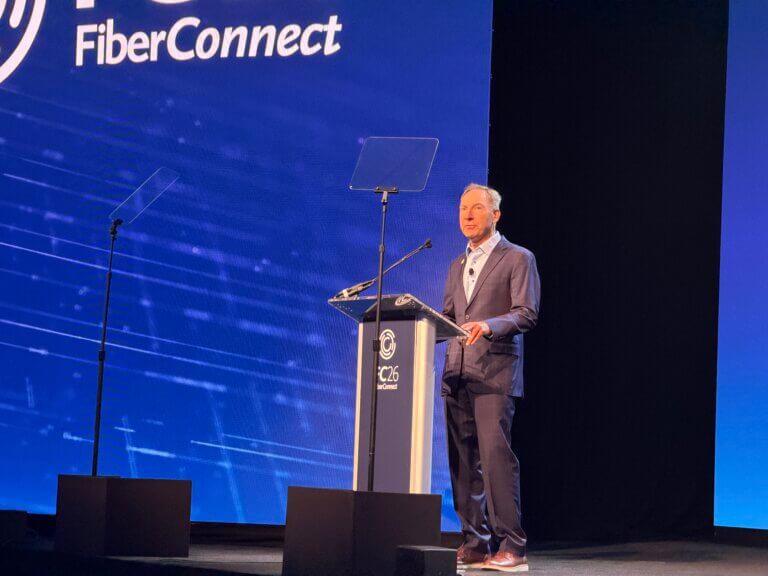
ORLANDO — Fiber Connect 2026 opens this week at a moment when the U.S. broadband industry is operating at unprecedented scale. According to figures shared by the Fiber Broadband Association, nearly 100 million homes had been passed with fiber by the end of 2025, including roughly 85 million unique homes. The industry set another deployment record last year with approximately 11.8 million new homes passed, surpassing the previous annual records of 10.3 million in 2024 and 9.1 million in 2023. Fiber providers now expect 2026 to establish yet another deployment record as construction momentum accelerates nationwide.
But the tone at Fiber Connect this year feels materially different from prior conferences. There seems to be a new optimism about fiber deployments. Maybe the mood shift is driven by the AI boom. Or maybe the major players and private equity have figured out a workable business model.
Only a few years ago, the event centered heavily on rural broadband gaps, federal funding programs, and whether FTTH economics could work outside dense urban markets. In Orlando this week, the emphasis has shifted toward acceleration, scale, and infrastructure convergence. Large operators, regional providers, infrastructure funds, electric cooperatives, municipalities, wholesale fiber builders, and mobile carriers are simultaneously expanding networks at a pace rarely seen in the history of U.S. telecom infrastructure.
The result is one of the most aggressive broadband construction cycles the industry has experienced in decades.
At the center of that expansion remains AT&T, which continues scaling fiber deployment as part of a long-term convergence strategy spanning residential broadband, enterprise networking, mobile backhaul, edge infrastructure, and AI-era connectivity. AT&T is now targeting more than 60 million fiber locations by the end of the decade through a combination of organic buildouts and its Gigapower infrastructure partnership. Company executives increasingly describe fiber not simply as consumer broadband infrastructure, but as the transport foundation supporting wireless densification, cloud services, and future AI-driven workloads.
Verizon is also expanding fiber deeper into its long-term infrastructure strategy. The company’s integration of Frontier Communications assets is expected to substantially expand its fiber footprint while strengthening converged broadband and wireless offerings. Verizon continues emphasizing fiber as critical infrastructure for 5G transport, enterprise networking, edge compute services, and AI-enabled applications requiring ultra-low latency and high-capacity optical connectivity.
Meanwhile, T-Mobile has emerged as an increasingly important participant in the fiber ecosystem. Historically viewed primarily as a wireless operator, T-Mobile has expanded aggressively into fiber infrastructure through partnerships, acquisitions, and joint ventures. The company continues positioning fixed wireless access as an important coverage solution, but executives increasingly acknowledge that fiber remains the highest-capacity long-term architecture for dense residential, enterprise, and AI-intensive environments.
GFiber has also reaccelerated deployments after several quieter years, emphasizing streamlined construction techniques, simplified deployment architectures, and highly targeted market expansion. The company remains influential in industry discussions surrounding permitting reform, open-access models, and deployment efficiency.
Beyond the national carriers, Fiber Connect 2026 reflects the growing influence of regional operators and alternative infrastructure providers.
Brightspeed continues one of the industry’s largest rural fiber expansion efforts across multiple states, targeting millions of passings in historically underserved markets. C Spire has steadily expanded fiber deployments across the Southeast while positioning fiber as strategic infrastructure for both residential broadband and enterprise connectivity. Electric cooperatives, municipal broadband systems, tribal operators, and wholesale open-access networks also maintain a growing presence across the conference floor.
The scale and diversity of fiber deployment activity has expanded dramatically. According to FBA figures, there are now 1,561 fiber operators across the U.S., based on the latest FCC Broadband Data Collection reporting. Over just the past six months, 42 new fiber providers entered the market while 71 operators doubled their deployment footprint. Those figures reinforce how competitive and fragmented the fiber market has become, extending far beyond traditional incumbent telecom operators.
Infrastructure investors have likewise become major participants in the fiber economy. Private equity firms, pension funds, sovereign wealth investors, and infrastructure-focused asset managers continue pouring capital into long-term broadband assets, betting that fiber networks will underpin decades of digital infrastructure growth.
Importantly, FBA executives note that the current fiber boom is overwhelmingly driven by private capital investment rather than government subsidy programs alone.
While federal initiatives such as ARPA, RDOF, ReConnect, Capital Projects Fund, and BEAD continue playing important roles in extending broadband into high-cost rural areas, FBA estimates that government subsidies represent only about 8.7% of current FTTH deployment activity. More than 91% of deployment spending is now being driven by private-sector capital expenditures from operators, infrastructure funds, and investors pursuing long-term broadband growth opportunities.
The industry also believes the addressable market remains far larger than current deployment figures may suggest.
While roughly 85 million unique homes now have fiber availability, FBA estimates the broader Total Addressable Market — including second, third, and fourth competitive overbuild opportunities — approaches 130 million homes nationwide. In other words, operators increasingly view fiber deployment not simply as a one-time expansion cycle, but as a long-duration competitive infrastructure market extending well into the next decade.
One of the most important themes emerging at Fiber Connect 2026 is how closely broadband expansion now overlaps with AI infrastructure development.
Operators increasingly describe fiber as the physical foundation supporting hyperscale AI clusters, cloud interconnection, edge computing, distributed inference, and massive east-west traffic movement between data centers. The rapid expansion of AI infrastructure is driving demand not only for long-haul optical capacity, but also for denser metro fiber rings, lower-latency transport architectures, and deeper regional connectivity near power-rich AI campus developments.
FBA leaders repeatedly emphasized that “the AI era does not happen without fiber.”
The association estimates that Microsoft, Amazon, Google, and Meta are collectively investing roughly $370 billion annually into AI infrastructure. Fiber plays multiple roles in that ecosystem — connecting GPU racks inside data centers, interconnecting hyperscale campuses, linking regional cloud facilities, and ultimately enabling AI inference at the network edge.
That strategic shift is reshaping the Fiber Broadband Association itself.
Last fall, FBA presented a five-year vision to its premier members outlining plans to expand beyond traditional FTTH advocacy into AI-enabled and quantum-enabled fiber infrastructure. The association increasingly positions itself not only as a broadband organization, but also as a broader infrastructure organization supporting the optical foundation for AI, cloud, quantum networking, and future digital economies.
That transition is visible throughout Fiber Connect 2026.
Sunday’s pre-conference workshop, “The Fourth Pillar of the AI Era,” introduced attendees to AI infrastructure fundamentals and the emerging role fiber providers may play within that ecosystem. The conference’s AI and Emerging Tech Infrastructure Summit later this week will culminate with a keynote presentation from Michio Kaku. Organizers also plan to expand Fiber Connect 2027 with a new AI and Quantum Infrastructure Pavilion designed to attract companies building next-generation optical, compute, and infrastructure technologies.
At the same time, Fiber Connect continues emphasizing practical applications that benefit consumers and businesses directly, including telehealth, precision agriculture, gaming, streaming, cloud services, edge compute, and distributed data center infrastructure.
Operators throughout the conference also continue facing significant deployment challenges.
Construction labor shortages remain severe across many regions, with the industry estimating a need for more than 200,000 additional workers to sustain current deployment trajectories. Contractors continue reporting shortages of skilled splicers, outside plant technicians, permitting specialists, and construction crews. Power availability constraints surrounding large AI campuses are also beginning to influence where fiber routes and data center developments can realistically scale.
Permitting and rights-of-way coordination remain major bottlenecks as well. Operators throughout Fiber Connect repeatedly emphasized that deployment timelines often depend less on financing availability and more on municipal approvals, pole attachment negotiations, utility coordination, and environmental review processes.
Another major trend shaping Fiber Connect 2026 is the rise of converged infrastructure strategies.
Rather than treating wireline broadband, wireless transport, enterprise networking, and cloud connectivity as separate businesses, operators increasingly view fiber as the common foundational layer underneath all of them. A single fiber route may now support FTTH access, mobile backhaul, enterprise Ethernet, edge compute traffic, AI transport workloads, and cloud interconnection simultaneously.
That convergence is reshaping infrastructure economics across the industry.
The broadband market itself has also become dramatically more competitive. Traditional incumbent carriers now compete not only with cable operators, but also with overbuilders, infrastructure-backed startups, fixed wireless providers, electric cooperatives, municipal systems, and open-access wholesale platforms. While cable operators continue upgrading DOCSIS infrastructure, many Fiber Connect participants argue that long-term bandwidth scaling increasingly favors deeper fiber penetration throughout access networks.
Federal broadband funding programs remain part of the overall deployment picture, although notably less central to the conference narrative than in prior years.
The $42.45 billion Broadband Equity, Access, and Deployment (BEAD) program still represents one of the largest broadband infrastructure investments in U.S. history and remains critically important for extending connectivity into high-cost rural and underserved areas. Recent milestones — including Nebraska-based Vistabeam activating what it described as the nation’s first BEAD-funded broadband household connection — demonstrate that the program is finally beginning to move from planning into physical deployment.
Still, the broader mood at Fiber Connect 2026 suggests that commercial fiber expansion and AI-driven infrastructure demand have now become the industry’s dominant growth engines.
U.S. Fiber Broadband Market Snapshot — Fiber Connect 2026
| Category | Key Metric | Industry Significance |
|---|---|---|
| Total Fiber Passings | ~100M passings including overbuilds | Reflects intensity of competitive fiber deployment nationwide |
| Unique Homes Passed | ~85M unique homes | Represents distinct U.S. homes with fiber availability |
| 2025 New Passings | 11.8M homes | Highest annual fiber deployment level ever recorded |
| 2024 New Passings | 10.3M homes | Previous industry deployment record |
| 2023 New Passings | 9.1M homes | Demonstrated accelerating FTTH deployment momentum |
| Remaining Unique Homes | ~60M homes | Large untapped fiber expansion opportunity remains |
| Total Addressable Market | ~130M homes | Includes 2nd, 3rd, and 4th provider overbuild opportunities |
| Fiber Operators in U.S. | 1,561 operators | Reflects highly fragmented and competitive FTTH market |
| New Fiber Entrants | 42 in past 6 months | Shows continued investor and operator confidence in fiber economics |
| Operators Doubling Footprint | 71 providers | Aggressive network scaling continues across multiple regions |
| Private CapEx Share | 91%+ of FTTH deployment | Commercial investment remains the primary deployment engine |