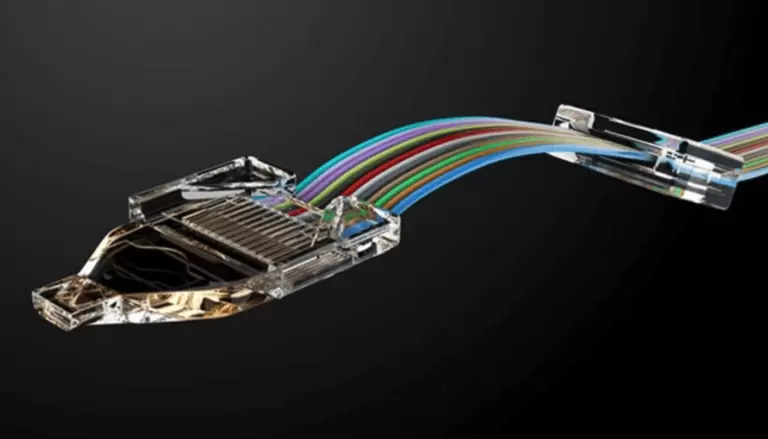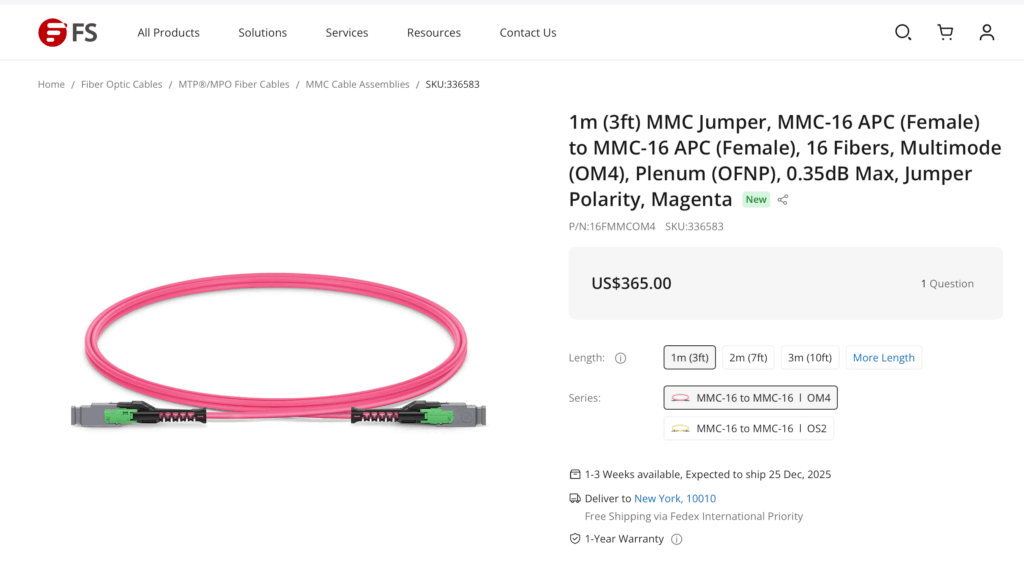
FS introduced a new lineup of MMC cables and fiber panels engineered to meet growing demands for ultra-high-density optical connectivity in AI-driven and hyperscale data centers. The portfolio centers on a VSFF (Very Small Form Factor) multi-fiber connector that triples the density of traditional MPO formats, targeting environments where GPU clusters, next-generation switches, and high-bandwidth architectures continue to push fiber counts higher.
The MMC family includes jumpers, breakouts, trunks, and harnesses designed to simplify cable routing and streamline patching in dense racks. FS pairs its TMT Elite ferrule with an optimized connector structure to deliver 0.35 dB insertion loss with APC polish. The company also unveiled a 1U MMC fiber panel that supports up to 6,336 fibers when populated with MMC-24 connectors, addressing data center needs for compact, scalable fiber management.
FS positions the MMC platform as a path for operators transitioning from MTP/MPO-based topologies to new VSFF architectures as AI workloads increase optical port requirements. “Our MMC solutions give data centers the high-density, low-loss foundation needed for next-generation AI infrastructure,” the company said.
• MMC jumpers: MMC-16↔MMC-16, MMC-16↔MTP-16, MMC-24↔MTP-24 for short-reach, high-density device connections
• MMC breakout: MMC-16→2×MTP-8 and MMC-24→3×MTP-8 for migration from 8-fiber systems
• MMC trunk: Customized MMC-16 (up to 384 fibers) and MMC-24 (up to 576 fibers) with double-jacket construction
• MMC harness: MMC-16→8×LC duplex for transitioning to LC environments
• 1U fiber panel: 66 four-port MMC adapters supporting up to 6,336 fibers on standard 19-inch racks
“Our MMC solutions give data centers the high-density, low-loss foundation needed for next-generation AI infrastructure,” FS stated.
🌐 Analysis
The move aligns with industry-wide momentum toward VSFF connectors as AI clusters scale to tens of thousands of optical lanes per deployment. Competitors such as US Conec, Senko, and Corning have been advancing similar high-density formats to support 1.6 Tbps/3.2 Tbps optical modules and 200G/lane SerDes roadmaps. FS’s adoption of MMC broadens market availability and underscores how AI architectures are accelerating the migration away from MPO form factors.