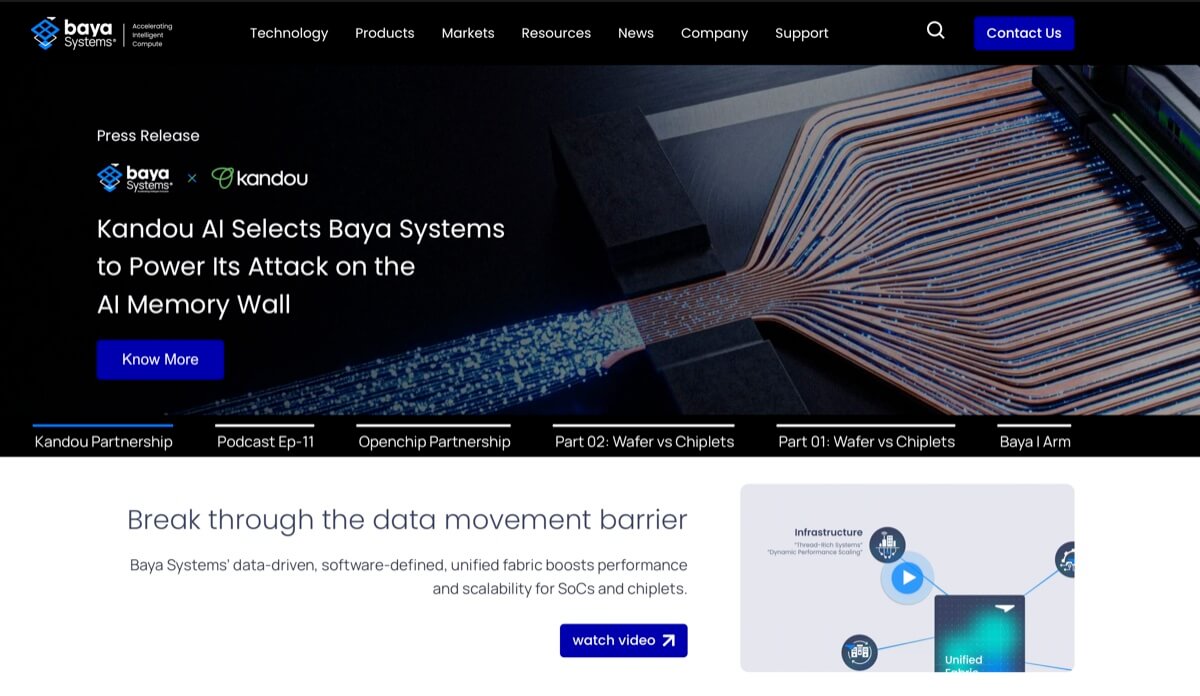
Kandou AI has licensed Baya Systems’ WeaveIP software-defined fabric and WeaverPro architecture development platform for its next-generation AI connectivity products, marking a collaboration aimed at improving data movement inside AI infrastructure. The agreement integrates Baya’s configurable on-chip fabric technology with Kandou AI’s Copper MIMO (Chord Signaling) architecture, which targets 448 Gbps copper connectivity for AI servers, accelerators, and memory systems.
The companies said the partnership addresses one of the central architectural challenges facing AI infrastructure: the “memory wall,” where compute performance continues to outpace memory bandwidth and interconnect capabilities. Kandou AI is developing copper-based interconnect technology intended to provide an alternative to optical links for selected AI infrastructure deployments, while Baya’s software-defined fabric manages communication among heterogeneous compute engines, memory, I/O resources, and chiplets. Kandou also adopted WeaverPro to model, validate, and optimize interconnect architectures—including QoS policies, traffic partitioning, and protocol adaptation—before RTL implementation, with the goal of shortening chip development cycles.
The collaboration reflects the industry’s growing emphasis on modular AI architectures built from chiplets and heterogeneous accelerators. Rather than focusing solely on faster processors, semiconductor companies increasingly optimize system-level data movement across compute, memory, networking, and storage resources. Baya said its tiled implementation methodology enables customers to assemble verified fabric components into configurable architectures, while Kandou plans to incorporate the technology throughout development of its next-generation AI connectivity platform.
• Kandou AI licensed Baya Systems’ WeaveIP fabric IP and WeaverPro software platform.
• Partnership targets AI infrastructure data movement bottlenecks associated with the memory wall.
• Kandou AI is developing 448 Gbps Copper MIMO (Chord Signaling) connectivity technology.
• WeaverPro supports architectural exploration before RTL implementation, including QoS and protocol optimization.
• Baya’s fabric technology supports heterogeneous compute, memory, I/O, and chiplet-based system architectures.
“Solve the memory wall is a system-level challenge,” said Srujan Linga, Co-Founder and CEO of Kandou AI. “Our breakthrough signaling technology is only one part of a broader AI system. We need a fabric architecture that can move data with the precision and efficiency our products demand.”
🌐 Analysis
The announcement highlights a broader shift in AI silicon design from optimizing individual compute devices toward optimizing the movement of data across increasingly disaggregated systems. As AI clusters incorporate chiplets, HBM, CXL memory expansion, PCIe, UALink, Ethernet fabrics, and custom accelerators, the on-chip and chiplet interconnect fabric has become a strategic layer alongside high-speed physical connectivity.
Baya joins a growing ecosystem of companies developing advanced Network-on-Chip and chiplet fabrics, while Kandou continues to position Copper MIMO as an alternative to optical interconnects for selected high-bandwidth AI deployments. The combination illustrates how future AI platforms will increasingly combine specialized IP blocks from multiple vendors to reduce development time while addressing system-level bandwidth and latency constraints.
🌐 We’re tracking the latest developments in networking silicon. Follow our ongoing coverage at: https://convergedigest.com/category/semiconductors/
| Baya Systems Profile | |
| Headquarters | Santa Clara, California |
| CEO / Founder | Dr. Sailesh Kumar |
| Founded | 2023 |
| Business | Software-defined semiconductor fabric IP |
| Core Technology | WeaveIP™ configurable Network-on-Chip and chiplet fabric with WeaverPro™ design software. |
| Target Markets | AI accelerators, HPC, automotive, edge computing |
| Key Products | WeaveIP™, WeaverPro™ |
| Recent Milestone | Selected by Kandou AI for next-generation AI connectivity platform |
| Funding | Series B-backed private company |
| Recent Converge Digest Coverage | |
| • | Baya Systems raises Series B funding to expand software-defined AI fabric IP |
| • | Baya Systems unveils software-defined fabric platform for chiplet-based AI architectures |
| • | Coverage of AI infrastructure interconnect trends and Network-on-Chip evolution |
| • | Analysis of chiplet architectures and heterogeneous AI system design |
| • | Coverage of emerging AI interconnect technologies including UALink, CXL and advanced NoC fabrics |
| Kandou AI — Company Profile | |
| Headquarters | Saint-Sulpice, Switzerland, with engineering and business operations in Silicon Valley. |
| Leadership | Srujan Linga, Co-Founder & CEO |
| Company Focus | Semiconductor connectivity technology for AI infrastructure, high-performance computing, chiplets and advanced memory systems. |
| Core Innovation | Copper MIMO (Chord™ Signaling), an information theory-based signaling technology that extends high-speed copper connectivity beyond conventional SerDes implementations. |
| Performance Target | 448 Gbps copper connectivity today with a roadmap beyond 448G for next-generation AI systems. |
| Technology Advantage | Designed to increase bandwidth while reducing power consumption, latency and cost compared with traditional copper interconnect implementations, extending the practical reach of copper in AI infrastructure. |
| Primary Applications | AI Accelerators GPU Clusters Chiplets Memory Fabrics Scale-Up Networks |
| Strategic Partnership | In July 2026, Kandou AI licensed Baya Systems’ WeaveIP™ software-defined fabric and WeaverPro™ development platform to accelerate its next-generation AI connectivity architecture. |
| Industry Challenge | Addresses the AI memory wall by improving data movement between compute, memory and networking resources, where bandwidth increasingly limits overall system performance. |
| Investors | Maverick Silicon • Bessemer Venture Partners (BVP) • Capital Group • SoftBank • Synopsys • Cadence • Alchip |
| Competitive Landscape | Competes in the AI connectivity ecosystem alongside advanced SerDes, DSP, retimer and optical interconnect technologies, with a focus on extending copper’s role in high-bandwidth AI clusters. |
| Why It Matters | As AI infrastructure evolves toward heterogeneous compute, chiplets and disaggregated memory, efficient data movement is becoming as important as processor performance. Kandou AI’s signaling technology targets one of the industry’s biggest bottlenecks by enabling higher-bandwidth copper links for future AI platforms. |