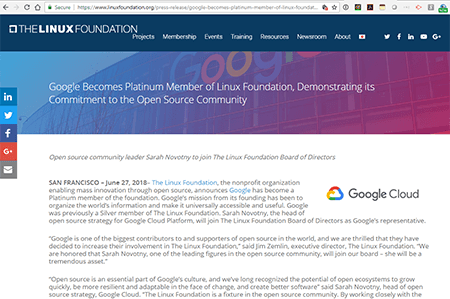
Google has become a Platinum member of The Linux Foundation, and captured a board seat at the foundation in the process.
Sarah Novotny, the head of open source strategy for Google Cloud Platform, will join The Linux Foundation Board of Directors as Google’s representative.
“Google is one of the biggest contributors to and supporters of open source in the world, and we are thrilled that they have decided to increase their involvement in The Linux Foundation,” said Jim Zemlin, executive director, The Linux Foundation. “We are honored that Sarah Novotny, one of the leading figures in the open source community, will join our board – she will be a tremendous asset.”
 “Open source is an essential part of Google’s culture, and we’ve long recognized the potential of open ecosystems to grow quickly, be more resilient and adaptable in the face of change, and create better software” said Sarah Novotny, head of open source strategy, Google Cloud. “The Linux Foundation is a fixture in the open source community. By working closely with the organization, we can better engage with the community-at-large and continue to build a more inclusive ecosystem where everyone can benefit.”
Some of The Linux Foundation open source communities Google supports include Cloud Foundry, Node.js and the Open API Initiative.
Google was also a founding member of the Cloud Native Computing Foundation (CNCF), having created and open sourced CNCF’s popular Kubernetes container orchestration platform, and is a founding member of the Core Infrastructure Initiative, which takes a proactive approach to securing some of the more important software technologies in the world, and the TODO Group, which collaborates on practices, tools, and other ways to run successful and effective open source projects and programs. Moreover, Google has been a leader in Software Defined Networking and other open source networking projects.
In a blog posting, Google highlighted the following open source project it backed:
Google regularly open-sources internal projects
- Kubernetes – container orchestration (github)
- TensorFlow – #1 machine learning repository on github
- BBR congestion control algorithm – your Internet just got faster (github)
- Open compute project rack – efficient data center for everyone (pdf)
- gRPC – high performance RPC framework (github)
- Bazel – continuous integration system (github)
- VP9 – royalty free video encoding format (project)
- Chromium – the most popular browser (github)
- Android – the most popular smartphone operating system (website)
- Golang — develop simple, efficient and reliable software at scale (github)
- V8 — high-performance JavaScript engine (github)