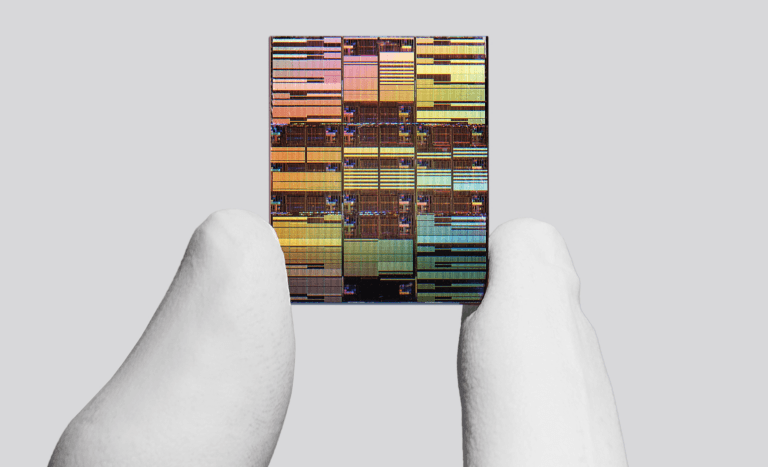
IBM Telum Processor features interconnect to link up to 32 chips
IBM unveiled its upcoming Telum Processor for artificial intelligence applications. A Telum-based system is planned for the first half of 2022.
Telum is IBM’s first processor that contains on-chip acceleration for AI inferencing while a transaction is taking place. The chip contains 8 processor cores with a deep super-scalar out-of-order instruction pipeline, running with more than 5GHz clock frequency, optimized for the demands of heterogenous enterprise class workloads. The completely redesigned cache and chip-interconnection infrastructure provides 32MB cache per core, and can scale to 32 Telum chips. The dual-chip module design contains 22 billion transistors and 19 miles of wire on 17 metal layers.
The chip is developed in Samsung’s 7nm EUV technology node.
IBM said its Telum processor excels in AI-specific workloads, such financial services workloads like fraud detection, loan processing, clearing and settlement of trades, anti-money laundering and risk analysis.
Every article published by Converge Digest is researched, curated, fact-checked and editorially reviewed by Jim Carroll, Editor & Publisher. AI-assisted drafting may be used to accelerate production, but all content is reviewed, refined and approved prior to publication.
You just read about IBM. One of the companies whose work it now carries:
Micromuse built Network fault, event and service management software for carriers and enterprises. What became of it?
Micromuse brought Network fault, event and service management software for carriers and enterprises to Networking. That work was distinctive enough to lead to its acquisition by IBM for US$865M. The standalone name now passes into the archive — but the team and technology continue inside IBM today. One of 430 names here whose work outlived the company.
You just read about Semiconductors. A technology from the archive that helped get us here:
Itanium (IA-64 / EPIC) served 2001–2021. What ultimately replaced it?
Itanium (IA-64 / EPIC) a VLIW-style 'EPIC' design that pushed instruction scheduling onto the compiler for wide parallelism - elegant in theory, brutal to compile for in practice. Its job passed to x86-64 (AMD64) — but the problem it solved, and the ideas it proved, live on in what replaced it. The standard rests here in the archive. One of 198 technologies here that opened a door and then held it for the next.