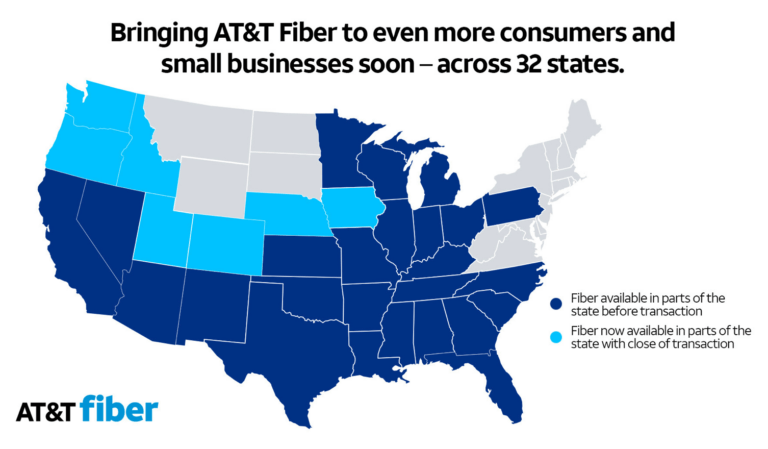
Lumen reported fourth-quarter and full-year 2025 results alongside the close of its $5.75 billion transaction with AT&T, positioning the balance-sheet reset as a catalyst for its enterprise-focused network strategy.
The company said the AT&T deal reduced total debt by more than $4.8 billion, lowered net leverage by about one turn to below 4x, and cut annual interest expense by nearly 45% versus 2025 levels, while reducing capex by more than $1 billion. Lumen also pointed to a one-time giveback tied to the FCC’s Rural Digital Opportunity Fund in Q2 2025 as a notable item affecting comparability, and said it expects a $400 million tax refund in the first half of 2026.
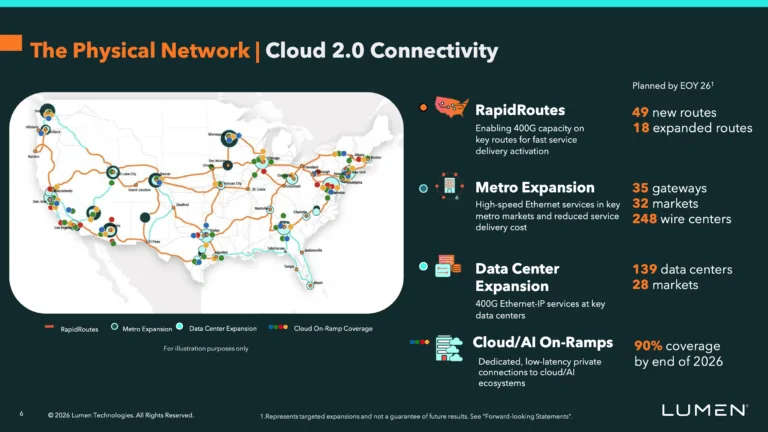
Operationally, Lumen highlighted additional momentum in its Private Connectivity Fabric (PCF) and Network-as-a-Service (NaaS) efforts, including $2.5 billion in new PCF contracts and 29% growth in its NaaS customer base. For 2026, Lumen guided to adjusted EBITDA of $3.1–$3.3 billion, free cash flow of $1.2–$1.4 billion, and capex of $3.2–$3.4 billion, with net cash interest of $650–$750 million.
- AT&T transaction: $5.75B closed; total debt reduced $4.8B+; net leverage below 4x; annual interest expense down ~45%; capex reduced $1B+
- Q4 2025: revenue $3.041B; adjusted EBITDA (ex special items) $767M; free cash flow (ex special items) $(765)M; net loss $(2)M
- Full-year 2025: revenue $12.402B; adjusted EBITDA (ex special items) $3.360B; free cash flow (ex special items) $1.041B; net loss $(1.739)B
- Enterprise + on-demand services: $2.5B in additional PCF contracts; NaaS customer base up 29%
- 2026 outlook: adjusted EBITDA $3.1–$3.3B; free cash flow $1.2–$1.4B; capex $3.2–$3.4B; net cash interest $650–$750M
“The combination of a solid fourth quarter and the close of the AT&T transaction marks a defining moment for Lumen and strengthens our foundation for growth,” said Lumen CEO Kate Johnson. “We’re emerging as a simpler, more focused enterprise company with a stronger balance sheet and greater flexibility to invest in our strategy to modernize the physical network, scale our digital platform, and help customers move data quickly, securely, and effortlessly to thrive in the AI era. This is how we create value for our customers and shareholders.”
🌐 Analysis: Lumen’s emphasis on Private Connectivity Fabric and NaaS maps to a broader infrastructure trend: enterprises and cloud operators increasingly want reserved capacity, faster turn-up, and software-controlled provisioning for AI-driven east-west traffic across metro and long-haul routes. The divestiture-driven deleveraging also reflects a wider operator pattern of separating consumer access assets from enterprise transport platforms in order to fund automation, fiber densification, and optical upgrades that support multi-cloud and AI workload mobility.