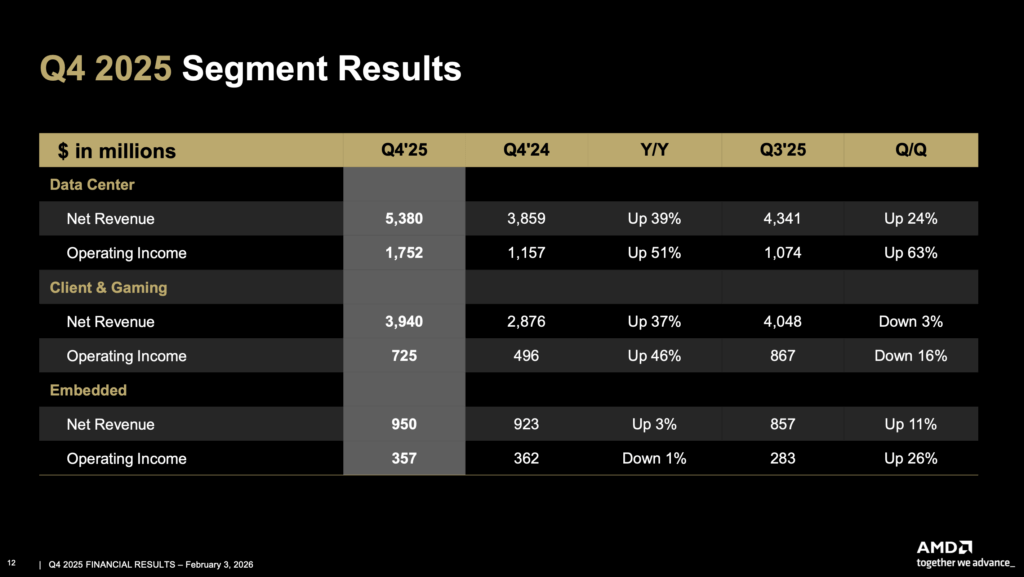
Advanced Micro Devices reported record fourth-quarter and full-year 2025 financial results on February 3, underscoring continued momentum across its data center, client, and AI businesses. Fourth-quarter revenue reached $10.3 billion, up 34% year-over-year, with GAAP operating income of $1.8 billion and net income of $1.5 billion. Non-GAAP operating income rose to a record $2.9 billion, reflecting improved scale and product mix.
For the full year, AMD posted record revenue of $34.6 billion, up 34% year-over-year, with GAAP net income of $4.3 billion and non-GAAP net income of $6.8 billion. Data Center revenue climbed to $16.6 billion for the year, driven by strong demand for EPYC CPUs and continued ramp of Instinct GPUs. Client and Gaming revenue also reached a record $14.6 billion, supported by Ryzen CPU share gains and stronger semi-custom and Radeon GPU sales.
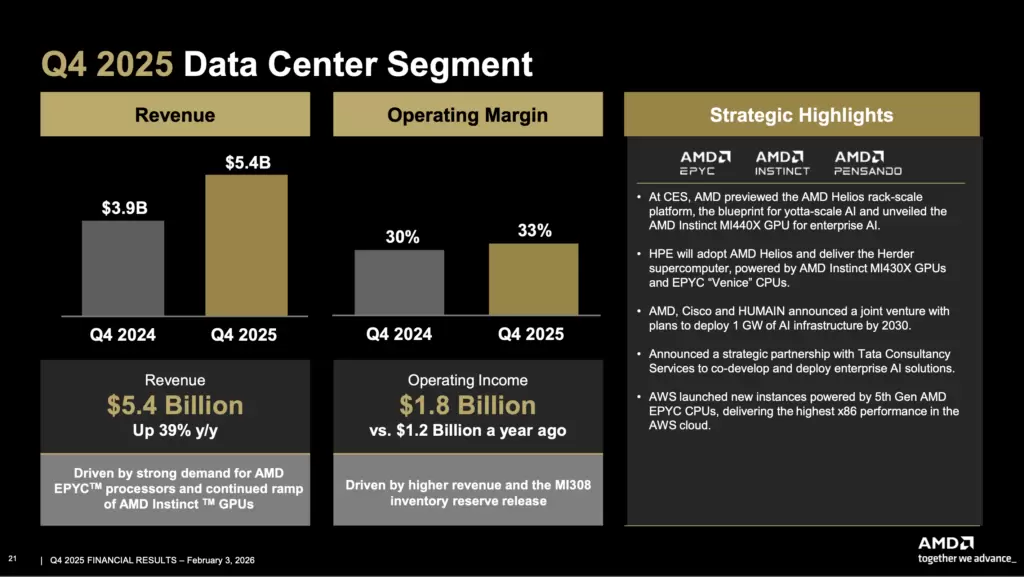
AMD noted that 2025 results included approximately $440 million in net inventory and related charges tied to U.S. export controls on Instinct MI308 GPUs, partially offset by a $360 million reserve release in Q4. Looking ahead, AMD expects first-quarter 2026 revenue of approximately $9.8 billion, plus or minus $300 million, with non-GAAP gross margin of about 55%, reflecting continued AI demand alongside typical seasonal dynamics.
- Q4 2025 highlights: Revenue $10.3 B (+34% Y/Y); GAAP operating margin 17%; non-GAAP EPS $1.53
- Full-year 2025: Revenue $34.6 B (+34% Y/Y); Data Center revenue $16.6 B (+32% Y/Y)
- Data Center: Q4 revenue $5.4 B (+39% Y/Y) on EPYC CPU demand and Instinct GPU shipments
- Client & Gaming: Q4 revenue $3.9 B (+37% Y/Y); full-year $14.6 B (+51% Y/Y)
- Q1 2026 outlook: Revenue ~$9.8 B ± $300 M; non-GAAP gross margin ~55%
“2025 was a defining year for AMD, with record revenue and earnings driven by strong execution and broad-based demand for our high-performance and AI platforms,” said Lisa Su, chair and CEO of AMD.
🌐 Analysis
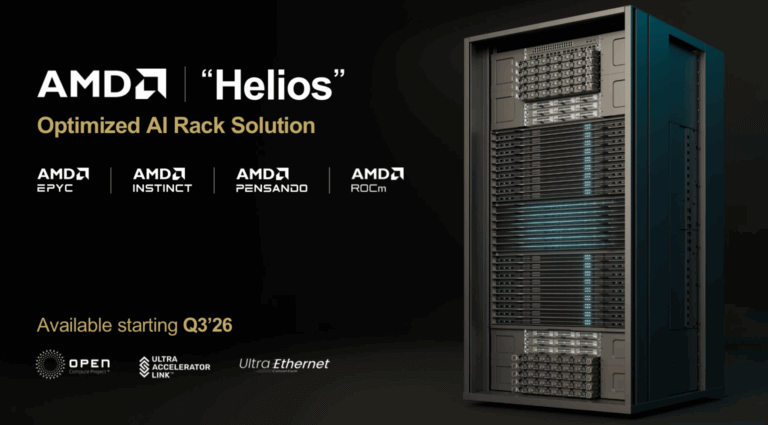
AMD’s results highlight how AI-driven infrastructure spending continues to reshape the semiconductor market, with data center CPUs and accelerators emerging as primary growth engines. The company’s expanding Instinct GPU portfolio and EPYC CPU roadmap position it more directly against NVIDIA and Intel as hyperscalers and enterprises diversify AI compute suppliers, while recent CES disclosures around rack-scale platforms and ecosystem partnerships signal a longer-term push toward full-stack AI infrastructure solutions.