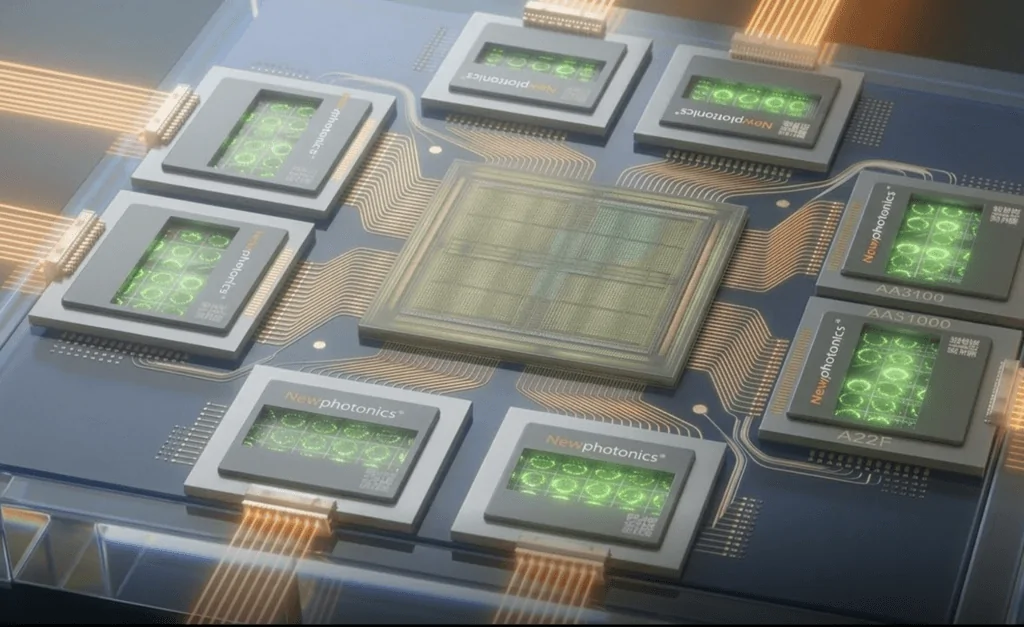
NewPhotonics unveiled its Syncra micro-ring modulator (MRM) platform at OFC 2026 in Los Angeles, introducing a heaterless silicon photonics design intended to reduce power consumption and thermal constraints in next-generation co-packaged optics (CPO). The company also introduced Niox, a photonic monitoring and calibration technology designed to stabilize optical performance without the heaters and monitoring photodiodes traditionally used in micro-ring modulator implementations.
Syncra MRMs modulate PAM4 signals while maintaining wavelength stability without thermal tuning elements. Conventional silicon photonics MRMs typically rely on integrated heaters and monitoring photodiodes to compensate for temperature-driven wavelength drift. These components increase power consumption and introduce localized thermal effects that complicate dense integration. NewPhotonics said its heaterless architecture removes these elements, enabling higher density optical engines while reducing thermal cross-talk and energy overhead in hyperscale data center interconnects.
The Niox technology monitors optical energy within the waveguide without absorbing photons, enabling real-time wavelength calibration in the optical domain. By stabilizing resonance without heaters, the architecture aims to preserve the low-power advantages of micro-ring modulators while supporting operation across varying temperatures. NewPhotonics designed both technologies to work within standard silicon photonics manufacturing processes without requiring process design kit (PDK) modifications, which could simplify production and improve scalability for AI infrastructure deployments.
- Syncra micro-ring modulators operate without integrated heaters or monitoring photodiodes.
- Heaterless architecture reduces power consumption and thermal cross-talk in dense optical engines.
- Niox photonic monitoring technology enables real-time wavelength calibration without absorbing photons.
- Designed for PAM4 modulation in high-density co-packaged optics architectures.
- Implemented in standard silicon photonics manufacturing processes without PDK changes.
- Target applications include hyperscale AI clusters and next-generation data center interconnects.
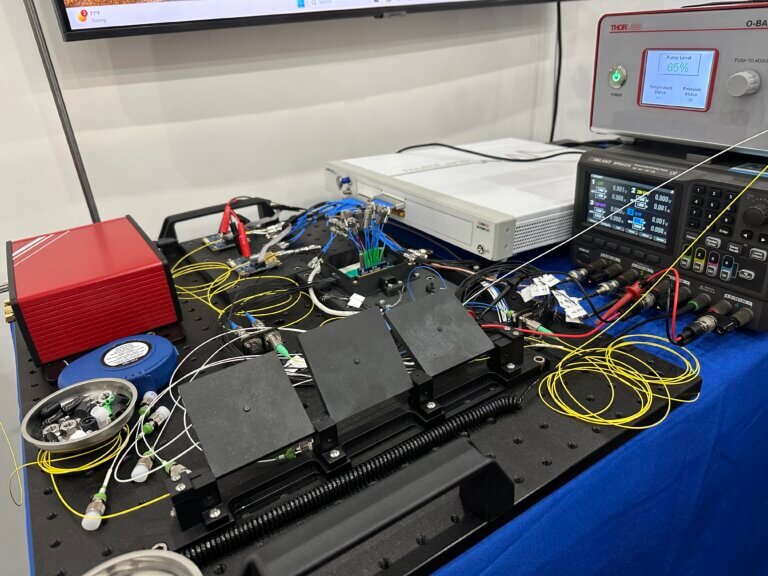
- Technology demonstration scheduled in the Corporate Pavilion at OFC 2026 in Los Angeles.
“Delivering next generation co-packaged optics with real impact on both power and performance bottlenecks requires a multi-disciplinary approach to silicon photonics integration,” said Yosef Ben Ezra, CTO of NewPhotonics. “We are paving the transition from pluggables to co-packaged optics in the data center with innovative optics-first technologies that will scale connectivity for AI in pragmatic and progressive ways over the coming decade.”
🌐 Analysis: Heaterless micro-ring modulators address a persistent challenge in silicon photonics: the power and thermal overhead required to maintain resonance stability. As hyperscalers explore CPO architectures for AI clusters, eliminating heaters could significantly reduce optical engine power consumption and enable denser integration around GPUs and switching ASICs. Several companies, including Intel, Ayar Labs, and Lightmatter, are also pursuing advanced silicon photonics architectures aimed at improving energy efficiency and scalability for AI interconnects.