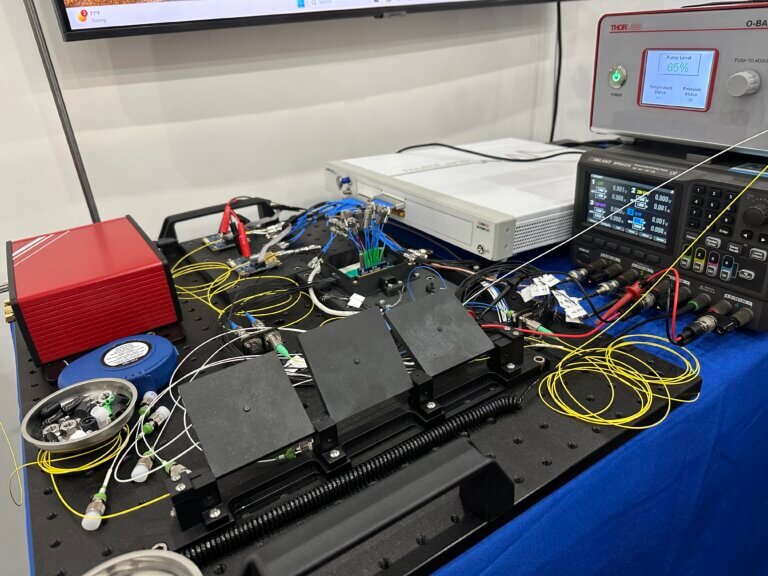
NewPhotonics unveiled the NPG10240, a 3.2 Tbps DR8 transmitter-on-chip photonic integrated circuit (PIC) featuring integrated lasers, 448 Gbps modulators, and the company’s OSPic optical signal processor. The device targets next-generation AI data center interconnects as hyperscalers move toward higher-density optical fabrics capable of supporting large-scale AI clusters. The company designed the engine to enable 400G-per-lane connectivity with improved power efficiency and simplified optical system design.
The NPG10240 integrates laser sources, high-speed modulators, and programmable optical equalization within a compact flip-chip packaged transmitter engine. NewPhotonics’ OSPic technology processes signal impairments directly in the optical domain, reducing RF design constraints and improving signal integrity at 448 Gbps per lane. By integrating the optical equalization engine with the PIC and laser sources, the architecture reduces external components and optical coupling losses while supporting pluggable optics and near-package optics (NPO) designs used in emerging AI infrastructure.
The 3.2T transmitter-on-chip architecture targets hyperscale deployments where bandwidth density and manufacturing efficiency are becoming key design parameters. NewPhotonics plans to make samples of the NPG10240 available in Q4 2026.
• 3.2 Tbps DR8 transmitter-on-chip PIC designed for next-generation AI data center connectivity
• Supports 400G-per-lane operation using 448 Gbps optical modulators
• Integrated laser sources and programmable optical equalization engine (OSPic)
• Optical-domain signal processing reduces RF impairments and improves link integrity
• Flip-chip packaging simplifies system assembly and improves manufacturing yield
• Optimized for pluggable optics and high-density near-package optics (NPO) architectures
• Sampling expected in Q4 2026
“More important than bandwidth expansion is the AI factory requirement for scalable optical integration delivering lower power at higher manufacturing efficiency,” said Doron Tal, SVP and GM of Optical Connectivity at NewPhotonics. “Our 3.2 Tbps class optical solution removes key barriers to deploying 448G/lane optics across the most demanding architectures.”
🌐 Analysis
The move to 448 Gbps electrical and optical lanes represents the next major step in the AI data center optical roadmap, enabling 3.2T pluggable modules and eventually higher-capacity switch fabrics. Vendors across the ecosystem—including DSP suppliers, switch ASIC providers, and optics manufacturers—are preparing for this transition as hyperscale AI clusters demand dramatically higher bandwidth density between accelerators, switches, and memory pools.
NewPhotonics’ approach is notable because it shifts some signal conditioning into the optical domain rather than relying entirely on electronic DSP equalization. If successful, this type of integrated photonic processing could reduce power consumption and complexity in next-generation optics, particularly for near-package optics (NPO) and co-packaged optics (CPO) architectures that aim to shorten electrical paths and scale bandwidth beyond the limits of traditional pluggable modules.
🌐 We’re launching the “Data Center Networking for AI” series on NextGenInfra.io and inviting companies building real solutions—silicon, optics, fabrics, switches, software, orchestration—to share their views on video and in our expert report. To get involved, send a note to [email protected] or [email protected].