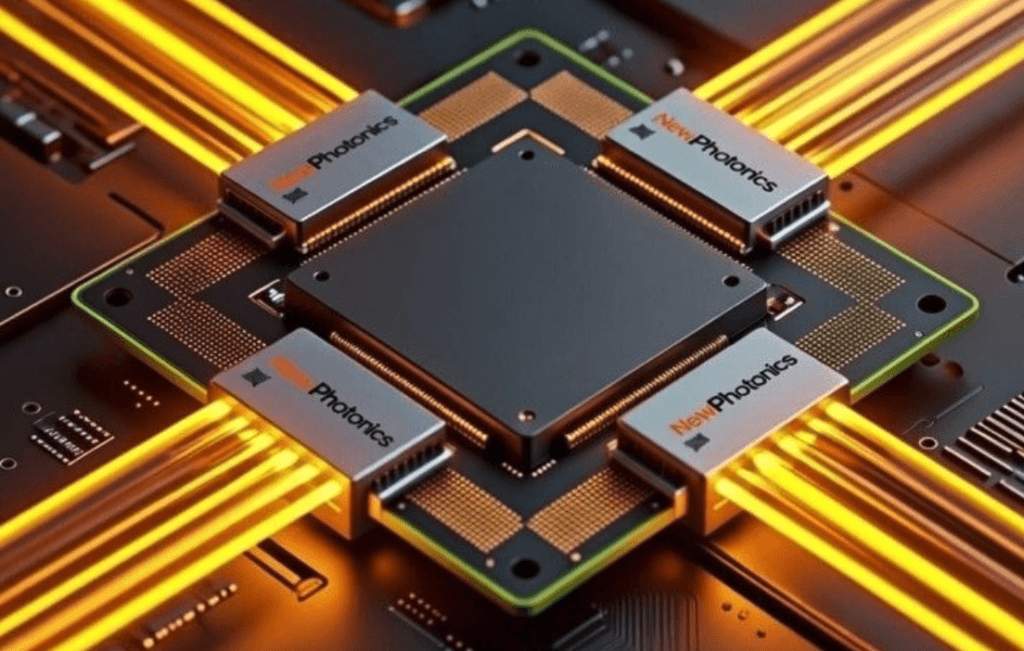
NewPhotonics announced a 1.6T near-packaged optics (NPO) chiplet designed to bring serviceability and interoperability into next-generation AI data center architectures. The new NPC50503 integrates lasers and an all-optical signal processor into a compact silicon photonics transmitter optimized for placement adjacent to GPUs and AI accelerators.
The NPC50503 targets scale-up and scale-out interconnects as AI systems move toward 200 Gbps per lane and beyond. By integrating lasers directly into a monolithic silicon photonics flip-chip package, the device aims to reduce power consumption while simplifying assembly for serviceable NPO deployments. The chiplet supports modular replacement strategies that address operational challenges associated with tightly coupled optical-compute architectures.
NewPhotonics positions the solution as a bridge between pluggable optics and co-packaged optics, enabling hyperscalers to adopt near-packaged designs without sacrificing field serviceability. The company plans private demonstrations of the chiplet at the upcoming Optical Fiber Communication Conference in Los Angeles.
- 1.6T near-packaged optics transmitter with integrated lasers
- 224 Gbps per lane PAM4, compliant with IEEE 802.3dj
- 8 dB RF link-budget improvement beyond the 21 dB long-channel baseline
- Low-power flip-chip BGA package optimized for small-form-factor co-packaging
- Per-channel output power monitoring and transmission-disable control
- Reference design for RF and optical integration in AI systems
“As AI systems push 200Gbps per lane and beyond, power efficiency, signal integrity, serviceability, and operational control become imperative,” said Doron Tal, SVP and GM of NewPhotonics. “Our NPC50503 chiplet moves advanced optical-domain capabilities directly adjacent to compute in a modular and serviceable near-packaged architecture.”
🌐 Analysis
The announcement reflects growing industry interest in near-packaged optics as a pragmatic step toward co-packaged optics, particularly as hyperscalers evaluate trade-offs between power efficiency and operational flexibility. NewPhotonics’ focus on serviceability and interoperability aligns with broader efforts across the silicon photonics ecosystem to reduce deployment risk while supporting 1.6T-class interconnects for AI training and inference clusters.