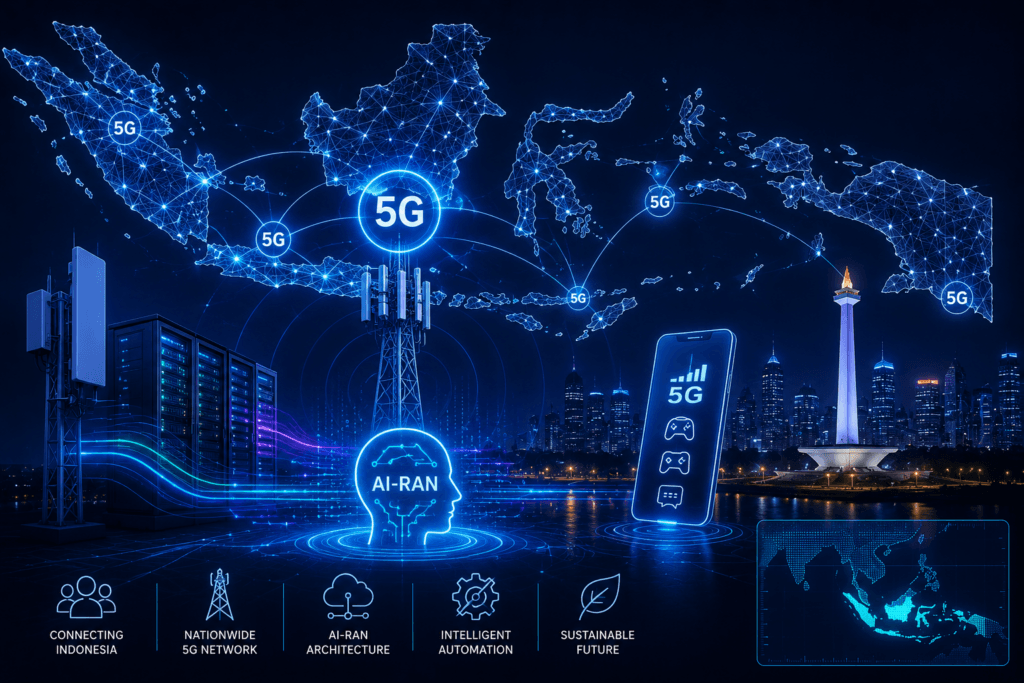
Nokia and Indosat Ooredoo Hutchison (IOH) announced a nationwide network modernization initiative aimed at expanding 5G coverage across Indonesia while laying the foundation for AI-enabled services. Under the agreement, Nokia will deploy advanced low-band and mid-band 5G infrastructure across Indosat’s network, helping improve coverage, capacity, and performance for both consumer and enterprise users.
The rollout includes Nokia’s Habrok and Pandion radio platforms, Levante basebands, Centralized RAN architecture, and automation software. Low-band 5G will be introduced across Indosat’s nationwide footprint, while mid-band 5G coverage is expected to reach approximately 80% of the network over the next three and a half years. The companies said the upgraded infrastructure will support applications spanning public services, healthcare, education, agriculture, industrial automation, and digital services.
A key element of the partnership is the integration of AI-RAN technologies developed jointly by Nokia, NVIDIA, and Indosat. Following the industry’s first AI-RAN call demonstrated at Mobile World Congress 2026, the partners plan to begin AI-RAN field trials in Indonesia before the end of the year. Indosat is also advancing an AI Grid architecture that combines centralized AI factories with distributed AI-RAN infrastructure, creating a platform intended to distribute both AI services and connectivity across the country.
- Nationwide 5G modernization initiative across Indonesia
- Low-band 5G deployment across Indosat’s full network footprint
- Mid-band 5G planned to cover approximately 80% of the network
- Deployment includes Nokia Habrok and Pandion radios
- Levante basebands and Centralized RAN architecture included
- AI-RAN field trials planned by the end of 2026
- Collaboration includes Nokia, NVIDIA, and Indosat
- Supports Indosat’s AI Grid initiative
- Targets enterprise, public sector, and consumer applications
- Focus on automation, energy efficiency, and digital inclusion
“The next phase of network evolution will be defined by how well operators combine connectivity, intelligence and scale,” said Justin Hotard, President and CEO of Nokia.
🌐 Analysis
This agreement is significant because it moves beyond traditional 5G deployment and directly links radio infrastructure investments with AI infrastructure strategy. Indosat has emerged as one of the industry’s most aggressive proponents of AI-RAN, working closely with Nokia and NVIDIA to explore how radio access infrastructure can support both mobile connectivity and AI workloads. The companies demonstrated the first AI-RAN call at Mobile World Congress 2026, and the next step will be validating those concepts in live commercial networks.
The announcement also builds on Indosat’s broader AI Factory and sovereign AI initiatives in Indonesia. Earlier this year, Indosat partnered with NVIDIA to establish AI infrastructure designed to support local AI development and national digital transformation efforts. By combining centralized AI computing resources with distributed AI-RAN infrastructure, Indosat is pursuing an architecture that could eventually place AI services closer to users while leveraging existing telecommunications assets. The project positions Indonesia among the earliest large-scale deployments of AI-RAN concepts outside of laboratory environments.