Nokia reported fourth-quarter and full-year 2025 results that reflected steady execution, with growth in Network Infrastructure offset by higher restructuring and integration costs. Fourth-quarter comparable net sales reached EUR 6.1 billion, growing 3% year-over-year on a constant currency and portfolio basis, driven by gains in both Network Infrastructure and Mobile Networks. Comparable gross margin expanded 90 basis points to 48.1%, supported by a favorable product mix, while comparable operating margin declined to 17.3% as the company increased investment in Network Infrastructure, including costs related to the Infinera integration.
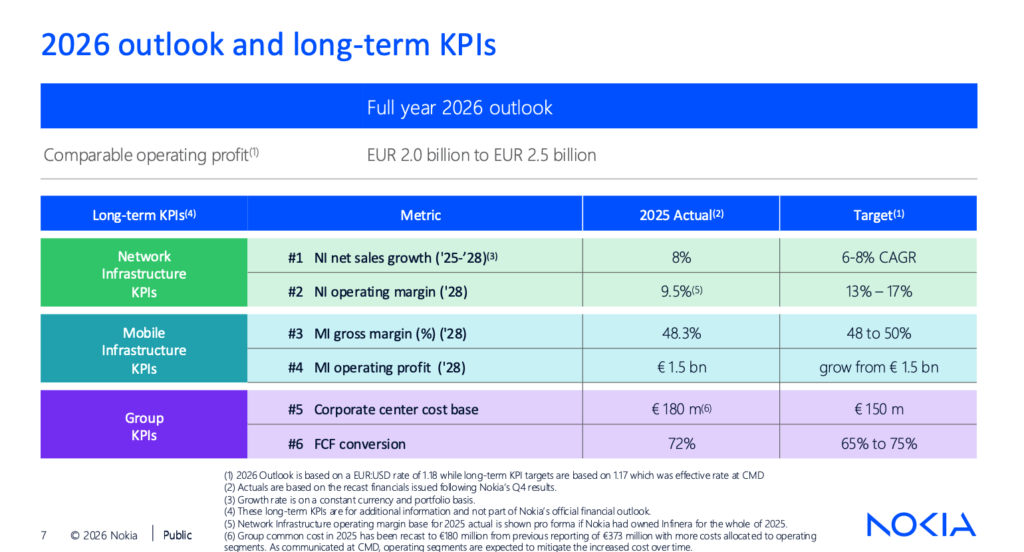
For the full year 2025, Nokia delivered comparable net sales growth of 2% year-over-year and generated EUR 2.0 billion in comparable operating profit, landing within prior guidance. Free cash flow totaled EUR 1.5 billion, equating to a 72% conversion from comparable operating profit, and net cash stood at EUR 3.4 billion at year-end. The Board proposed a dividend authorization of up to EUR 0.14 per share, and approved a EUR 0.03 per share dividend payable in February 2026.
Operationally, Network Infrastructure remained Nokia’s primary growth engine. Fourth-quarter comparable net sales in the segment grew 7%, led by Optical Networks, which expanded 17% as demand from AI and cloud customers accelerated. IP Networks also grew, supported by expanding data center deployments, while Fixed Networks remained flat as portfolio de-prioritization offset fiber optical line terminal growth. Mobile Networks posted 6% growth in Q4, driven by strong year-end demand and improved product mix, while Cloud and Network Services declined modestly in the quarter despite full-year growth driven by core network demand.
- Q4 2025 comparable net sales reached EUR 6.1 billion, up 3% year-over-year on a constant currency and portfolio basis
- Q4 comparable gross margin expanded to 48.1%, up 90 basis points year-over-year
- Q4 comparable operating margin declined to 17.3% due to growth investments and Infinera integration
- Full-year 2025 comparable operating profit totaled EUR 2.0 billion
- Full-year free cash flow reached EUR 1.5 billion, representing 72% conversion
- Network Infrastructure grew 7% in Q4, including 17% growth in Optical Networks
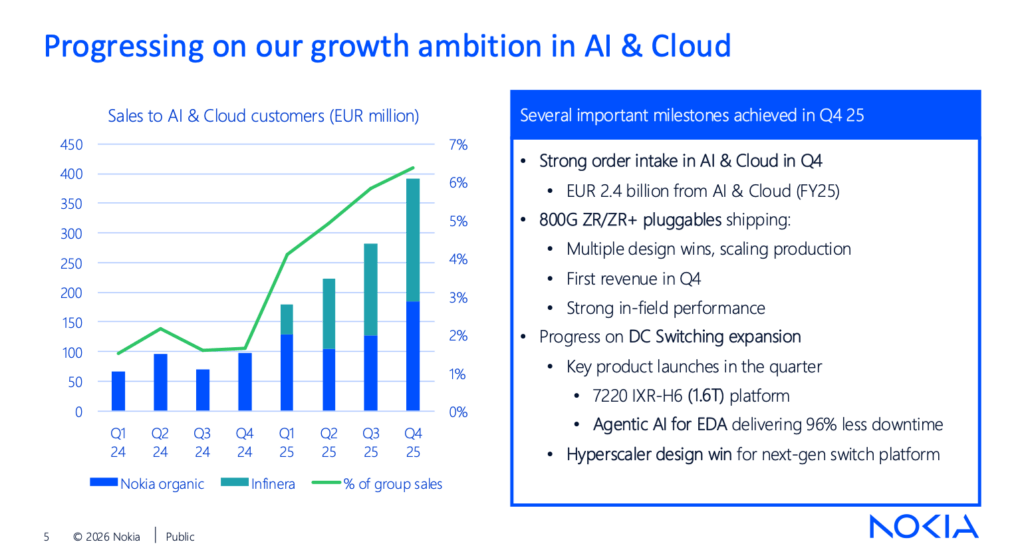
- Sales to AI and cloud customers totaled EUR 2.4 billion for full-year 2025
- 800G ZR and ZR+ pluggables shipped in volume during Q4, with first commercial revenue recognized
- Nokia launched the 7220 IXR-H6 (1.6T) platform and secured hyperscaler design wins for next-generation switching
- Book-to-bill ratios in Optical and IP Networks remained above one
- Q4 net cash benefited from EUR 0.9 billion related to NVIDIA’s equity investment, partially offset by the EUR 0.5 billion acquisition of the remaining stake in Nokia Shanghai-Bell
- Nokia introduced 2026 guidance targeting EUR 2.0–2.5 billion in comparable operating profit
“Our fourth quarter performance was in line with our expectations, reflecting disciplined execution across the business,” said Justin Hotard, President and CEO of Nokia. “Network Infrastructure delivered strong growth driven by AI and cloud demand, and we continued to invest with a long-term view as networks take on a more central role in enabling AI at scale.”
Highlights of the quarterly earnings call
- Management said Q4 performance stayed in line with internal expectations, and framed 2025 as a “foundational” year tied to the Infinera acquisition, operating model simplification, and a renewed AI & Cloud strategy.
- Network Infrastructure order intake stayed strong in both Optical and IP Networks, and management said book-to-bill remained above 1 in each business (not just in aggregate).
- Nokia said AI & Cloud demand drove optical momentum, and described its optical revenue base as still telco-centric (roughly “70/30”), which management said influenced its decision to guide to 10%–12% growth for combined Optical + IP in 2026 despite stronger Q4 optical growth.
- Management said 800G ZR/ZR+ pluggables shipped into scaled deployments, and it focused commentary on ramping production to meet demand and on initial in-field performance.
- Executives said the AI data center buildout remained “consistently constrained,” citing recurring constraints across power, connectivity, compute silicon, and memory as a backdrop for why they expected sustained infrastructure spending rather than a late-1990s-style boom/bust dynamic.
- Nokia said it saw optical supply constraints as “normal” at current market scale and tied its 2026 CapEx step-up to both internal capacity and broader ecosystem capacity-building.
- Management highlighted its indium phosphide (InP) vertical integration as a differentiator, and said its InP fab investments required smaller “chunk” increments than high-volume silicon fabs.
- Executives said a new InP fab in California (initiated by Infinera pre-acquisition) was expected to come online later in 2026, and they linked it primarily to supporting 2027 production/demand ramp, with more limited contribution in 2026.
- Nokia said the CapEx increase reflected long-term conviction, noting manufacturing investments would not generate returns within a single year; CFO also characterized the CapEx level as modest relative to hyperscaler data center CapEx, even if elevated for Nokia.
- Management described Scale-Across optical connectivity as a key near-term tailwind, and pointed to future speed transitions (1.6T and 3.2T) as additional drivers; executives also said coherent optics inside the data center could expand over time.
- On IP Networks, management said ramp would take time but cited encouraging signals: a Q4 design win, an order backlog, and leadership change (new head of IP networking with data center experience) to accelerate execution.
- Nokia said it expected Q1 2026 net sales to decline more than normal seasonality because Q4 seasonality ran “above normal,” with CFO pointing to telco purchasing patterns (especially in Mobile Networks) as a driver.
- CFO said margin phasing skewed to a weaker first half in Network Infrastructure due to new product introductions, with improvement expected in the second half as products moved past ramp-up.
- On memory pricing, management said memory did not represent a material portion of total bill of materials, and said Nokia used multi-year supply agreements; management also expected market-wide increases to be reflected in pricing over time.
- Mobile Infrastructure commentary emphasized profitability discipline over share-at-any-cost; management acknowledged headwinds tied to the prior AT&T contract loss while describing the broader RAN market as stable with regional variability.
- On AT&T specifically, management characterized AT&T as a strategic customer across multiple domains (core and fiber access as well as broader infrastructure), and said Nokia would pursue “profitable market share” while prioritizing delivery on current commitments.
- Nokia said it completed full ownership of Nokia Shanghai-Bell to increase operational flexibility, and it reiterated synergy expectations of ~EUR 200 million run-rate with integration costs of ~EUR 350–400 million over 24–36 months.
- CFO reiterated the capital allocation framework: prioritize internal R&D investment first, then consider M&A, then dividends, and then buybacks if excess cash remained.
- Management said the operating profit guidance range (EUR 2.0–2.5 billion) reflected simultaneous exposure to different cycles: high growth in AI & Cloud, a flatter telco environment, and an emerging defense/mission-critical enterprise opportunity—driving a deliberate emphasis on predictability in guidance.
- Nokia reiterated that it hedged roughly half of USD flows for the year, and CFO quantified sensitivity pre-hedging at roughly EUR 50 million operating profit impact per $0.02 move in EUR:USD (with about half mitigated by hedging).
- Management said Nokia Defense was created as an incubation unit to centralize R&D and go-to-market for defense solutions, combining Nokia Federal Solutions in the U.S. and Phoenix Group technology acquired in 2024, and described growing customer interest in 4G/5G for military environments.
🌐 Analysis
Nokia’s 2025 results underscored the company’s strategic pivot toward AI-driven network infrastructure, with optical and IP platforms increasingly aligned to hyperscaler and data center investment cycles. The Infinera acquisition and expanded 800G pluggable shipments strengthened Nokia’s position in high-capacity optical interconnects, while new switching platforms extended its footprint inside the data center. Management’s 2026 outlook reflected an emphasis on execution discipline and margin recovery as restructuring activity moderated and AI-related infrastructure demand continued to scale across the industry.