Groq and Nvidia signed a non-exclusive licensing agreement that allows Nvidia to use Groq’s inference technology as both companies push to scale AI inference globally. The deal centers on improving performance and lowering cost for inference workloads, a growing bottleneck as AI models expand into production across enterprises and cloud platforms.
Under the agreement, Groq Founder Jonathan Ross, Groq President Sunny Madra, and additional Groq engineers will join Nvidia to help advance and scale the licensed inference technology. The arrangement focuses on technology transfer and execution rather than exclusivity, leaving both companies free to pursue parallel platforms and customers.
Groq will continue operating as an independent company, with Simon Edwards stepping into the role of chief executive officer. Groq stated that its cloud service, GroqCloud, will continue to operate without interruption, signaling continuity for existing customers and partners as the licensing work with Nvidia moves forward.
- Non-exclusive agreement licenses Groq inference technology to Nvidia
- Focus on scaling high-performance, lower-cost AI inference
- Groq technical leadership to join Nvidia to support technology scaling
- Groq remains independent; GroqCloud operations unchanged
- Simon Edwards named CEO of Groq
“By licensing our inference technology to Nvidia, we’re expanding access to high-performance inference while continuing to execute on Groq’s independent roadmap,” said Jonathan Ross, Founder of Groq.
🌐 Background
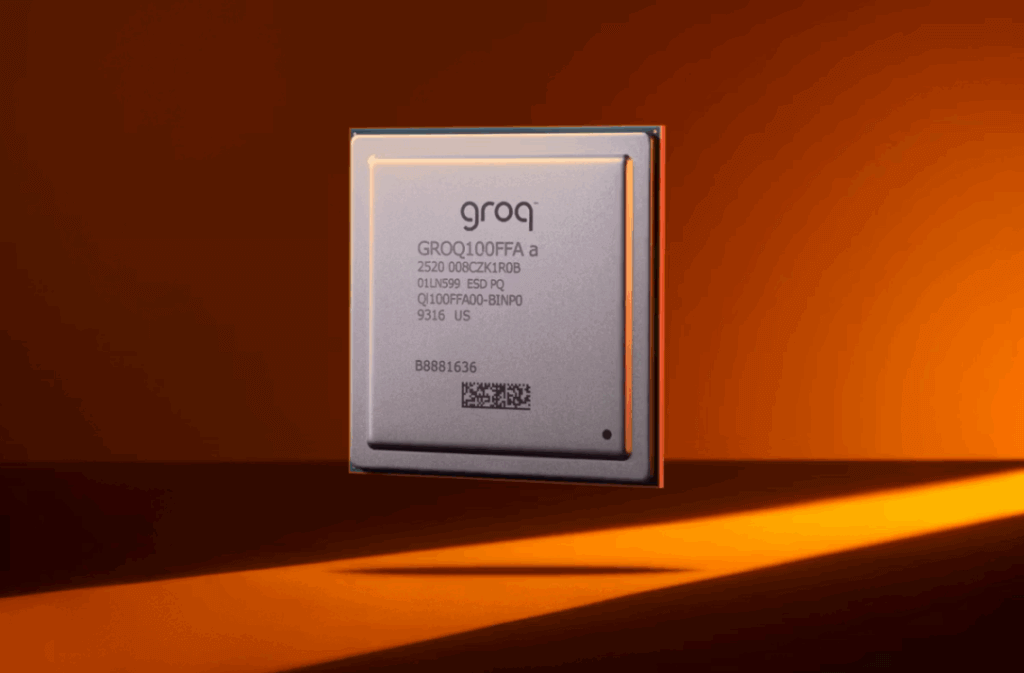
Groq is a U.S.-based AI infrastructure company headquartered in Mountain View, California, focused on delivering deterministic, ultra-low-latency inference for large language models and other compute-intensive workloads. Founded in 2016 by Jonathan Ross, a former Google engineer who led development of the original Tensor Processing Unit (TPU), Groq’s core technology is its Language Processing Unit (LPU)—a purpose-built, software-defined processor architecture designed to execute AI models with predictable performance, high throughput, and strong energy efficiency. The company’s platform spans custom silicon, compiler software, and systems, and is delivered both as on-premises hardware and via GroqCloud. Groq is privately held and venture-backed, with funding from investors including Social Capital, D1 Capital, Tiger Global, and BlackRock.
🌐 Analysis
The Groq–Nvidia licensing agreement lands as hyperscalers and platform vendors increasingly treat inference as a strategic control point rather than a secondary workload. Nvidia has dominated AI acceleration through GPUs and a tightly integrated CUDA software stack, but the rapid growth of deployed models—especially smaller, fine-tuned and agentic workloads—has shifted attention toward latency, determinism, and cost per inference. Licensing Groq’s inference technology gives Nvidia optionality to incorporate alternative architectural ideas without committing to an acquisition or exclusive path, while also hedging against customers exploring non-GPU inference solutions.
At the same time, Google has accelerated efforts to vertically integrate inference through its own silicon. Google continues to expand deployment of its Tensor Processing Units (TPUs), positioning them not only for internal workloads but also as a competitive alternative for cloud customers running inference at scale. Recent TPU generations emphasize power efficiency, tight coupling with Google’s software stack, and optimized performance for transformer-based models. By pushing TPUs deeper into production inference, Google reduces dependence on external accelerators and pressures the broader ecosystem on pricing and availability.
Taken together, these moves highlight a market where no single architecture dominates inference. Nvidia is broadening its technology portfolio through licensing and partnerships, Google is doubling down on vertically integrated TPUs, and specialized players like Groq are finding leverage by focusing narrowly on inference performance. The result is a more fragmented but competitive inference landscape, where architectural diversity becomes a feature rather than a liability as AI workloads scale across clouds, enterprises, and edge environments.