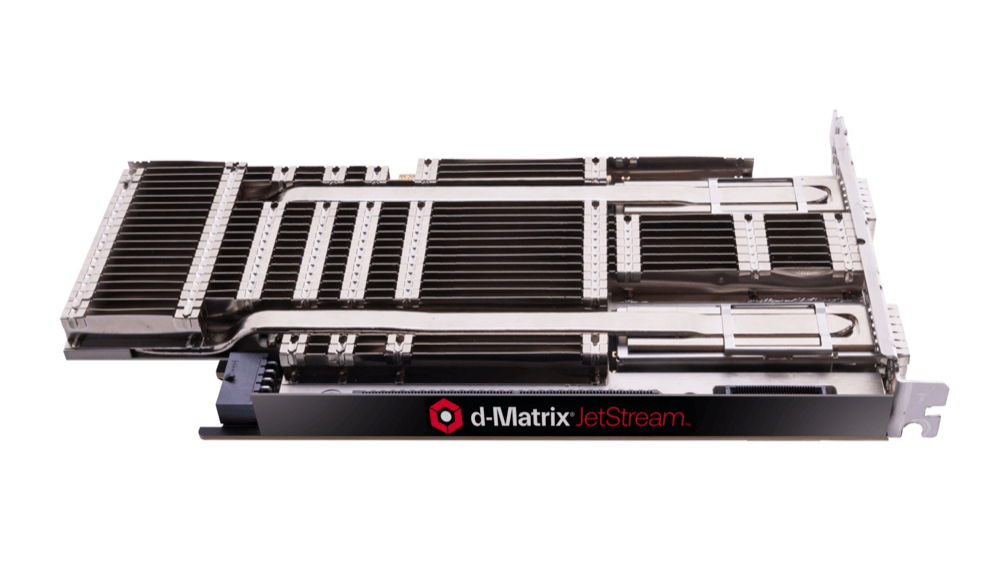
Parasail will deploy d-Matrix Corsair inference accelerators alongside NVIDIA Hopper and Blackwell GPUs to build a heterogeneous AI inference infrastructure designed to improve token generation performance and economics. The companies said the architecture can deliver up to 10x faster interactive inference for select workloads by assigning compute-intensive prefill processing to NVIDIA GPUs and latency-sensitive decode operations to d-Matrix Corsair accelerators.
The deployment represents an emerging disaggregated approach to AI inference infrastructure in which different accelerator architectures handle specific phases of large language model processing. Parasail operates a programmable inference cloud that aggregates GPU capacity across more than 40 data centers in 15 countries. Its automatic kernel optimization technology dynamically routes workloads across the heterogeneous fleet based on model and processing requirements.
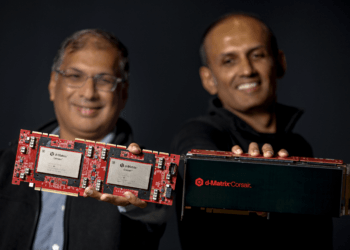
d-Matrix Corsair uses the company’s Digital In-Memory Compute (DIMC) chiplet architecture, which places compute resources closer to memory to reduce data movement during inference. Corsair uses TSMC’s N6 process, organic substrates, and LP-DDR5 memory. d-Matrix said the platform can provide up to 10x faster interactive inference and up to 3x better energy efficiency compared with traditional approaches. Parasail and d-Matrix plan to publish performance results and case studies following the initial deployments and explore broader integration across Parasail’s global infrastructure footprint.
• Architecture: NVIDIA Hopper and Blackwell GPUs combined with d-Matrix Corsair inference accelerators.
• Workload partitioning: GPUs handle compute-intensive prefill processing, while Corsair accelerators target latency-sensitive token decode.
• Performance claim: Up to 10x faster interactive inference for select workloads, according to d-Matrix.
• Energy efficiency: Up to 3x improvement compared with traditional approaches, according to d-Matrix.
• d-Matrix technology: Digital In-Memory Compute chiplet architecture designed to reduce data movement between processors and memory.
• Corsair implementation: TSMC N6 process technology, organic substrates, and LP-DDR5 memory.
• Parasail infrastructure: More than 40 data centers across 15 countries.
• Software layer: Automatic kernel optimization dynamically routes workloads to the appropriate accelerator architecture.
• Deployment status: Corsair is available to select qualified customers, while Parasail’s inference services are commercially available.
• Next steps: The companies plan to publish performance results and case studies after the first deployments and evaluate expanded integration across Parasail’s global fleet.
“We’re relentless about delivering the best inference performance per dollar,” said Mike Henry, founder and CEO of Parasail. “Everyone’s focused on the next GPU generation, but we run large Hopper and Blackwell fleets today and pairing them with Corsair lets us deliver our customers the edge they need while also extending the life of the hardware we’ve already deployed.”
🌐 Analysis: The Parasail deployment highlights growing architectural specialization inside AI inference systems. Separating prefill and decode across GPUs and purpose-built accelerators could allow cloud operators to optimize infrastructure utilization, latency, power consumption, and cost without replacing existing GPU fleets.
The deployment also provides an important commercial test for d-Matrix’s DIMC architecture as specialized inference silicon competes for workloads alongside GPUs and other AI accelerators. Published benchmarks and production case studies from the initial deployments will provide more evidence about the performance, software orchestration, networking requirements, and economics of heterogeneous inference infrastructure.
🧠 d-Matrix HOT START-UP Start-Up Coverage ↗ AI Inference Accelerators for Enterprise and Cloud Deployments | |
| d-Matrix is a privately held semiconductor company developing AI inference accelerators designed specifically for large language models (LLMs) and generative AI workloads. Its Digital In-Memory Compute (DIMC) architecture combines high compute density with integrated memory to reduce data movement, improving power efficiency and lowering inference latency for enterprise AI infrastructure. The company’s Corsair™ platform targets production-scale inference deployments in cloud data centers, enterprise AI infrastructure and emerging AI service providers. | |
| Why It Matters | As generative AI transitions from model training to production-scale inference, accelerator architectures are increasingly optimized for token generation rather than training throughput. d-Matrix focuses exclusively on inference, where power efficiency, memory bandwidth and low latency are essential for deploying large language models economically at scale. |
| Founded | 2019 |
| Headquarters | Santa Clara, California, USA |
| Chief Executive Officer | Sid Sheth |
| Core Technologies | Digital In-Memory Compute (DIMC) • AI Inference Accelerators • Integrated Memory Architecture • Large Language Model Inference • Token Generation • AI System Software |
| Key Products | Corsair™ Inference Platform • Corsair™ Accelerator Cards • AI Inference Software Stack • Enterprise AI Infrastructure |
| Funding | Raised approximately $500 million to date from leading global investors, including a $275 million Series C financing. The company is valued at approximately $2 billion as it commercializes production-scale AI inference silicon and software platforms. |
| Target Markets | Enterprise AI • Cloud Service Providers • AI Inference Clouds • Neocloud Providers • Financial Services • Healthcare • Government • Edge AI |
| Editorial Coverage | Converge Digest tracks d-Matrix across AI inference accelerators, AI infrastructure, custom silicon, memory-centric computing, enterprise AI, data center architectures, inference optimization and next-generation semiconductor innovation. |
| Industry Context | The rapid growth of generative AI has created a new class of semiconductor companies focused specifically on inference rather than model training. d-Matrix is among a new generation of AI silicon innovators developing architectures optimized for lower latency, reduced power consumption and improved cost efficiency for production-scale LLM deployments. |
| Profile Updated | July 2026 |
| Related Knowledge Hubs | d-Matrix • AI Infrastructure • AI Inference • Semiconductors • Large Language Models • Data Centers |
Parasail AI infrastructure company building a distributed cloud platform for deploying and scaling AI inference workloads across heterogeneous compute resources. | |
| Overview | Parasail operates an AI compute platform focused on simplifying access to distributed accelerator capacity and optimizing the deployment of AI models. Its infrastructure aggregates compute resources across multiple data centers and providers, while orchestration software routes workloads based on performance, availability, latency, and cost. The company initially launched as an AI deployment network and has expanded its positioning around an AI Supercloud architecture for inference and AI agent workloads. |
| Why It Matters | The rapid growth of generative AI is creating demand for inference infrastructure that can deliver large volumes of tokens without requiring customers to commit to long-term GPU capacity. Parasail is developing an orchestration layer that can combine distributed GPU and accelerator resources into a unified inference platform. Its July 2026 deployment of d-Matrix Corsair accelerators alongside NVIDIA Hopper and Blackwell GPUs illustrates the emerging role of heterogeneous compute architectures in production AI inference. |
| Founded | Public details are limited. Parasail emerged from stealth and commercially launched its AI deployment network in April 2025. |
| Headquarters | San Francisco Bay Area, California, United States |
| CEO / Leadership | Mike Henry — Co-Founder and CEO Henry previously held an executive role at Groq, where he helped develop the company’s cloud offering, and earlier founded AI hardware company Mythic. |
| Core Technologies | AI Inference GPU Orchestration Distributed Compute Heterogeneous Accelerators AI Agents Inference Optimization |
| Key Products / Platforms | Parasail AI Supercloud — Distributed compute and orchestration platform for deploying and scaling AI models and agents. Inference Endpoints — Production AI inference services optimized across globally distributed accelerator infrastructure. Compute Orchestration Layer — Software infrastructure that matches AI workloads with available compute resources based on application requirements. |
| Funding / Milestones | $42 million total disclosed funding. • April 2025 — Launched with a $10 million seed round backed by Basis Set Ventures, Threshold Ventures, Buckley Ventures, and Black Opal Ventures. • April 2026 — Raised a $32 million Series A co-led by Touring Capital and Kindred Ventures, with participation from Samsung NEXT, Flume Ventures, Banyan Ventures, and existing investors. • July 2026 — Announced deployment of d-Matrix Corsair inference accelerators alongside NVIDIA Hopper and Blackwell infrastructure for heterogeneous AI inference services. |
| Target Markets | AI-Native Startups Generative AI AI Agents Inference Services AI Developers |
| Editorial Coverage | Converge Digest tracks Parasail as part of its coverage of AI infrastructure, inference computing, GPU cloud services, heterogeneous accelerators, and emerging infrastructure providers serving AI-native workloads. |
| Industry Context | Parasail operates within the expanding AI inference infrastructure market, where hyperscale clouds, GPU cloud providers, inference-as-a-service platforms, and specialized accelerator companies are competing to reduce the cost and latency of serving AI models. Parasail’s architecture emphasizes orchestration across distributed compute resources rather than dependence on a single accelerator architecture or vertically integrated cloud infrastructure. |
| Profile Updated | July 2026 |
| Related Knowledge Hubs | AI Infrastructure • Data Centers • Startups |