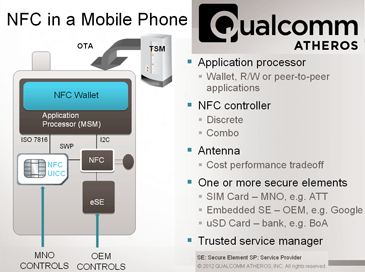
Qualcomm Atheros unwrapped a new ultra-low power near field communication (NFC) system-on-chip (SoC) for mobile devices.
The QCA1990 boasts an overall footprint that is 50 percent smaller than current NFC chips, making it the smallest on the market.
It can be paired with Qualcomm Atheros’ WCN3680 1-stream, dual-band 802.11ac Wi-Fi/Bluetooth 4.0/FM chip, the QCA1990 will enable seamless user experiences in the mobile, computing and consumer electronics markets. It also offers platform-level integration with the Qualcomm Snapdragon S4 and next-generation processors and modems to seamlessly enable NFC on Qualcomm’s OEM partner smartphones and tablets.
“Qualcomm Atheros believes NFC will be another key element of an enriched experience for smartphone and tablet consumers. As consumers continue to adopt functions like mobile payments and contactless data exchange, Qualcomm intends to be at the forefront of delivering simple, easy-to-use solutions to OEM partners,” said David Favreau, vice president of product management, Qualcomm Atheros. ”
Every article published by Converge Digest is researched, curated, fact-checked and editorially reviewed by Jim Carroll, Editor & Publisher. AI-assisted drafting may be used to accelerate production, but all content is reviewed, refined and approved prior to publication.
You just read about Qualcomm. One of the companies whose work it now carries:
Cambridge Silicon Radio (CSR) built Bluetooth, Wi-Fi, audio and location semiconductors. What became of it?
Cambridge Silicon Radio (CSR) brought Bluetooth, Wi-Fi, audio and location semiconductors to Semiconductor. That work was distinctive enough to lead to its acquisition by Qualcomm for US$2.5B. The standalone name now passes into the archive — but the team and technology continue inside Qualcomm today. One of 430 names here whose work outlived the company.
You just read about All. A technology from the archive that helped get us here:
Google/Alphabet Project Loon served 2011–2021. What ultimately replaced it?
Google/Alphabet Project Loon solar-powered balloons drifting in the stratosphere (~20 km), steering by rising and falling into different wind layers, relaying LTE from ground stations to phones far below. Its job passed to Unit economics — but the problem it solved, and the ideas it proved, live on in what replaced it. The standard rests here in the archive. One of 198 technologies here that opened a door and then held it for the next.