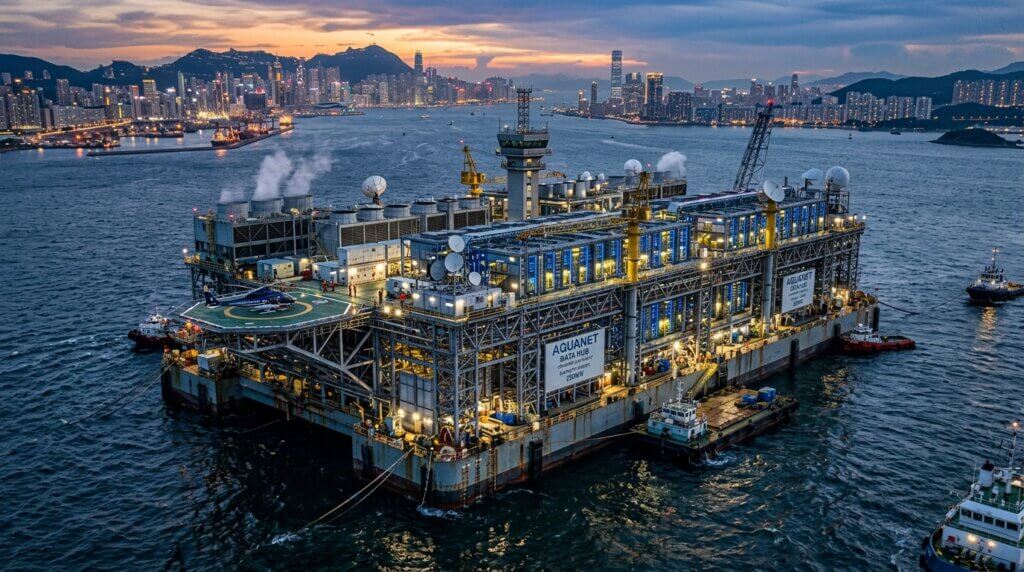
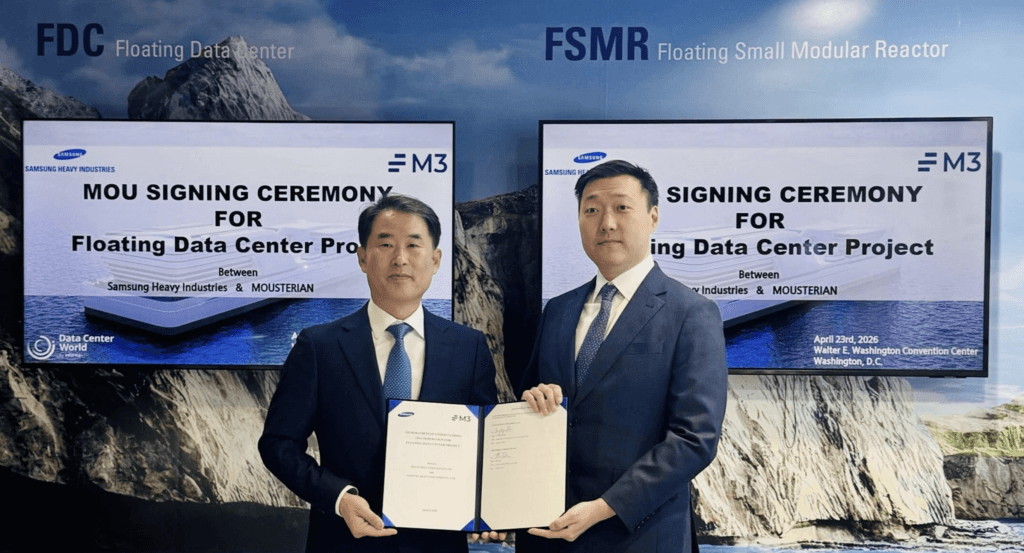
Samsung Heavy Industries, one of the world’s largest shipbuilders and offshore engineering firms, has signed a memorandum of understanding to develop floating data centers in partnership with Mousterian Corporation (M3), a U.S.-based developer of water-adjacent digital infrastructure. The agreement targets deployment of floating data center (FDC) platforms to support rising hyperscale and AI compute demand, particularly in regions constrained by land availability and grid interconnection delays.
Under the cooperation, M3 will lead site origination, development, tenant engagement, and overall project delivery, while Samsung Heavy Industries will contribute maritime engineering, fabrication, and large-scale shipyard production capabilities. The companies plan to pursue a portfolio of FDC projects across multiple jurisdictions, using industrialized offshore construction methods to accelerate deployment timelines compared to traditional land-based facilities.
The floating data center model focuses on siting compute infrastructure adjacent to existing power generation assets, including locations with stranded or underutilized capacity. By bypassing conventional grid bottlenecks and land permitting challenges, the partners aim to enable faster delivery of gigawatt-scale AI infrastructure while leveraging maritime platforms for cooling and modular expansion.
• SHI brings shipyard-scale fabrication and offshore engineering expertise to digital infrastructure
• Mousterian leads development, tenant sourcing, and capital formation for FDC projects
• Floating data centers positioned near power generation to bypass grid interconnection delays
• Targeting hyperscale and AI workloads requiring rapid, large-scale deployment
• Portfolio approach spans multiple global regions, including the United States
“Bringing a partner of Samsung Heavy Industries’ caliber alongside our development platform validates the institutional viability of the floating data center asset class,” said Min Suh, CEO of Mousterian Corporation.
🌐 Analysis: Floating data centers present a technically intriguing response to the dual constraints of power availability and land scarcity, but their viability depends heavily on execution details and site economics. On the positive side, proximity to power generation—particularly coastal plants, LNG terminals, or offshore wind—can reduce transmission bottlenecks and shorten deployment timelines. Water-based siting also enables efficient heat rejection, which is increasingly valuable for high-density AI clusters that are pushing beyond traditional air-cooling limits. In addition, shipyard fabrication introduces a repeatable, modular manufacturing model that could improve build times and cost predictability if scaled effectively.
However, the economic case remains situational rather than universal. Offshore or nearshore installations introduce higher capital costs tied to marine engineering, mooring systems, corrosion protection, and specialized maintenance. Operational expenses may also increase due to access logistics, workforce constraints, and harsher environmental conditions. Financing could be more complex as well, since floating data centers sit at the intersection of maritime infrastructure and digital assets, potentially requiring new risk frameworks from lenders and insurers.
Power strategy is central to the model’s success. While floating data centers can tap stranded or underutilized generation, they still depend on stable, high-capacity energy sources and robust interconnection to fiber networks. Integrating subsea or coastal fiber, ensuring low-latency connectivity, and managing redundancy are non-trivial challenges. Compared to land-based alternatives such as “shadow grid” developments with on-site generation, floating platforms trade grid independence for maritime complexity. In practice, they are likely to emerge as a niche but valuable option—particularly in regions where power is abundant near water but land, permitting, or grid access remain constrained.