T-Mobile closed 2025 with 2.4 million total net customer additions in Q4 and 8.0 million for the full year, extending its lead in postpaid, broadband and overall subscriber growth. Service revenues rose 10% year-over-year to $18.7 billion in Q4 and 8% to $71.3 billion for 2025, driven by postpaid momentum and contributions from recent acquisitions . The company ended the year with 142.4 million total customers and 9.4 million broadband customers .
Postpaid phone net additions reached 962,000 in Q4 and 3.3 million for the year, while total broadband net additions hit 558,000 in the quarter and 2.0 million in 2025 . T-Mobile finished the year with 8.5 million 5G broadband customers . Postpaid ARPA increased to $150.17 in Q4, up from $146.28 a year earlier, reflecting plan optimization and account growth . Postpaid phone churn measured 1.02% in Q4 and 0.93% for the full year .
Profitability remained strong despite restructuring costs tied to a 2025 workforce initiative. Net income totaled $2.1 billion in Q4 and $11.0 billion for the year . Core Adjusted EBITDA rose 7% year-over-year to $8.4 billion in Q4 and $33.9 billion for 2025 . Net cash from operations reached $28.0 billion for the year, and Adjusted Free Cash Flow totaled $18.0 billion . For 2026, T-Mobile guides to 900,000 to 1.0 million postpaid net account additions and Core Adjusted EBITDA of $37.0 billion to $37.5 billion .
• 2.4 million total net customer additions in Q4; 8.0 million in 2025
• 962,000 postpaid phone net additions in Q4; 3.3 million in 2025
• 558,000 broadband net additions in Q4; 2.0 million in 2025
• $18.7 billion Q4 service revenue; $71.3 billion for 2025
• $33.9 billion Core Adjusted EBITDA in 2025; $18.0 billion Adjusted Free Cash Flow
• 2026 guidance: $37.0–$37.5 billion Core Adjusted EBITDA; $18.0–$18.7 billion Adjusted Free Cash Flow
“Q4 was a great proof point of our winning formula – and we see significant runway ahead to widen our margin of differentiation,” said Srini Gopalan, CEO of T-Mobile .
Addendum: Key Points from the Earnings Call
• Management emphasized continued premium plan mix expansion, noting premium loading approached double the premium base mix in Q4, supporting ARPA durability without broad-based price increases.
• Executives highlighted digital self-serve momentum, with unassisted digital upgrades rising sharply year-over-year, reducing call volumes and improving cost-to-serve metrics as part of the IntentCX transformation.
• Leadership detailed integration progress on UScellular spectrum and customers, including accelerated network rationalization and early synergy capture tied to backhaul consolidation and site optimization.
• Broadband strategy discussions focused on spectral efficiency gains and next-generation CPE enabling higher average usage per household while maintaining attractive unit economics.
• Business segment commentary pointed to continued traction in enterprise and public sector accounts, supported by 5G Advanced capabilities, network slicing and private network deployments.
• Capital allocation remarks reinforced a balanced approach: sustaining ~2.5x net leverage, maintaining dividend growth, and preserving flexibility for spectrum or strategic tuck-in acquisitions.
• Management reiterated that AI-driven network automation and customer-driven coverage analytics will underpin both margin expansion and service differentiation into the 6G cycle.
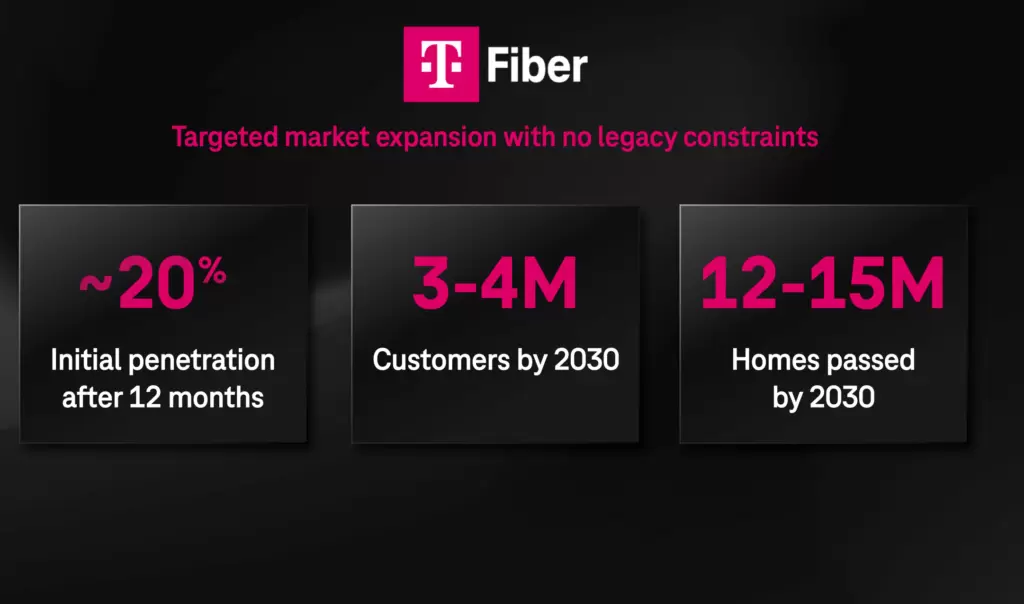
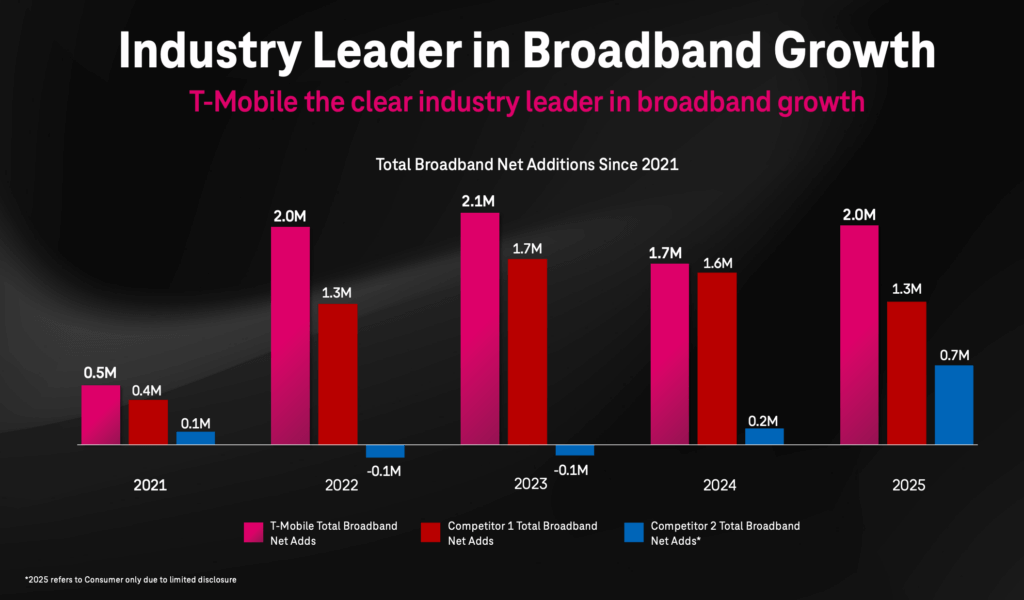
🌐 Analysis: The conference call underscored how T-Mobile is shifting from pure subscriber growth toward mix, efficiency and platform monetization. Digital automation, premium plan loading and broadband scale now form the core margin narrative, positioning the company to defend growth even as the U.S. wireless market matures and competitors focus on bundled convergence strategies.