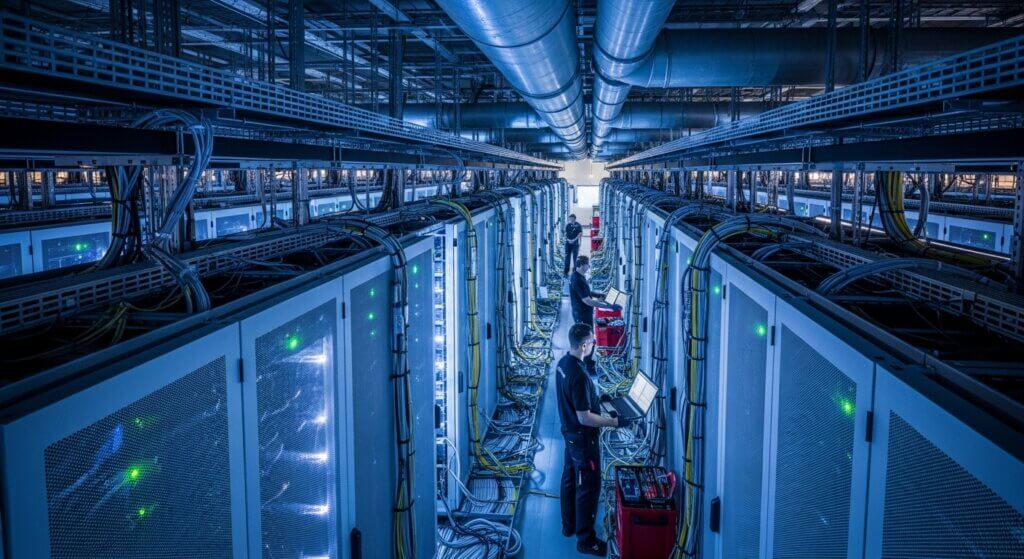
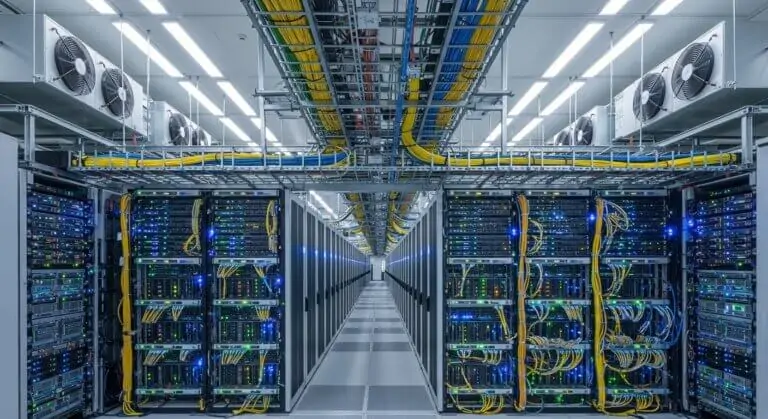
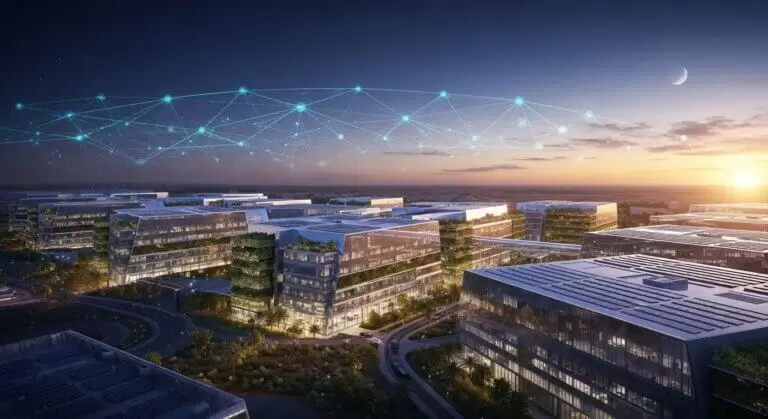
2025 marked the year when data center construction crossed a clear threshold—from hyperscale into industrial-scale AI infrastructure. Projects announced during the year increasingly resembled power plants and logistics hubs, with design targets measured in hundreds of megawatts and, in some cases, multiple gigawatts. These were not incremental expansions, but foundational builds intended to support sustained AI training and inference at unprecedented scale.
What made 2025 distinct was not just size, but intent. Data centers were no longer positioned as generic compute facilities; they were purpose-built for AI, with dense GPU clusters, liquid cooling, dedicated substations, long-haul fiber routes, and proximity to large-scale generation. Power availability—not land or buildings—emerged as the primary constraint shaping where and how these projects moved forward.
While many of these campuses will take years to fully materialize, their announcements already reshaped regional power planning, grid investment, and AI sovereignty strategies. Together, they provide a clear snapshot of how the data center industry is reorganizing around AI as its primary workload heading into the second half of the decade.
| Project | Why it mattered (location & scale) |
|---|
| AI Super-Campuses & Hyperscaler Flagships |
| Project Stargate | A proposed AI super-campus concept discussed at national scale, signaling the emergence of multi-hundred-MW to gigawatt-class AI facilities designed around long-term model training, custom silicon, and dedicated power generation. |
| Colossus (xAI) | xAI’s flagship training campus emphasizes speed of deployment, dense GPU clusters, and vertical integration, illustrating how AI developers are increasingly bypassing traditional cloud abstraction to build physical infrastructure directly. |
| Project Hyperion | A hyperscale AI campus engineered from the outset for liquid cooling, high-voltage delivery, and extreme rack densities, reflecting a clean-sheet approach to AI-first facility design. |
| Microsoft AI Data Center Mega-Regions (Fairwater-linked) | Microsoft outlined clustered AI data-center regions to support synchronized training across campuses, reshaping regional power planning, fiber routing, and inter-campus latency architecture. |
| AWS Project Rainier (NW Indiana) | A live hyperscale campus in Northwest Indiana spanning approximately 2+ GW at full build-out and backed by $10B+ in investment, highlighting the Midwest’s emergence as a strategic AI infrastructure region. |
| Google AI-Optimized Data Center Expansions | Google continued announcing AI-optimized builds emphasizing TPU acceleration, energy efficiency, and proximity to renewable power, reinforcing long-cycle AI capacity planning. |
| NeoCloud & AI-First Developers |
| Nscale Global AI Data Center Program | Nscale announced a multi-site global AI build-out with individual facilities in the 40–100+ MW class, validating investor demand for independent AI cloud infrastructure beyond hyperscalers. |
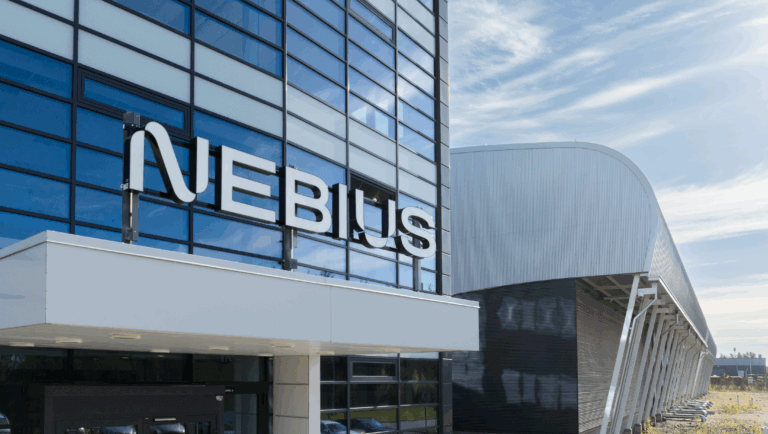
| Nebius AI Data Center Campuses | Nebius committed to large AI campuses across Europe and the U.S., supporting GPU-dense cloud services and illustrating the rise of non-U.S. AI infrastructure platforms. |
| CoreWeave Hyperscale AI Builds | CoreWeave expanded hyperscale AI facilities often exceeding 100 MW per campus, reinforcing its role as a GPU-native cloud operator serving large model developers. |
| Lambda 100 MW AI Data Center (Kansas City) | Lambda’s Kansas City project brought 100 MW of AI-ready capacity into a secondary U.S. market, highlighting geographic diversification of AI infrastructure. |
| Fluidstack Sovereign AI Data Centers | Fluidstack advanced sovereign AI builds tied to national initiatives, emphasizing jurisdictional control of compute alongside high-density GPU deployment. |
| Colocation, Power & Sovereign Infrastructure |
| Aligned Data Centers Mega-Campus Expansions | Aligned expanded AI-ready campuses with liquid cooling and power densities suitable for 100+ MW multi-building developments, reflecting colocation’s pivot to AI workloads. |
| QTS Hyperscale AI Campuses | QTS announced large AI-oriented campuses designed for hyperscalers and AI clouds, reinforcing colocation’s role in bridging near-term AI capacity gaps. |
| Digital Realty AI-Ready Builds | Digital Realty adapted global campuses with higher power envelopes and advanced cooling, integrating AI readiness into its interconnection-centric platform. |
| Vantage Data Centers Large-Scale Projects | Vantage expanded multi-hundred-MW campuses in power-advantaged regions, serving both hyperscaler overflow and AI cloud demand. |
| Fermi America Nuclear-Linked AI Data Centers | Fermi America proposed AI campuses co-located with nuclear generation, directly addressing power availability as the primary constraint on AI scale. |
| Middle East & APAC Sovereign AI Mega-Projects | Energy-rich nations and APAC governments accelerated hundreds-of-MW to GW-class AI campuses as part of national AI and digital sovereignty strategies. |
Wrap-Up: From Announcements to Execution
The defining characteristic of 2025’s data center announcements was commitment to scale, even in the face of permitting complexity, grid constraints, and long construction timelines. These projects are already influencing where utilities invest, how transmission planning evolves, and which regions emerge as AI hubs.
Looking Ahead to 2026
In 2026, attention will shift from headline announcements to groundbreaking, grid interconnection, and phased delivery. Expect sharper differentiation between projects that move quickly due to secured power and those that slow under regulatory and supply-chain pressure. The next competitive frontier will not be who announces the largest campus—but who can bring AI capacity online first, reliably, and at sustained scale.