Intel reported second-quarter 2026 revenue of $16.1 billion, up 25% year-over-year, driven by accelerating demand for AI infrastructure, strong growth in its Data Center and AI business, and continued expansion of Intel Foundry. The company said the quarter exceeded its own guidance as improved manufacturing yields and cycle times increased product output while AI deployments boosted demand across Xeon processors, purpose-built ASICs, advanced packaging and foundry services. The accompanying earnings presentation emphasized “unprecedented demand for AI compute” as the central driver behind Intel’s performance.
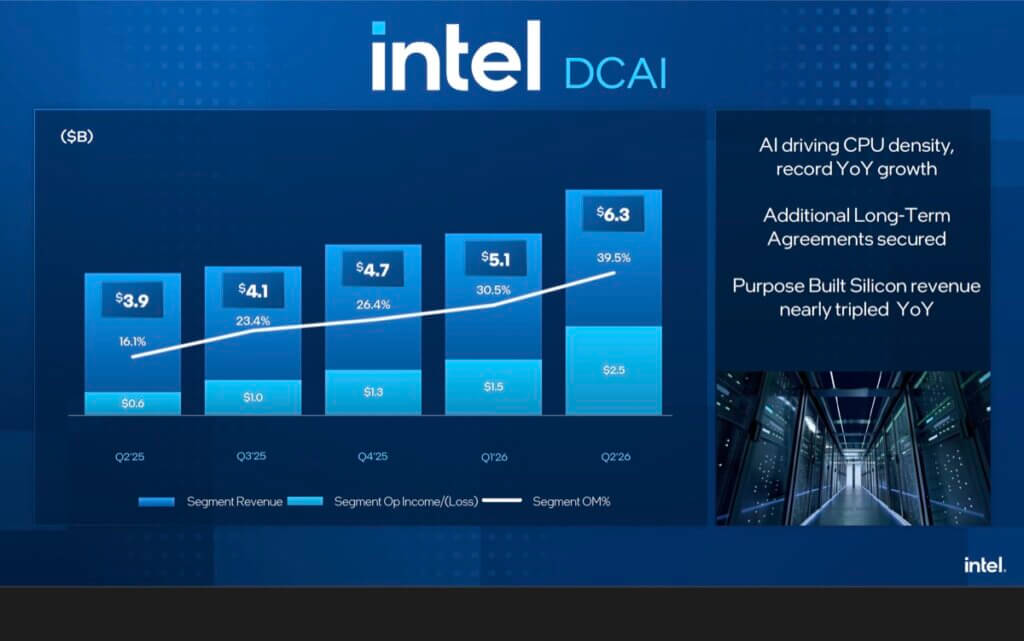
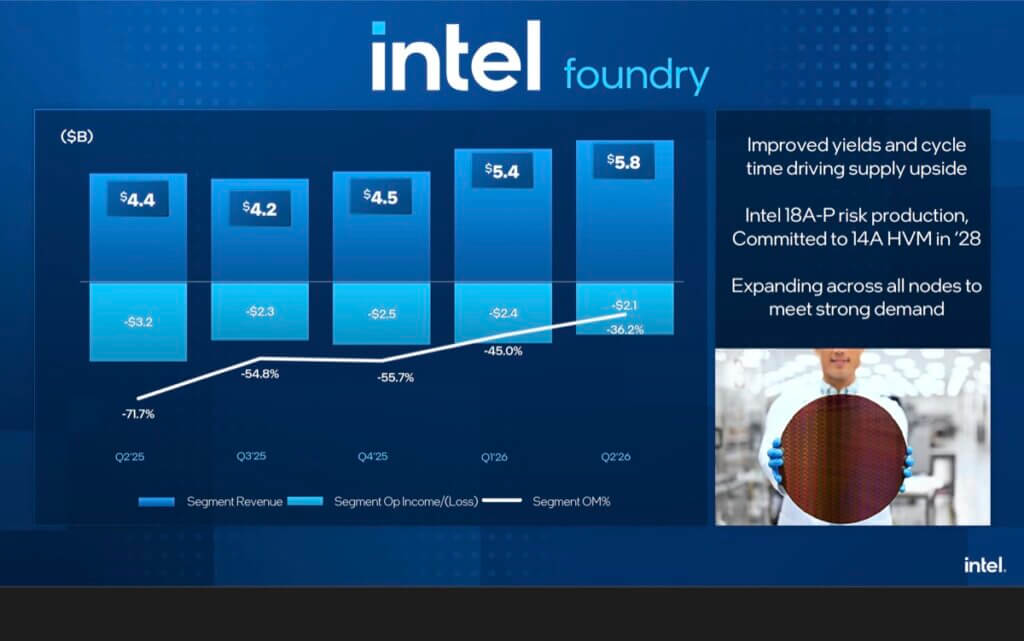
The Data Center and AI (DCAI) business generated $6.3 billion in revenue, up 59% from a year earlier, while the Client Computing and Physical AI Group (CCPG) increased 13% to $8.9 billion. Intel Foundry revenue climbed 31% to $5.8 billion as Intel advanced Intel 18A-P into risk production and continued scaling Intel 18A manufacturing. During the quarter Intel introduced Xeon 6+ processors built on Intel 18A, expanded its Ethernet E835 portfolio from 10GbE to 200GbE, demonstrated rack-scale AI infrastructure with SambaNova and Foxconn, expanded OpenVINO Physical AI for robotics developers, and announced additional purpose-built silicon engagements including Fortinet’s Security Processor 6. Intel also disclosed a €5 billion investment to expand production capacity for Xeon processors built on Intel 3.
Financially, Intel reported GAAP revenue of $16.1 billion, gross margin of 40.4%, operating margin of 11.1%, and GAAP EPS of $(2.16), reflecting a large non-cash accounting impact related to escrowed CHIPS Act shares. On a non-GAAP basis, gross margin reached 41.8%, operating income totaled $2.8 billion, and EPS was $0.42. Cash from operations reached $7.0 billion during the quarter. For Q3, Intel forecast revenue between $15.8 billion and $16.8 billion with non-GAAP gross margin of approximately 42% and non-GAAP EPS of $0.38. The earnings presentation also highlighted record DCAI profitability, improving foundry economics, and continued execution toward Intel 14A high-volume manufacturing in 2028.
| Intel Q2 2026: AI Infrastructure & Network Highlights | |
| Revenue | $16.1B (up 25% YoY) |
| DCAI Revenue | $6.3B (up 59% YoY) |
| Client Computing | $8.9B (up 13%) |
| Intel Foundry | $5.8B (up 31%) |
| Non-GAAP Gross Margin | 41.8% |
| Operating Cash Flow | $7.0B |
| AI Infrastructure | Rack-scale inference systems with SambaNova & Foxconn |
| Server CPUs | Xeon 6+ launched on Intel 18A |
| Networking | Ethernet E835 portfolio scales from 10GbE to 200GbE |
| Purpose-built Silicon | Revenue nearly tripled YoY according to management |
| Foundry Progress | Intel 18A-P entered risk production; Intel 14A remains on track for 2028 HVM |
| Q3 Guidance | Revenue $15.8B–16.8B; non-GAAP GM 42%; non-GAAP EPS $0.38 |
“Our Q2 results represent our strongest revenue growth in more than fifteen years, enabled by greater speed, accountability, and customer focus,” said Lip-Bu Tan, Intel CEO. “AI is driving unprecedented demand for compute, and as we continue to execute, Intel is well-positioned to capture sustainable growth across our CPU franchise, ASICs, advanced packaging and vast wafer foundry network.”
🌐 Analysis
Intel’s results show that its recovery increasingly depends on AI infrastructure rather than the traditional PC market alone. The 59% increase in Data Center and AI revenue, continued expansion of Intel Foundry, and growing portfolio of AI networking, packaging, and ASIC engagements indicate that Intel is broadening its participation across multiple layers of the AI infrastructure stack instead of relying solely on x86 CPUs.
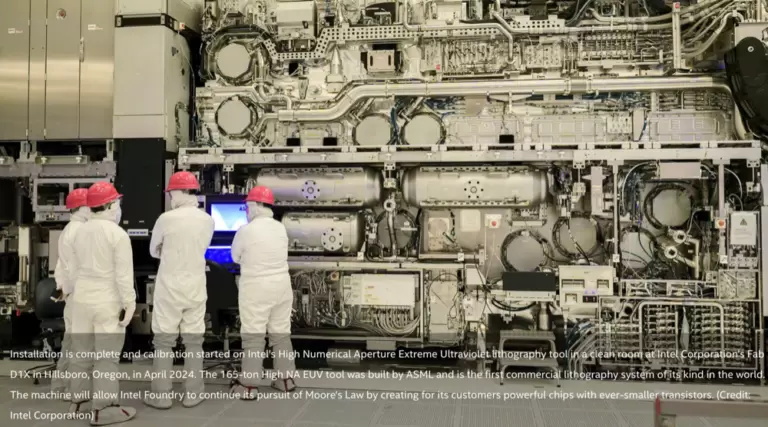
The quarter also demonstrates continued execution on Intel’s manufacturing roadmap. Intel highlighted Intel 18A production, Intel 18A-P risk production, High-NA EUV manufacturing for Panther Lake, and expanded investments in packaging and fabrication capacity. Combined with recent collaborations involving Google Cloud, Fortinet, Foxconn, SambaNova and other ecosystem partners, Intel continues positioning its products and foundry business to compete across AI servers, networking, edge AI and custom silicon.