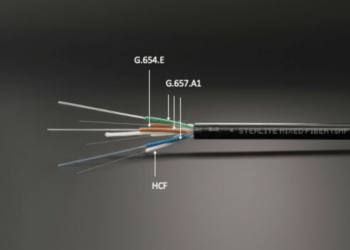

Sterlite Technologies Ltd (STL) completed a successful multi-core fibre (MCF) field trial with Colt Technology Services across Colt’s London metro optical network, demonstrating the viability of MCF as a high-capacity backbone for next-generation networks. The trial validated real-world deployment of STL’s Multiverse 4-core fibre on live metro routes, targeting AI, cloud, and digital services that require sustained bandwidth growth without increasing fibre count.
The deployment ran between two Colt points of presence over approximately 9 km and 63 km, achieving an 800 Gbps line rate. STL and Colt verified 100GE and 400GE services and completed a full test regime covering chromatic dispersion, polarization mode dispersion, crosstalk, throughput, fault analysis, OTDR, loss, and optical return loss. Results met operational requirements across underground and ducted environments.
STL’s 4-core MCF integrates four transmission cores within the same cladding diameter as standard single-mode fibre, maintaining a 250/200-micrometre coating while increasing capacity per fibre. The companies positioned the trial as a step toward scaling metro capacity using existing ducts and civil infrastructure, with an end-to-end ecosystem spanning fibre, cable, and termination solutions.
- 4-core MCF deployed at standard SMF cladding diameter
- London metro routes spanning ~9 km and ~63 km
- 800 Gbps line rate achieved; 100GE and 400GE services validated
- Comprehensive optical testing completed, including CD, PMD, crosstalk, OTDR, and ORL
- Focus on higher capacity per fibre without additional civil works
“As demand for network capacity surges, customers need more bandwidth without compromising security, performance, or sustainability,” said Buddy Bayer, Chief Operating Officer, Colt Technology Services.
🌐 Analysis
MCF field trials are gaining momentum as operators look for capacity scaling options that avoid new duct builds, particularly in dense metro environments. This UK deployment follows broader industry efforts to move MCF beyond the lab, as vendors and carriers assess interoperability with existing transceivers and operational processes while planning for AI-driven traffic growth.