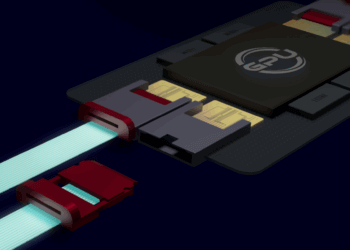

Teradyne and MultiLane announced plans to form a joint venture, MultiLane Test Products (MLTP), to address rising demand for high-speed test solutions driven by AI data center infrastructure. The companies said MLTP will focus on accelerating development of test systems for critical high-speed data connections across the compute stack. The transaction is expected to close in the first half of 2026, subject to customary conditions.
Under the agreement, MultiLane will contribute all assets related to its test and measurement business into the joint venture, while continuing to operate its interconnect and data center test solution businesses independently. Teradyne will hold a majority ownership stake, with MultiLane retaining minority ownership. The structure combines Teradyne’s global scale in semiconductor and electronics test with MultiLane’s specialization in high-speed instrumentation spanning wafer-level to system-level validation.
The companies position MLTP to serve customers designing and deploying next-generation AI infrastructure, where signal integrity, bandwidth scaling, and validation of high-speed links have become increasingly critical. By aligning semiconductor test, product test, and data center-level validation, the joint venture aims to shorten development cycles and broaden access to high-speed test capabilities across silicon, modules, and systems.
- MLTP will target test solutions for high-speed interconnects used in AI and data center equipment
- MultiLane contributes its entire test and measurement business to the joint venture
- Teradyne becomes majority owner, leveraging its global semiconductor and electronics test footprint
- Transaction expected to close in the first half of 2026
“Compute architectures are evolving quickly, driven by explosive growth in AI and the need for massive, reliable high-speed interconnects. With the creation of MultiLane Test Products, we can expand our ability to support Teradyne customers all the way from the wafer level to the data center,” said Greg Smith, President and CEO of Teradyne.
🌐 Analysis
The formation of MLTP reflects a broader shift in the semiconductor test market as AI workloads push interconnect speeds and system complexity beyond traditional validation boundaries. By linking wafer-level semiconductor test with system and data center-scale I/O validation, Teradyne and MultiLane are aligning test capabilities with how AI infrastructure is increasingly designed and deployed, from advanced silicon nodes to rack-scale systems.
MultiLane is a specialist test and measurement company focused on validating high-speed electrical and optical interconnects across the entire compute and networking stack. Founded in 2012 and headquartered in Beirut, Lebanon, with significant operations in Silicon Valley, Europe, and Asia, the company has built a reputation for delivering purpose-built tools that track the rapid evolution of Ethernet, PCIe, and emerging AI-scale interconnect standards.
MultiLane was founded by Fadi Daou, who continues to serve as Founder and CEO. The company emerged at a time when traditional general-purpose test equipment struggled to keep pace with rapidly increasing serial I/O speeds. MultiLane’s strategy centered on tightly integrating hardware, firmware, and software to deliver test platforms optimized specifically for high-speed links rather than broad instrumentation portfolios. Over the past decade, MultiLane expanded from a niche signal-integrity testing vendor into a supplier trusted by semiconductor companies, networking OEMs, optical module vendors, and hyperscale operators. Its growth closely followed major industry transitions—from 100G to 400G, and now to 800G and beyond—particularly in data center and AI infrastructure environments.
MultiLane’s portfolio spans wafer-level, device, module, and system-level test, with a strong emphasis on real-world interoperability and stress testing. Key product areas include:
- High-speed BERT platforms supporting PAM4 signaling at 56G, 112G, and emerging 224G rates
- Oscilloscope-based and BERT-based signal integrity solutions for electrical and optical links
- Optical module and transceiver test systems, including pluggables used in hyperscale and AI clusters
- Protocol-aware validation tools aligned with Ethernet, PCIe, and emerging AI interconnect ecosystems
Teradyne is a global supplier of automated test equipment spanning semiconductor test, electronics test, and industrial automation, with a growing emphasis on infrastructure needed for AI-scale computing. As part of that strategy, Teradyne recently acquired Quantifi Photonics, a New Zealand–founded specialist in photonic and optical test instrumentation used in coherent optics, transceivers, and integrated photonics. The acquisition extends Teradyne’s reach beyond traditional electrical test into optical and photonic domains that are increasingly central to AI data centers, where high-speed optical interconnects dominate scale-out and, increasingly, scale-up architectures. By integrating Quantifi Photonics’ optical test capabilities with its existing semiconductor and product test platforms, Teradyne aims to support customers validating complete electrical-to-optical signal chains, from silicon and photonic devices through modules and systems.