
Ayar Labs secured $500 million in Series E funding to accelerate high-volume production of its co-packaged optics (CPO) technology aimed at AI scale-up infrastructure. The round was led by Neuberger Berman and included investors such as ARK Invest, Insight Partners, Qatar Investment Authority (QIA), Sequoia Global Equities, and 1789 Capital, alongside strategic investors AMD, Alchip, MediaTek, and NVIDIA. The financing brings Ayar Labs’ total funding to approximately $870 million and values the company at $3.75 billion.
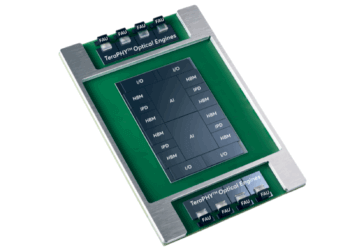
The company plans to use the funding to expand manufacturing and test capacity, strengthen ecosystem partnerships, and grow global operations, including at its new office in Hsinchu, Taiwan. Ayar Labs develops optical interconnect technology designed to replace copper links between accelerators and switches in large AI systems. Its solution centers on the TeraPHY optical engine, which integrates optical I/O directly with processors using standard semiconductor packaging flows. The approach targets the growing bandwidth and power challenges in AI clusters where thousands of GPUs must communicate at extremely high speeds.
Ayar Labs was founded in 2015 as a spin-out of research conducted at MIT, the University of California, Berkeley, and the University of Colorado Boulder. CEO Mark Wade previously served as a program manager at DARPA and has led the company since its early commercialization phase. The company has worked closely with semiconductor and packaging partners to transition silicon photonics technology from research prototypes into production-ready optical chiplets designed for integration with next-generation AI processors and switches.
• Series E funding of $500 million led by Neuberger Berman
• Total funding reaches approximately $870 million with a valuation of $3.75 billion
• Strategic investors include AMD, NVIDIA, MediaTek, and Alchip
• Technology centers on the TeraPHY optical I/O chiplet for co-packaged optics
• Funds will expand production, test capacity, and global operations including Hsinchu, Taiwan
• Goal is to replace power-hungry copper interconnects in large AI clusters with optical links
“AI infrastructure is hitting a power wall driven by interconnect inefficiency. As bandwidth demands explode, copper becomes the bottleneck — consuming too much power and limiting AI throughput per watt and per dollar,” said Mark Wade, CEO and co-founder of Ayar Labs. “Co-packaged optics overcomes these barriers, enabling thousands of GPUs to operate as a unified system. This funding fuels our ability to meet the demands of hyperscale AI.”
🌐 Analysis
Ayar Labs has spent more than a decade translating academic research in optical I/O into production silicon photonics devices designed for integration directly with advanced compute packages. The founding team—drawn from MIT and other university photonics labs—focused on the long-standing challenge of replacing electrical I/O with optical links inside compute packages. Early milestones included demonstrations of optical chiplet architectures, partnerships with GlobalFoundries for silicon photonics manufacturing, and the commercial introduction of the TeraPHY optical engine and SuperNova laser source technology.
The funding comes amid a broader industry shift toward optical interconnects in AI systems. In 2025, Marvell acquired Celestial AI to accelerate its own optical interconnect roadmap for AI data centers. Celestial AI developed a competing architecture based on its Photonic Fabric platform, which similarly aims to replace power-intensive electrical links between AI accelerators with optical connectivity. While both companies target AI scale-up fabrics, Ayar Labs has emphasized chiplet-style optical I/O integrated directly with processor packages, whereas Celestial AI positioned its technology as a broader optical memory and interconnect fabric. The significant capital raise for Ayar Labs suggests continued investor confidence that optical I/O will become a critical component of next-generation AI compute clusters as bandwidth and power constraints intensify.
🌐 We’re tracking the latest developments in networking silicon. Follow our ongoing coverage at: https://convergedigest.com/category/semiconductors/