Arm posted record quarterly revenue and used its latest earnings report to sharpen its positioning around AI infrastructure, data center CPUs, and agentic AI workloads. The company reported Q4 FY2026 revenue of $1.49 billion, up 20% year-over-year, with royalty revenue climbing 11% to $671 million and license revenue rising 29% to $819 million. Arm said growth came from broader adoption of Armv9, Compute Subsystems (CSS), and increasing deployment of Arm-based CPUs in cloud and AI data centers.
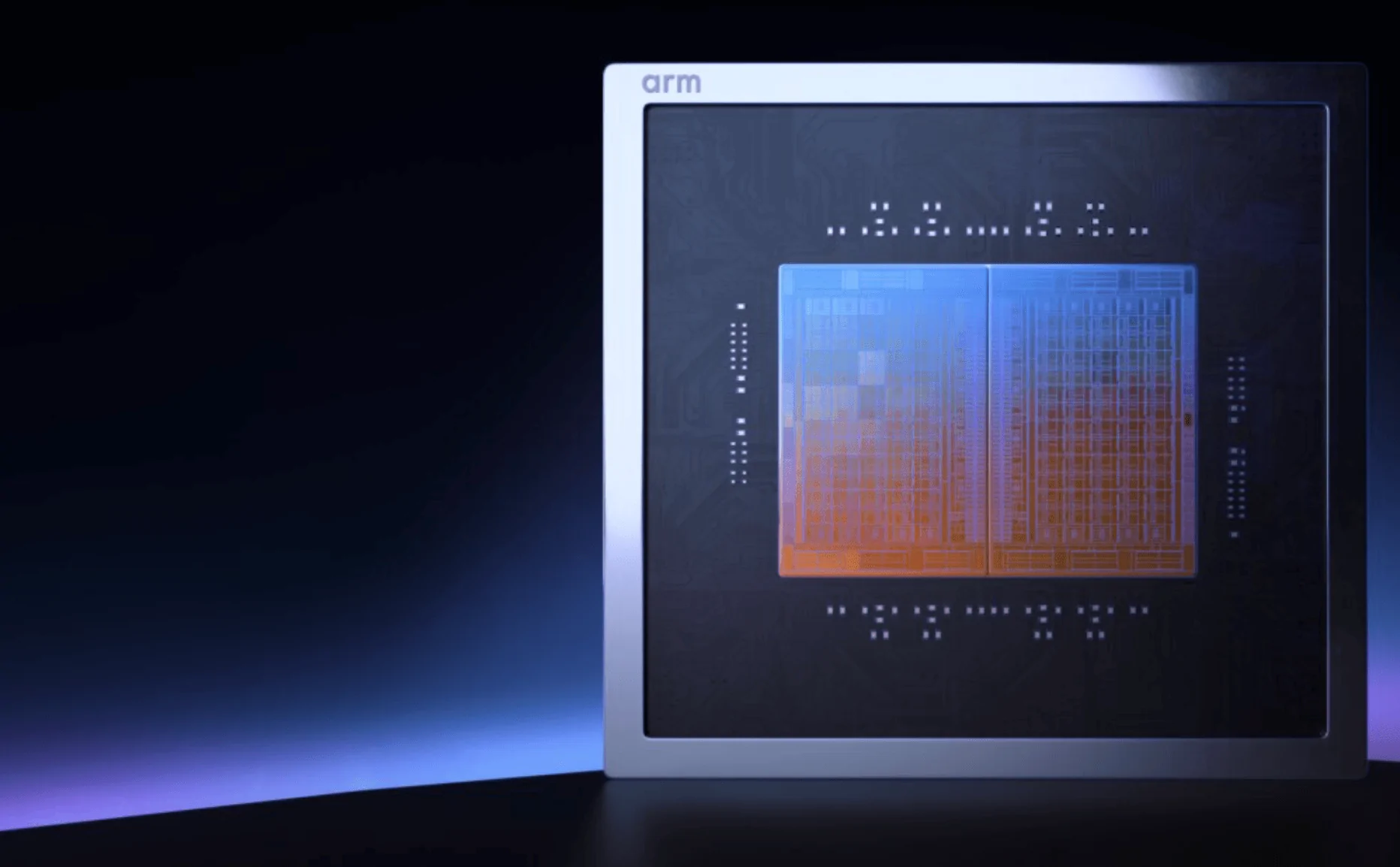
A central theme of the earnings release was Arm’s expansion beyond IP licensing into silicon products for hyperscale AI infrastructure. Arm formally introduced its “Arm AGI CPU,” a production silicon platform designed for cloud and AI data centers, co-developed with Meta. The company said it already has visibility into more than $2 billion in potential demand over the next two years. Arm framed the AGI CPU as a purpose-built processor optimized for orchestrating large AI clusters, arguing that agentic AI workloads dramatically increase CPU requirements as accelerators generate tokens while CPUs manage scheduling, memory, networking, and coordination tasks.
Arm also outlined an aggressive long-term AI infrastructure roadmap. The company projected its Cloud AI total addressable market could expand from $245 billion in FY2026 to more than $1 trillion by FY2031, driven by inference and agentic AI deployments. Arm forecast that its AGI CPU business could scale to approximately $15 billion in annual revenue by FY2031, while maintaining growth in its traditional licensing and royalty business. Management emphasized that Arm-based CPUs are increasingly becoming the orchestration layer for AI clusters deployed by hyperscalers including AWS, Google, Microsoft, Meta, NVIDIA, and Oracle.
- Q4 FY2026 revenue reached $1.49 billion, up 20% year-over-year
- Royalty revenue increased 11% to $671 million
- License revenue rose 29% to $819 million
- Non-GAAP operating margin reached 49%
- Arm introduced its first production silicon “AGI CPU” for AI data centers
- Meta co-developed the initial Arm AGI CPU platform
- Arm said it sees over $2 billion in AGI CPU demand over the next two years
- Arm estimates agentic AI data centers may require 4x more CPU cores within the same power envelope
- Arm expects meaningful AGI CPU revenue beginning in FY2028
- The company projects AGI CPU revenue could scale to approximately $15 billion annually by FY2031
- Arm said Cloud AI will become its fastest-growing royalty revenue driver
- Arm estimates royalty revenue could grow at a 20% CAGR from FY2026 through FY2031
“Arm delivered a third consecutive year of more than 20% revenue growth, driven by strong demand for the Arm compute platform,” said Rene Haas, CEO of Arm. “As AI becomes more agentic, demand for Arm AGI CPU, Arm’s first data center chip plan, exceeded expectations, reinforcing Arm as the compute platform for the AI era.”
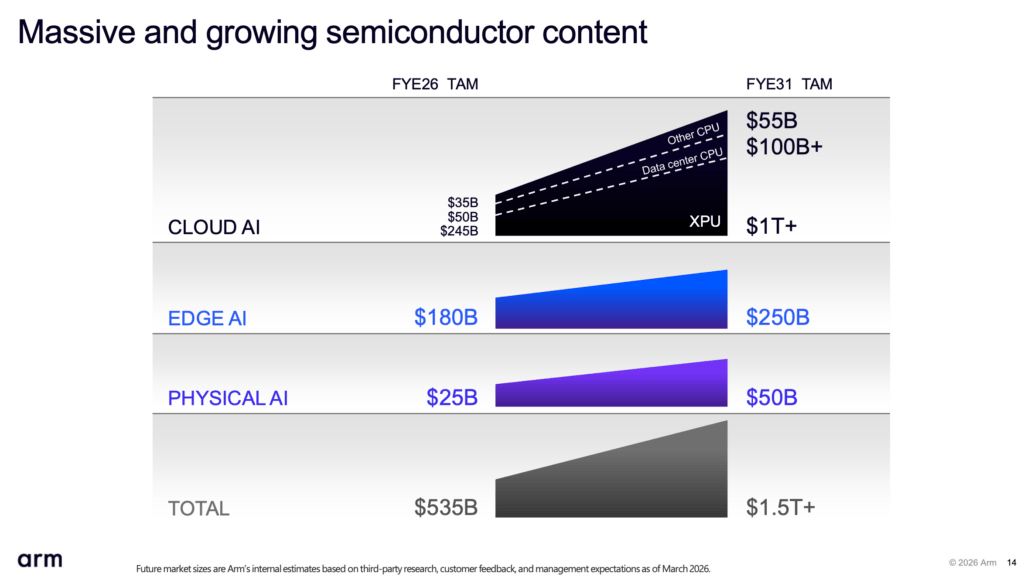
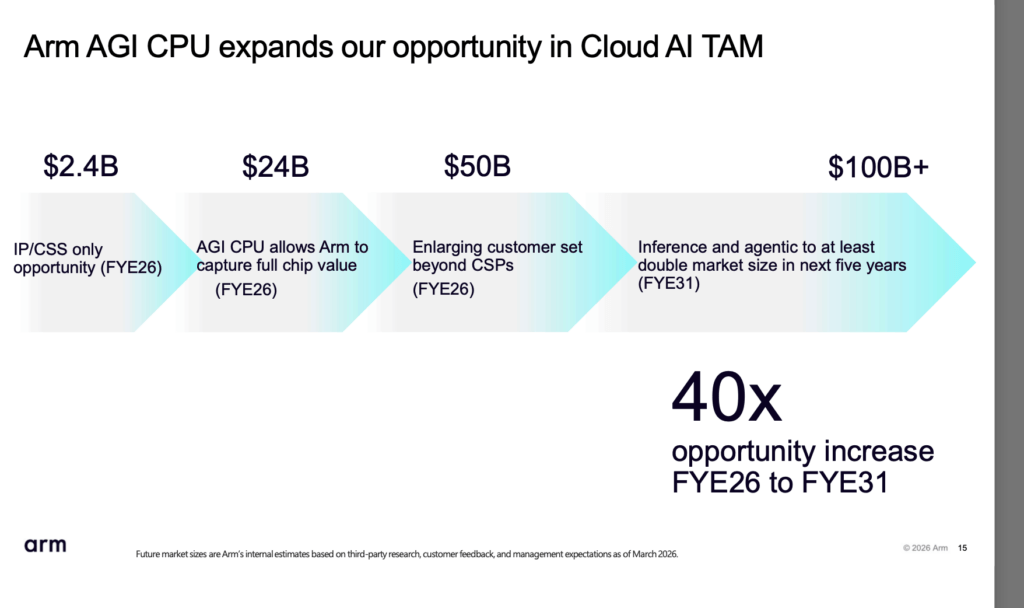
🌐 Analysis: Arm’s earnings underscore how the AI infrastructure market is increasingly shifting toward heterogeneous compute architectures where CPUs regain strategic importance as orchestration engines for large-scale AI clusters. While GPUs and XPUs remain central for training and inference acceleration, hyperscalers are now emphasizing CPU efficiency, memory bandwidth, scheduling, networking, and power optimization across multi-rack AI systems. Arm is positioning its AGI CPU strategy directly into this orchestration layer.
🌐 Analysis: The announcement also places Arm into more direct competition with Intel, AMD, and potentially NVIDIA’s Grace CPU roadmap. At the same time, Arm continues benefiting from broad ecosystem adoption through AWS Graviton, Google Axion, Microsoft Cobalt, NVIDIA Grace, Oracle Cloud Infrastructure, and custom hyperscaler silicon programs. The company’s emphasis on CSS platforms, Armv9 royalty expansion, and vertically integrated AI CPUs suggests a major strategic evolution from pure IP licensing toward higher-value silicon participation in AI infrastructure.