
Deutsche Telekom and SAP will build a sovereign AI platform for the German federal government after being ranked first in a tender issued by Germany’s Federal Ministry for Digitalization and State Modernization (BMDS). The platform is intended to provide a shared AI infrastructure for federal agencies, states, and municipalities, supporting applications such as intelligent document processing, knowledge management, translation, text summarization, and planning and approval workflows. Google and adesso had previously filed procurement complaints but later withdrew them, clearing the way for the project, with the ministry booking €250 million in domestic AI data center capacity to kickstart the initiative.
The initiative positions AI infrastructure as a foundational element of Germany’s broader digital sovereignty strategy. The platform will run on Deutsche Telekom’s sovereign cloud infrastructure in German data centers and will integrate SAP Business Technology Platform services. Deutsche Telekom said the architecture will serve as a central hub for public administration and operate as a development environment for future AI-powered public services. One of the first applications will be KIPITZ, an AI assistant designed for public sector employees that supports document handling, search, summarization, translation, and administrative workflow acceleration.
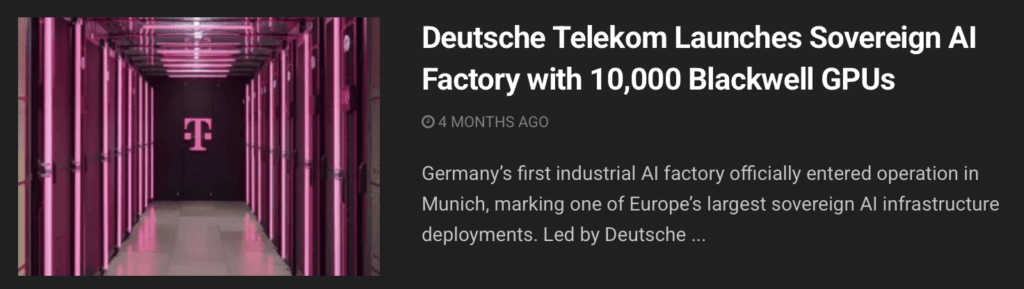
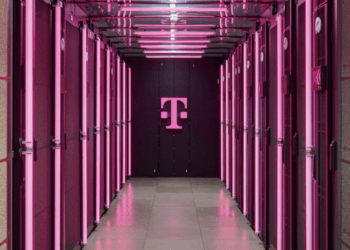
The platform is also a core building block of the “Germany Stack,” a national framework intended to provide common digital infrastructure across government and regulated sectors. Telekom describes the Germany Stack as a layered architecture spanning infrastructure, platform services, and applications—all designed to operate under German and European legal and security frameworks. The company said the environment will be powered by more than 10,000 accelerated NVIDIA GPUs hosted in a secure, subterranean Munich data center, connected through Telekom’s fiber network and cyber defense infrastructure. Separately, Telekom also confirmed that its T Cloud Public sovereign cloud platform is now part of Germany’s framework agreement for cloud and AI services for public authorities, enabling direct procurement of cloud and AI resources without separate tendering processes.
- Deutsche Telekom and SAP selected as top-ranked bidders for Germany’s sovereign AI platform tender, backed by a €250 million ministry allocation for domestic data center capacity
- Platform targets use by federal, state, and municipal public administration agencies to reduce dependency on non-European hyperscale providers
- First workloads include document processing, knowledge management, summarization, translation, and approval workflows
- KIPITZ named as one of the first AI applications for public sector employees
- Platform runs on Telekom sovereign cloud infrastructure hosted in German data centers
- Germany Stack architecture spans infrastructure, cloud platform services, AI models, and applications
- Telekom says the system includes 10,000+ accelerated NVIDIA GPUs for AI compute capacity
- T Cloud Public already supports more than 7,000 customers across business, research, and government sectors
- Security certifications include BSI C5:2020, ISO 27001, and GDPR compliance
- Baden-Württemberg’s Moodle learning platform, serving 1.5 million students, cited as an existing deployment example
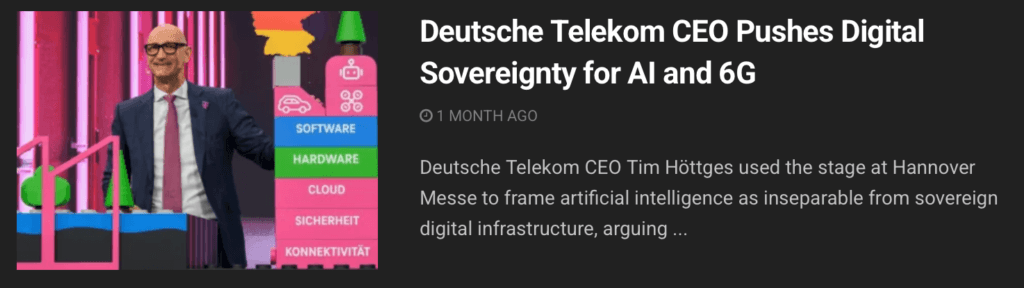
Tim Höttges, CEO of Deutsche Telekom, said: “Anyone who wants to remain relevant in the world must lead in the race for digital sovereignty. Europe has enormous catching up to do — and we will not close that gap through discussions, but through action. Telekom and SAP are leading the way here. Together, we are ensuring that Germany and Europe take their digital future into their own hands.”
Christian Klein, CEO of SAP, said: “Digital sovereignty and artificial intelligence go hand in hand. We are contributing our strengths in business processes, data, and trustworthy AI through the SAP Business AI Platform to accelerate innovation in the public sector together with Telekom.”
🌐 Analysis: Germany’s AI cloud initiative reflects a broader push across Europe to build sovereign alternatives to U.S.-dominated hyperscale and AI infrastructure. The emphasis on local cloud control, domestic data residency, and interoperability aligns with parallel European efforts around cloud sovereignty, trusted AI, and strategic digital infrastructure. For Deutsche Telekom, the project extends its role beyond telecom connectivity into national-scale cloud and AI infrastructure. It also highlights growing interest among governments in combining sovereign cloud, AI platforms, and accelerated compute into a single stack for public-sector modernization.