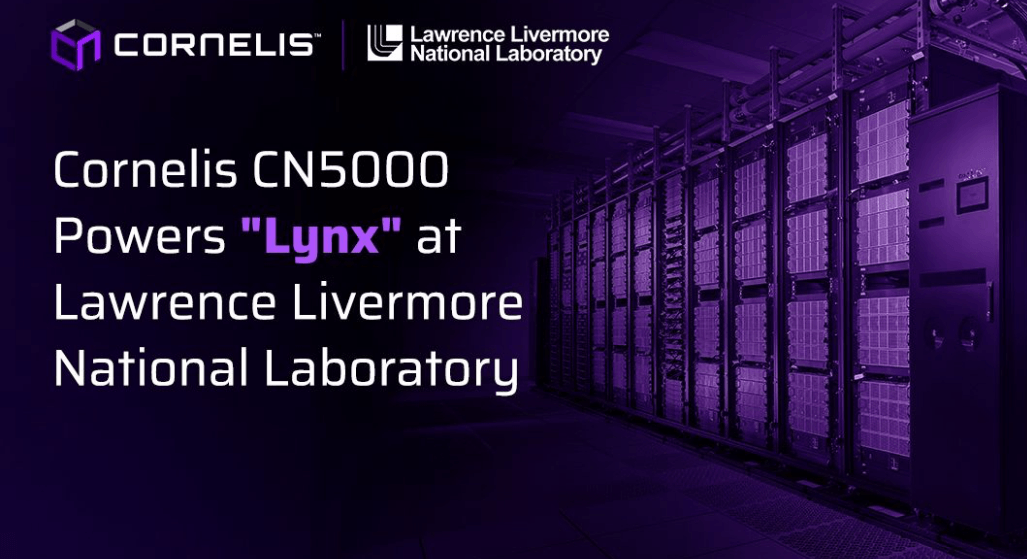
Cornelis Networks announced that its CN5000 Omni-Path 400Gbps fabric has entered production at Lawrence Livermore National Laboratory as the networking foundation for the new “Lynx” supercomputing cluster. The 952-node system, built with Dell PowerEdge servers, Intel Xeon processors, and Cornelis CN5000 networking, will support the National Nuclear Security Administration Advanced Simulation and Computing (ASC) program and broader national security missions.
Lynx is part of NNSA’s Commodity Technology Systems (CTS-2) initiative and provides additional production computing capacity for modeling, simulation, and analysis workloads that underpin stewardship of the U.S. nuclear stockpile. The system is being integrated into LLNL’s high-performance computing environment and will support mission-critical scientific and engineering applications.
At the core of the deployment is Cornelis’ CN5000 Omni-Path architecture, which provides a lossless, low-latency, congestion-free 400Gbps interconnect designed for large-scale HPC and AI workloads. The company said the deployment demonstrates that CN5000 is now production-ready for demanding government, academic, and commercial computing environments where network performance can significantly impact overall system efficiency and application scalability.
Matt Leininger, Senior Principal HPC Strategist at LLNL, said the project reflects years of collaboration between NNSA’s ASC program and Cornelis to advance next-generation high-performance computing technologies. Stephen Rinehart, Assistant Deputy Administrator for NNSA’s Office of Advanced Simulation and Computing, noted that Lynx builds on the agency’s Next-Generation High Performance Computing Network effort and strengthens the infrastructure supporting future ASC workloads.
Brad Haczynski, Chief Commercial Officer at Cornelis Networks, said the successful deployment validates CN5000 as a production-ready networking platform capable of delivering the performance and price-performance required for modern HPC and AI deployments.
🌐 We’re tracking the latest developments in AI infrastructure, supercomputing, and data center networking at Converge Digest.
🔵 Analysis
The Lynx deployment is significant because it represents one of the first major production wins for Cornelis’ CN5000 generation at a premier U.S. national laboratory. While much of the AI infrastructure market has focused on Ethernet and InfiniBand, national laboratories continue to evaluate alternative high-performance interconnect architectures that can deliver deterministic performance, low latency, and efficient scaling for tightly coupled simulation workloads.
Cornelis traces its roots to Intel’s Omni-Path business. After acquiring the technology, the company continued investing in the architecture while much of the broader industry consolidated around InfiniBand and Ethernet-based AI fabrics. CN5000 represents a major evolution of that roadmap, bringing 400Gbps performance to Omni-Path while emphasizing lossless transport, congestion management, and efficient utilization of large-scale compute clusters.
For NNSA, networking performance is particularly important because many ASC applications involve large-scale physics simulations where communication overhead can become a limiting factor. Unlike AI training clusters that may tolerate some network variability, nuclear stockpile stewardship, computational fluid dynamics, materials science, and other tightly coupled HPC applications often depend on predictable latency and high message rates across thousands of nodes.
The deployment also highlights the continued importance of traditional HPC infrastructure even as AI dominates industry investment. Facilities such as LLNL increasingly operate environments that support both simulation-centric HPC workloads and AI-driven applications. This convergence is creating opportunities for networking vendors that can demonstrate strong performance across both domains.
Commercially, Lynx provides Cornelis with a highly visible reference deployment as the company seeks broader adoption of CN5000 among government agencies, research institutions, universities, and enterprise AI infrastructure operators. A successful production deployment at LLNL carries considerable credibility within the HPC community and could help position Cornelis as a differentiated alternative in a market increasingly dominated by a small number of networking suppliers.
| Company | Cornelis Networks |
| Leadership | Lisa Spelman | CEO (Former Intel VP & GM of Xeon) |
| HQ | Wayne, Pennsylvania, USA |
| Core Focus | Intelligent, ultra-low-latency scale-out networking fabrics purpose-built for HPC and Generative AI clusters. |
| Core Tech | Omni-Path Architecture (OPA), OpenFabrics Interfaces (OFI / libfabric), and emerging Ultra Ethernet Consortium (UEC) standards. |
| Portfolio | CN5000 400Gbps Fabric: Shipping platform optimized for zero-congestion AI collectives and tightly coupled MPI simulations. CN6000 800Gbps SuperNICs & Switches: Next-gen dual-protocol silicon natively supporting RoCEv2, Ultra Ethernet, and legacy Omni-Path. |
| Metrics | ⚡ Delivers up to 1.6 Billion messages per second per port. 📉 Achieves up to 45% lower tail latency than 400G InfiniBand NDR under heavy, dynamic buffer utilization. |
| Architecture | Fine-Grained Adaptive Routing (hardware-level packet spraying), Credit-Based Flow Control (lossless transport), and link-level hardware replay for immediate error correction without end-to-end penalty. |
| Markets | AI Cloud Factories HPC / Supercomputing Federal & National Labs Tier-2 Cloud Providers |
| Deployments | 🚀 NNSA “Lynx” Cluster: Currently in production at Lawrence Livermore National Laboratory (LLNL). Spans 952 Dell PowerEdge nodes running Intel Xeon processors interconnected via the CN5000 fabric. |
| Edge | Positions itself as an open-ecosystem, non-proprietary alternative to NVIDIA InfiniBand. Actively leverages a channel-first allocation strategy, making it a critical choice for tier-2 clouds and enterprises looking to bypass hyperscaler supply bottlenecks. |
| Objective | “Deliver an independent, ultra-dense, and energy-efficient scale-out fabric roadmap that hits sub-microsecond latency boundaries across multi-thousand node AI environments.” |