• Home
  • About
  • Events Calendar
  • Blueprint Guidelines
  • Privacy Policy
  • Manage Email Delivery
  • NextGenInfra.io
  • buzzwords
  • Archives
  • Milestones
  • On This Day
  • Video Search
Converge Digest
Thursday, July 16, 2026
  • Home
  • About
  • Events Calendar
  • Blueprint Guidelines
  • Privacy Policy
  • Manage Email Delivery
  • NextGenInfra.io
  • buzzwords
  • Archives
  • Milestones
  • On This Day
  • Video Search
No Result
View All Result
Converge Digest
No Result
View All Result

Home » Starlink V3 Boosts Per-Satellite Downlink Capacity to 1 Tbps

Starlink V3 Boosts Per-Satellite Downlink Capacity to 1 Tbps

July 16, 2026
in Space Networking & Orbital Data Centers
A A
Screenshot

Screenshot

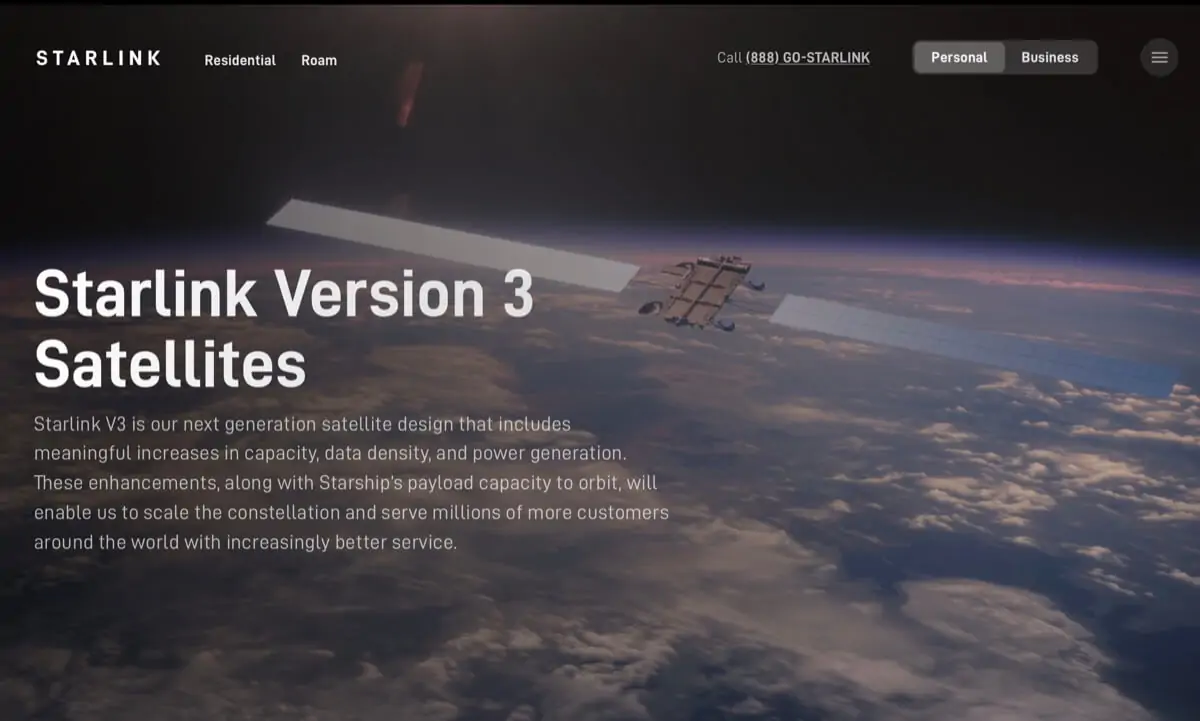
Starlink detailed updated specifications for its Version 3 satellite platform, increasing per-satellite downlink capacity to 1 Tbps and uplink capacity to 160 Gbps. The new design delivers approximately 10 times the downlink capacity and 22 times the uplink capacity of a Starlink V2 satellite while expanding the number of independently steerable communication beams.

Each V3 satellite supports 2,048 downlink beams and 2,048 uplink beams, compared with 192 downlink and 144 uplink beams on V2. SpaceX-developed beamformer chips control the phased-array antennas, while upgraded modem silicon supports approximately 64 times more throughput per chip. Starlink said this architecture will allow satellites to dynamically allocate capacity between dense metropolitan areas and sparsely populated regions.

Starlink also expanded the satellite’s backbone connectivity. Each V3 spacecraft carries six 400 Gbps optical intersatellite links, creating multiple paths through Starlink’s petabit-scale laser mesh. Four quad-band RF antennas support Ka-, E-, V- and W-band backhaul, providing up to 1.2 Tbps of aggregate RF backhaul capacity and access to 60 GHz of uplink spectrum across frequencies and polarizations.

• Per-satellite downlink capacity: 1 Tbps

• Per-satellite uplink capacity: 160 Gbps

• Downlink improvement over V2: approximately 10×

• Uplink improvement over V2: approximately 22×

• Phased-array capacity: 2,048 downlink beams and 2,048 uplink beams

• Optical intersatellite links: six 400 Gbps space lasers

• Aggregate optical interface capacity: 2.4 Tbps

• RF backhaul capacity: 1.2 Tbps across Ka-, E-, V- and W-band antennas

• Backhaul uplink spectrum: 60 GHz across frequencies and polarizations

• Modem throughput improvement: approximately 64× per chip

• Solar-array power generation: approximately twice that of V2

• Solar-array construction: four stitched 19-meter (62-foot) blanket segments

• Deployment target: approximately 20× more constellation capacity per Starship launch than a Falcon 9 launch carrying V2 satellites

• Manufacturing location: Redmond, Washington

• Related platforms: Starlink Mobile Gen 2 and the planned Starmind AI satellite constellation

“Starlink’s system is designed to scale rapidly and improve continuously,” the company stated.

🌐 Analysis: V3 shifts Starlink’s scaling model from adding large numbers of similar satellites toward sharply increasing capacity, beam count and backhaul bandwidth per spacecraft. The architecture also links satellite performance more tightly to Starship because the larger launch vehicle determines how quickly SpaceX can place this higher-capacity platform into operational orbit.

The six 400 Gbps optical links are particularly significant from a network architecture perspective. They position the optical mesh as a space-based transport layer that can route traffic around congested gateways, infrastructure outages and long terrestrial paths while supporting redundant routes between satellites.

Profile: Starlink
Parent companySpaceX
Satellite productionRedmond, Washington
LeadershipElon Musk, SpaceX CEO and Chief Engineer; Gwynne Shotwell, SpaceX President and COO
OwnershipBusiness operated by SpaceX; Starlink-specific financial results are not separately disclosed
Core networkLEO broadband Phased arrays Laser mesh
V3 user capacity1 Tbps downlink; 160 Gbps uplink
V3 beam count2,048 downlink and 2,048 uplink beams
Optical networkSix 400 Gbps intersatellite laser links per V3 satellite
RF backhaul1.2 Tbps using Ka-, E-, V- and W-band antennas
Service portfolioResidential, business, mobility, maritime, aviation, enterprise backhaul and Direct to Cell
V3 deployment modelStarship-based launch, targeting approximately 20× more capacity per launch than Falcon 9 deployments of V2 satellites
Recent Starlink Coverage on Converge Digest
May 26, 2026Starcloud Taps SpaceX Starlink Laser Links for Orbital Data Centers
May 12, 2026FCC Clears EchoStar Spectrum Sales to AT&T and SpaceX
April 8, 2026US Mobile Bundles Starlink Residential Broadband with MVNO Service
February 2026Zayo Adds Managed Starlink LEO Connectivity for Enterprise Resilience
Nov. 6, 2025BT Signs with Starlink to Deliver Satellite Broadband Across the UK
Tags: SpaceXAIStarlink
ShareTweetShareSummarizeSummarize
Previous Post

QTS Targets Gigawatt-Scale AI Expansion with New Texas Campus

Jim Carroll

Jim Carroll

Editor and Publisher, Converge! Network Digest, Optical Networks Daily - Covering the full stack of network convergence from Silicon Valley

Related Posts

Screenshot
Space Networking & Orbital Data Centers

Starlink Bonded Gateways Add 20 Gbps to Quintillion Network in Arctic

July 9, 2026
All

SpaceXAI Details Gigawatt-Scale AI Data Centers in LEO

June 8, 2026
Space Networking & Orbital Data Centers

Starcloud Taps SpaceX Starlink Laser Links for Orbital Data Centers

May 26, 2026
5G / 6G / Wi-Fi

T-Mobile Combines 5G and Starlink in “SuperBroadband” for Enterprises

April 28, 2026
5G / 6G / Wi-Fi

US Mobile Bundles Starlink Residential Broadband with MVNO Service

April 8, 2026
Space Networking & Orbital Data Centers

Zayo Adds Managed Starlink LEO Connectivity for Enterprise Resilience

February 27, 2026

Categories

  • 5G / 6G / Wi-Fi
  • AI Infrastructure
  • All
  • Automotive Networking
  • Blueprints
  • Clouds and Carriers
  • Corporate Strategies
  • CPO
  • Data Centers
  • Enterprise
  • Explainer
  • Feature
  • Hot Start-ups
  • Last Mile / Middle Mile
  • Legal / Regulatory
  • Optical
  • Optical I/O
  • Pluggable Optics
  • Quantum
  • Research
  • Security
  • Semiconductors
  • Silicon Photonics
  • Space Networking & Orbital Data Centers
  • Subsea
  • Sustainability
  • Video
  • Webinars
Converge Digest

A private dossier for networking and telecoms

Follow Us

  • Home
  • About
  • Events Calendar
  • Blueprint Guidelines
  • Privacy Policy
  • Manage Email Delivery
  • NextGenInfra.io
  • buzzwords
  • Archives
  • Milestones
  • On This Day
  • Video Search

© 2026 Converge Digest - A private dossier for networking and telecoms.

No Result
View All Result
  • Home
  • About
  • Events Calendar
  • Blueprint Guidelines
  • Privacy Policy
  • Manage Email Delivery
  • NextGenInfra.io
  • buzzwords
  • Archives
  • Milestones
  • On This Day
  • Video Search

© 2026 Converge Digest - A private dossier for networking and telecoms.

This website uses cookies. By continuing to use this website you are giving consent to cookies being used. Visit our Privacy and Cookie Policy.
Go to mobile version