The FCC approved two EchoStar spectrum transactions totaling more than $40 billion, clearing the sale of about 50 MHz of nationwide 3.45 GHz and 600 MHz spectrum to AT&T and about 65 MHz of AWS-3, AWS-4, and H-Block spectrum to SpaceX. The agency said the approvals will move underused mid-band and low-band spectrum into commercial deployment for 5G, fixed wireless, and direct-to-device satellite services.
AT&T will use the EchoStar licenses to expand 5G coverage, capacity, and fixed wireless broadband. The FCC said AT&T had already deployed EchoStar’s 3.45 GHz spectrum across nearly 23,000 cell sites under short-term leasing arrangements, with reported download speed gains of up to 80% for mobile users and 55% for fixed wireless customers.
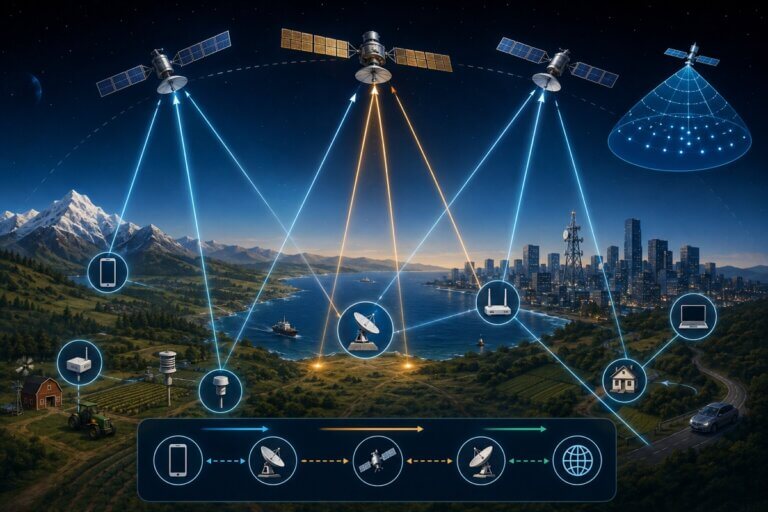
SpaceX will use the EchoStar spectrum for its next-generation Starlink direct-to-device service, giving it exclusive-use nationwide spectrum for satellite connectivity to standard smartphones and IoT devices. The FCC said the spectrum could support a move from text-oriented satellite connectivity toward mobile voice and data services, subject to buildout obligations and technical conditions.
• AT&T will acquire about 30 MHz of nationwide 3.45 GHz spectrum and about 20 MHz of nationwide 600 MHz spectrum.
• SpaceX will acquire about 15 MHz of unpaired AWS-3 spectrum, 40 MHz of AWS-4 spectrum, and 10 MHz of H-Block spectrum.
• EchoStar and AT&T will create a hybrid MNO arrangement intended to keep Boost Mobile operating with access to AT&T’s network.
• The FCC imposed buildout conditions on both AT&T and SpaceX to ensure the spectrum moves into active use.
• EchoStar must establish a $2.4 billion escrow account for qualifying claims tied to the transactions.
“Today’s approvals, coupled with other secondary-market transactions and FCC auctions already in the pipeline, put America on the path to releasing approximately 300 megahertz of low- and mid-band spectrum by the end of 2027,” said FCC Chairman Brendan Carr.
SpaceX Spectrum Acquisition from EchoStar
| Spectrum Band | Bandwidth | Frequency Range | Primary Use Case | Strategic Value |
|---|---|---|---|---|
| AWS-4 | 40 MHz nationwide | 2000-2020 MHz / 2180-2200 MHz | Direct-to-device (D2D), hybrid satellite-terrestrial services | Large contiguous block with both terrestrial and MSS allocations suitable for satellite smartphone connectivity |
| AWS-3 (Unpaired) | 15 MHz nationwide | 1695-1710 MHz | Supplemental Coverage from Space (SCS) | Adds uplink capacity and expands spectrum resources for 5G-compatible D2D services |
| H-Block | 10 MHz nationwide | 1915-1920 MHz / 1995-2000 MHz | Satellite-to-smartphone connectivity | Supports direct integration with standard mobile devices and emerging 3GPP NTN architectures |
| Total Spectrum | ~65 MHz nationwide | Multiple mid-band/mobile satellite bands | Starlink next-generation D2D network | First nationwide exclusive-use spectrum portfolio dedicated to high-capacity Starlink D2D services |
🌐 Analysis: The approvals mark a major shift in U.S. spectrum policy toward secondary-market transactions as a tool for accelerating deployment. The AT&T transaction strengthens terrestrial 5G and fixed wireless capacity, while the SpaceX transaction pushes D2D from supplemental coverage toward a more integrated satellite-terrestrial architecture.
Additional Context on the EchoStar Transactions
The agreements were originally announced on August 26, 2025, as part of EchoStar’s broader financial and operational restructuring strategy. The combined transactions exceed $40 billion in enterprise value, according to the FCC and company disclosures.
• AT&T agreed to acquire approximately 50 MHz of nationwide spectrum, including 3.45 GHz and 600 MHz assets, to strengthen its 5G and fixed wireless footprint.
• SpaceX agreed to acquire approximately 65 MHz of AWS-3, AWS-4, and H-Block spectrum to support Starlink’s emerging direct-to-device architecture.
• EchoStar said proceeds from the transactions would help retire debt obligations and fund ongoing operations.
• EchoStar also outlined plans to transition Boost Mobile toward a “hybrid MNO” model that combines its own wireless core infrastructure with wholesale terrestrial access from AT&T and future Starlink D2D connectivity.
• The FCC noted that the transactions help resolve long-running disputes surrounding EchoStar’s use of AWS-4 and related spectrum assets.
🌐 Analysis: The transactions effectively reposition EchoStar away from the capital-intensive challenge of building a nationwide standalone 5G network. Instead, the company appears to be pivoting toward a lighter infrastructure model centered on MVNO economics, hybrid satellite-terrestrial coverage, and wholesale partnerships. Meanwhile, SpaceX gains one of the largest dedicated D2D spectrum portfolios globally, accelerating competitive pressure on traditional mobile operators and satellite providers alike.
🌐 We’re tracking the latest developments in satellite and hybrid space-terrestrial networks. Follow our ongoing coverage at: https://convergedigest.com/category/space