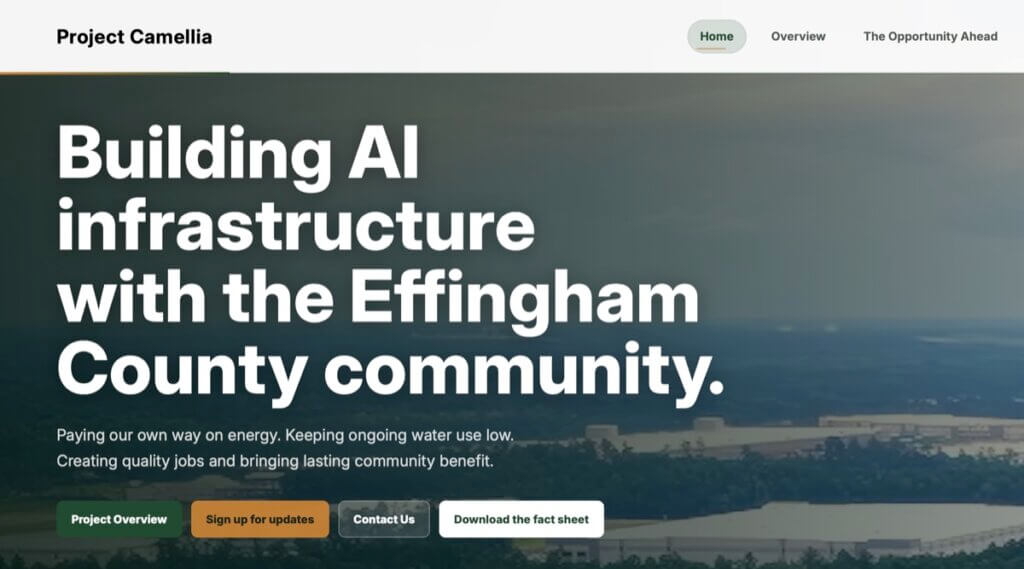
OpenAI outlined plans for Project Camellia, a proposed AI infrastructure campus in Effingham County, Georgia, centered on a data center requiring up to 3.2 gigawatts (GW) of electrical capacity supplied by Georgia Power between 2028 and 2032. The company said the project would be privately funded and designed around long-term AI computing infrastructure needed to support future frontier AI models. OpenAI stated that it will pay the full cost of the electrical infrastructure required for the project, in accordance with Georgia Public Service Commission rules, and said existing residential ratepayers will not subsidize the development.
The company emphasized several design commitments intended to address local concerns. OpenAI plans to deploy a closed-loop cooling system that recirculates water rather than continuously withdrawing fresh water, limiting ongoing water consumption primarily to normal workplace uses. The project also includes demand-response capabilities designed to reduce power consumption during periods of peak residential electricity demand to support grid reliability. OpenAI expects the campus to create thousands of construction jobs, permanent on-site positions, and hundreds of millions of dollars in state and local tax revenue over its lifetime.
OpenAI also announced an $80 million community benefits commitment covering priorities such as schools, workforce development, healthcare, housing, public safety, veterans’ services, utilities, and small business support. Separately, the company will make available up to $71 million in Codex credits for eligible Georgia college, technical school, and community college students to gain experience using OpenAI’s AI coding tools. An independent annual audit will evaluate compliance with these commitments, while feedback from local residents will help shape a formal Georgia Community Compact as development progresses. The proposed campus will be located within the Savannah Gateway Industrial Hub, an existing industrial-zoned development.
• Project Camellia targets 3.2 GW of AI computing capacity delivered in phases from 2028–2032.
• OpenAI says the project will be entirely privately funded.
• Georgia Power will provide electrical service under agreements consistent with Georgia Public Service Commission rules.
• Closed-loop cooling design aims to minimize ongoing water consumption.
• OpenAI says the facility will reduce electricity demand during periods of peak residential grid usage.
• Company commits $80 million for local community programs.
• Up to $71 million in Codex educational credits will be offered to eligible Georgia students.
• Annual independent public audits will monitor compliance with project commitments.
• The campus will be located within the Savannah Gateway Industrial Hub in Effingham County.
“We believe showing up early is the right way to build trust. Significant work remains on infrastructure, project phasing, design, financing, and operating model. As we work through these details, we intend to engage with local communities, government, workforce organizations, and our infrastructure and financing partners.”
🌐 Analysis: OpenAI is taking an unusually proactive approach to community engagement by launching Project Camellia as a public-facing initiative well before construction begins. The dedicated website, public meetings, independent audit commitment, and detailed explanations of expected impacts suggest the company is attempting to address local concerns before they evolve into organized opposition. That strategy reflects a broader trend across the AI infrastructure industry, where several large hyperscale data center projects have encountered delays or cancellations due to community concerns over electricity demand, water consumption, land use, and environmental impacts.
Based on the information presented on the Project Camellia website, OpenAI appears to recognize that water use and electricity costs will likely be the two most significant issues for local residents. Much of the company’s messaging focuses on explaining its closed-loop cooling design, its commitment to fund the required electrical infrastructure without increasing residential rates, and its plans to reduce power consumption during periods of peak grid demand. As AI campuses continue to grow into the multi-gigawatt range, community acceptance is becoming as important to project success as securing land, power, and financing.