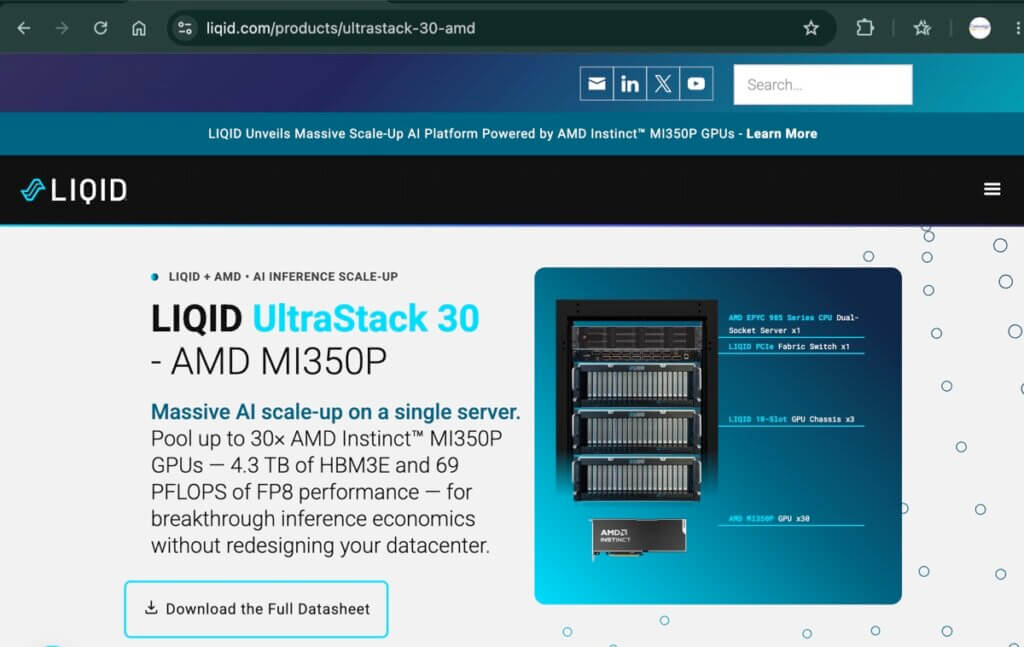
Liqid announced a new AI infrastructure platform built around AMD’s Instinct MI350P PCIe GPUs, combining its software-defined GPU pooling technology with AMD accelerators to create a scale-up system supporting up to 30 GPUs within a single server. The companies said the platform targets enterprise AI inference workloads by enabling organizations to deploy large AI models without redesigning existing PCIe-based data center infrastructure or adopting liquid cooling.
The new Liqid UltraStack 30 platform integrates dual-socket AMD EPYC 9005 Series processors with 30 AMD Instinct MI350P GPUs connected through Liqid’s GPU pooling architecture. The configuration delivers up to 69 PFLOPS of FP8 AI compute performance and aggregates approximately 4.3 TB of HBM3E memory in a single system while consuming roughly 22 kW of power. Liqid said the platform supports multiple concurrent AI models through Kubernetes integration and is designed for retrieval-augmented generation (RAG), long-context inference, enterprise AI assistants, scientific computing, and mixed-model deployments. The architecture also provides a migration path toward future CXL-based memory pooling capabilities as the ecosystem matures.
Liqid positions the platform as an alternative to proprietary scale-up AI systems by leveraging standard PCIe GPUs and software-defined resource pooling. According to the company, internal projections indicate up to 3.7× higher inference throughput measured in tokens per second, up to 2.1× more tokens per dollar, and up to 1.8× better tokens per watt than traditional server architectures. The solution is aimed at enterprise AI deployments, NeoCloud providers, research institutions, and high-performance computing environments seeking to improve GPU utilization while supporting increasingly large AI models.
| Liqid UltraStack 30 – Key Technical Specifications | |
| CPU | Dual-socket AMD EPYC 9005 Series |
| GPUs | 30× AMD Instinct MI350P PCIe |
| AI Performance | 69 PFLOPS (FP8) |
| HBM Capacity | 4.3 TB HBM3E |
| System Power | ~22 kW |
| Performance Density | ~3.14 PFLOPS/kW |
| Memory Density | ~195 GB HBM/kW |
| Software | Liqid Matrix with Kubernetes support |
| Future Roadmap | CXL memory pooling ready |
| Target Benefits* | Up to 3.7× tokens/sec, 2.1× tokens/$, 1.8× tokens/W; up to 65% lower deployment cost and 50% lower power consumption (*company projections) |
“Liqid has established itself as the leader in GPU pooling and scaling,” said Rick Hegberg, CEO of Liqid. “The AMD Instinct MI350P Series gives us the ideal PCIe-based GPU to build the next generation of AI infrastructure, allowing us to deliver solutions tuned for enterprise AI inference where utilization and cost per token decide the economics.”
🌐 Analysis
The announcement reflects growing industry interest in scale-up PCIe-based AI infrastructure that increases GPU utilization without relying exclusively on proprietary rack-scale architectures. As AI inference becomes a larger share of deployed workloads, vendors are increasingly emphasizing metrics such as tokens per dollar, tokens per watt, memory capacity, and GPU utilization rather than raw compute performance alone.
Liqid has specialized in composable infrastructure and GPU pooling for several years, while AMD continues to expand the ecosystem around its Instinct accelerator portfolio announced at Advancing AI 2026. The collaboration also aligns with broader industry efforts to prepare for future CXL-enabled memory pooling, which could allow GPU clusters to access larger shared memory pools for inference and large language model deployments.
Liqid HOT START-UP Converge Digest Startup Coverage Software-defined GPU, memory and composable infrastructure for AI data centers. Liqid develops software-defined infrastructure that enables GPUs, memory, storage and other PCIe-attached resources to be dynamically pooled, composed and orchestrated across bare-metal servers. Originally focused on composable infrastructure, the company has expanded its platform for AI infrastructure, enabling dynamic GPU pooling, CXL-ready memory expansion and resource orchestration designed to improve accelerator utilization and simplify deployment of large-scale AI training and inference environments. Its Matrix software platform allows infrastructure to be assembled programmatically rather than being constrained by fixed server architectures.
|