ChangXin Memory Technologies (CXMT) made history on July 27 with a record-setting initial public offering on Shanghai’s STAR Market, raising 57.92 billion yuan (approximately US$8.6 billion) in the largest semiconductor IPO ever completed in mainland China and the largest IPO in Asia so far this year. Trading under the ticker 688825.SH, the company priced its shares at 8.66 yuan, but investor demand drove the stock to approximately 49 yuanby the close of its first trading day, a gain of roughly 466%. The rally lifted CXMT’s market capitalization to approximately 3.3 trillion yuan (US$488 billion), briefly making it the most valuable company listed on mainland Chinese exchanges.
While the spectacular first-day gain reflected extraordinary investor enthusiasm, it was also amplified by a relatively small public float of approximately 6.73% of outstanding shares. Nevertheless, the listing represents a watershed moment for China’s semiconductor industry. For the first time, a domestic DRAM manufacturer has emerged with both the financial resources and production scale to compete globally in one of the semiconductor industry’s most capital-intensive markets.
The IPO proceeds will fund expansion of wafer manufacturing capacity, improvements in DRAM process technology, and continued research and development. According to the company’s prospectus, most of the capital will support conventional DRAM manufacturing rather than near-term development of high-bandwidth memory (HBM), underscoring CXMT’s strategy of expanding production in mainstream memory markets where demand remains strong.
Building China’s DRAM Industry
Founded in May 2016 in Hefei, Anhui Province, ChangXin Memory Technologies was created to establish an indigenous Chinese DRAM manufacturing capability after decades of dependence on foreign suppliers. The company grew from a collaboration between the Hefei municipal government, domestic investors, and a management team led by semiconductor entrepreneur Zhu Yiming, founder of GigaDevice.
The project also benefited from technical expertise originating from Germany’s former DRAM manufacturer Qimonda, including experienced engineering talent and portions of its intellectual property portfolio. Construction of CXMT’s first 300 mm fabrication facility began in 2017, followed by pilot production and commercial shipments of DDR4 and LPDDR4 memory devices. Over the following years the company steadily expanded manufacturing capacity while advancing through successive generations of proprietary DRAM process technology.
Today, CXMT operates multiple fabrication facilities centered in Hefei and has become China’s largest DRAM manufacturer. Industry analysts generally rank the company as the world’s fourth-largest DRAM supplier, behind only Samsung Electronics, SK hynix and Micron Technology.
The company’s financial performance reflects the rapid expansion. After years of heavy investment and cumulative losses associated with building a new memory manufacturer from the ground up, CXMT reported first-quarter 2026 revenue of approximately 50.8 billion yuan, representing year-over-year growth exceeding 700%, alongside a return to profitability. The company also projected first-half revenue of 110 billion to 120 billion yuan, highlighting the rapid increase in production and customer demand.
Leadership
CXMT’s founder and chairman, Zhu Yiming, studied physics at Tsinghua University before earning a graduate degree in electrical engineering at Stony Brook University in New York. After working in Silicon Valley, he returned to China and founded GigaDevice, which became one of the country’s leading flash memory design companies.
Recognizing China’s dependence on imported DRAM, Zhu partnered with the Hefei government in 2016 to launch what would become ChangXin Memory Technologies. His long-term vision centered on creating a domestic memory manufacturer capable of competing with the world’s established suppliers.
Day-to-day operations are led by Dr. Cao Kanyu (Mark Cao), the company’s president. Cao, who earned his Ph.D. at the University of California, Berkeley, has directed much of CXMT’s DRAM product development and technology roadmap since the company’s early years.
Product Portfolio
Unlike many semiconductor manufacturers, CXMT focuses exclusively on DRAM.
Its portfolio includes:
• DDR4 memory for PCs, servers and embedded systems
• LPDDR4X mobile memory
• DDR5 products for desktop, notebook and enterprise servers
• RDIMM, UDIMM, SODIMM, CUDIMM and MRDIMM server memory modules
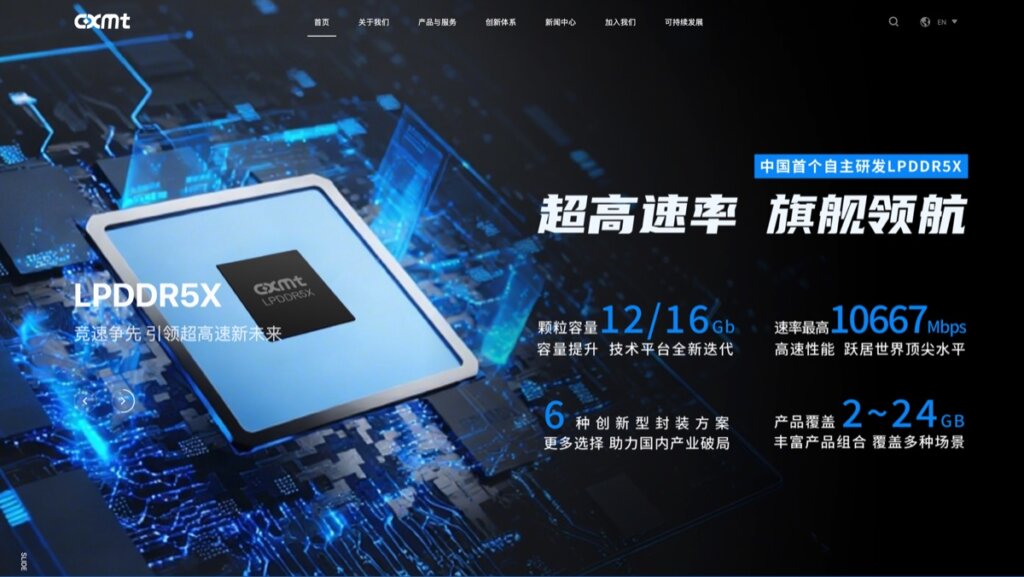
• LPDDR5 and LPDDR5X memory for smartphones, tablets and AI-enabled mobile devices
The company has steadily expanded densities and performance across successive product generations while obtaining qualification from an increasing number of system manufacturers and motherboard vendors.
Advancing Without EUV
Perhaps the company’s most significant technical achievement has been advancing DRAM manufacturing despite lacking access to extreme ultraviolet (EUV) lithography equipment, which remains unavailable because of export restrictions.
Instead, CXMT has continued shrinking process geometries using advanced deep ultraviolet (DUV) lithography combined with increasingly sophisticated multi-patterning techniques and extensive process optimization. The company has progressed through several internally developed process generations, moving from approximately 19 nm-class technology in its earliest commercial products to substantially more advanced manufacturing nodes supporting today’s DDR5 portfolio.
While Samsung, SK hynix and Micron continue introducing leading-edge DRAM using EUV lithography, CXMT has demonstrated that competitive DRAM manufacturing remains possible through alternative manufacturing approaches, albeit with greater process complexity.
A Market Opportunity Created by AI
Ironically, the explosive growth of artificial intelligence has created favorable conditions for CXMT’s expansion.
As NVIDIA’s accelerated computing platforms drove unprecedented demand for HBM, the industry’s three largest memory manufacturers redirected significant manufacturing capacity toward premium AI memory products. That shift tightened supplies of conventional DDR5 and LPDDR5 devices used in servers, PCs, networking equipment and consumer electronics.
Rather than competing directly in HBM, CXMT concentrated on expanding production of mainstream DRAM. The strategy positioned the company to benefit from improving pricing and increased demand for conventional memory products across China’s rapidly growing computing market.
China’s domestic demand for DRAM spans cloud infrastructure, enterprise servers, PCs, smartphones, automotive electronics and industrial systems, providing CXMT with a substantial home market as it continues expanding production.
Government Support
CXMT represents one of the most significant outcomes of China’s long-term semiconductor self-sufficiency strategy.
The Hefei municipal government played a central role in financing the company’s formation through what has become known as the “Hefei model”—using government investment to establish strategically important technology companies while attracting additional industrial and financial partners.
The company has also received investment from the China Integrated Circuit Industry Investment Fund (“Big Fund”), along with numerous provincial and state-backed investment organizations. Over the years, government support has included equity investment, infrastructure development, financing assistance and various industrial incentives.
According to the IPO prospectus, no single shareholder exercises controlling ownership of the company.
Competitive Landscape
The global DRAM market has historically been one of the semiconductor industry’s most concentrated sectors. Samsung Electronics, SK hynix and Micron Technology collectively account for well over 90% of worldwide DRAM production.
CXMT has emerged as the industry’s fourth major supplier, fundamentally changing that landscape.
Its continued growth, however, will depend on several factors:
• Advancing process technology despite continued export-control restrictions
• Improving manufacturing yields and production costs
• Expanding production capacity
• Broadening customer qualification outside China where possible
• Continuing development toward future generations of DRAM technology
While geopolitical restrictions remain a significant challenge, the company’s successful IPO provides both capital and visibility as it enters its next phase of growth.
🌐 Analysis
CXMT’s IPO represents considerably more than a successful stock market debut. It marks the emergence of the first new large-scale DRAM manufacturer in decades capable of competing alongside Samsung Electronics, SK hynix and Micron Technology. Building a merchant DRAM business requires enormous investments in fabrication facilities, manufacturing know-how, process technology and supply-chain development. Few companies have attempted it successfully, making CXMT’s rise one of the semiconductor industry’s most significant developments of the past decade.
The timing is equally notable. Rather than challenging incumbent suppliers directly in the fast-growing HBM market, CXMT has expanded aggressively in conventional DDR5 and LPDDR memory while the industry’s established leaders shifted increasing manufacturing capacity toward AI accelerators. That strategic focus allowed the company to capture demand across servers, PCs, mobile devices and enterprise infrastructure during a period of tightening supply for mainstream DRAM.
Export controls continue to define the company’s technology roadmap. Without access to EUV lithography systems, CXMT has relied on increasingly sophisticated DUV multi-patterning techniques and process innovation to continue shrinking feature sizes. Although that approach carries higher manufacturing complexity than EUV-based production, the company has demonstrated that meaningful progress remains possible despite technology restrictions.
For the broader AI infrastructure ecosystem, the emergence of a scaled fourth DRAM supplier introduces an important new variable into long-term supply planning. Memory has become one of the most strategic components in modern computing—from hyperscale data centers to AI servers and networking platforms. Whether CXMT can continue narrowing the technology gap with established industry leaders will depend on sustained execution, continued capital investment and its ability to navigate an increasingly complex geopolitical environment.
| ChangXin Memory Technologies (CXMT) | |
| Ticker | 688825.SH (STAR Market) |
| Market Cap | ≈3.3 trillion yuan (≈US$488 billion) after first trading day |
| Headquarters | Hefei, Anhui Province, China |
| Founded | May 2016 |
| Founder & Chairman | Zhu Yiming |
| President | Dr. Cao Kanyu (Mark Cao) |
| Core Technology | Merchant DRAM manufacturing using advanced DUV multi-patterning lithography |
| Products | DDR4, DDR5, LPDDR4X, LPDDR5, LPDDR5X, RDIMM, UDIMM, MRDIMM, CUDIMM, SODIMM |
| Industry Position | China’s largest DRAM producer; generally ranked as the world’s fourth-largest supplier |
| Technology Challenge | Advancing DRAM process nodes without access to EUV lithography |
| IPO | 57.92 billion yuan (US$8.6 billion), July 2026 |
| Strategic Significance | China’s first globally scaled merchant DRAM manufacturer and a key pillar of the country’s semiconductor self-sufficiency strategy. |