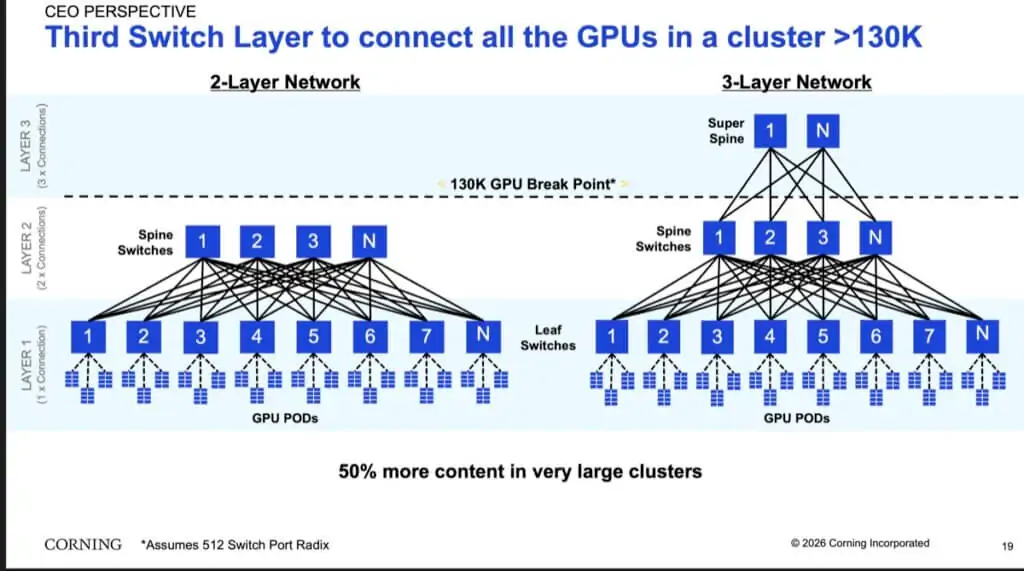
Corning Chairman and CEO Wendell Weeks outlined a photonics roadmap that could expand the company’s role in AI infrastructure from supplying data center fiber and connectivity to delivering passive optical components inside switches and accelerator systems. During Corning’s second-quarter 2026 investor call, Weeks described three drivers that could allow optical content to grow faster than GPU deployments: larger clusters requiring additional switching layers, rising GPU and switch-ASIC bandwidth, and the introduction of optical links into scale-up networks. Corning estimates that these forces could increase optical content per GPU by 1.3x to 1.5x by 2028, with substantially greater potential approaching 2030.
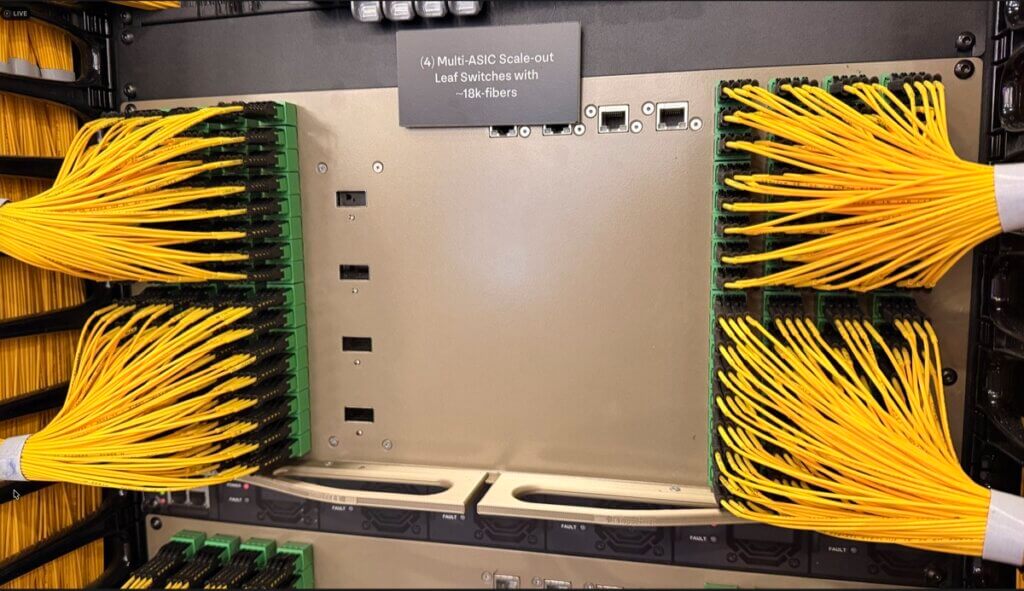
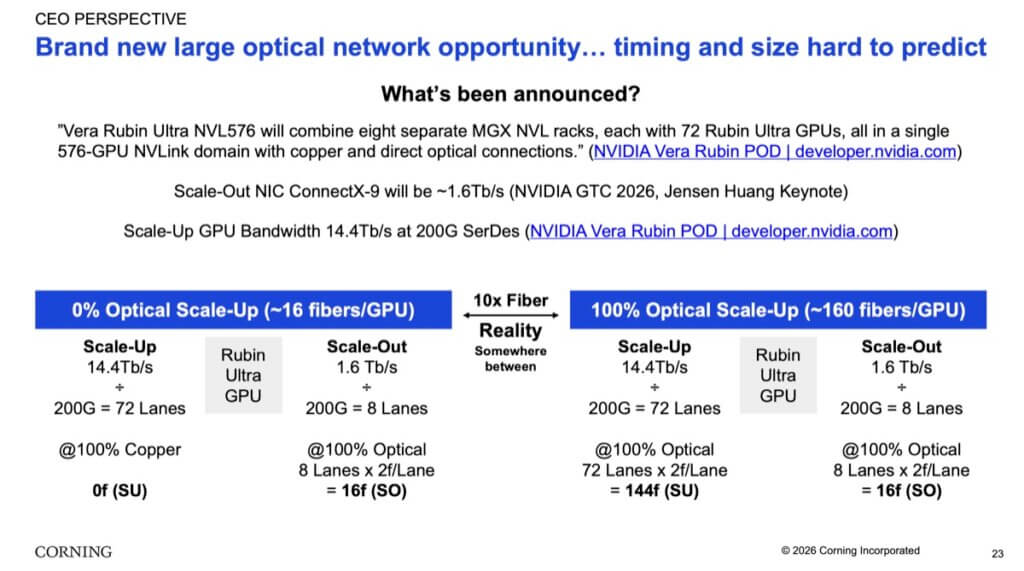
Corning used NVIDIA’s announced Vera Rubin Ultra NVL576 architecture to bracket the possible scale-up opportunity. The configuration connects eight 72-GPU racks into a 576-GPU NVLink domain using a hybrid of copper and direct optical connections. Corning’s model starts with 14.4 Tbps of scale-up bandwidth and 1.6 Tbps of scale-out bandwidth per GPU, both using 200G SerDes lanes. A system retaining copper throughout the scale-up network would require approximately 16 fibers per GPU for scale-out. A theoretical fully optical implementation would require 144 fibers for scale-up and 16 for scale-out, producing a total of 160 fibers per GPU—10 times the current scale-out-only requirement. Weeks emphasized that actual deployments will fall between those endpoints because NVIDIA has not publicly disclosed the percentage of scale-up ports that will use optics.
The second part of Corning’s roadmap moves beyond cabling between systems and brings the company’s optical technology “inside the box.” Corning expects co-packaged optics and near-package optics to move light generation, modulation and encoded-signal delivery closer to silicon photonic engines. The company sees an opportunity to supply fiber-array units, polarization-maintaining fiber and other passive photonic components that route and manage light between external laser sources, photonic integrated circuits and switch ASICs. Based on its assumptions and customer discussions, Corning believes this new Photonics Market-Access Platform could become a $10 billion revenue stream by 2030. Corning said co-packaged and near-package optics will probably appear first in scale-out systems, but optical scale-up could drive the larger long-term content opportunity.
• Corning identified three optical-growth drivers: larger clusters, bandwidth growth and optical scale-up.
• GPU clusters exceeding approximately 130,000 accelerators could require a third switching layer.
• Corning estimates the additional layer could increase optical content in very large clusters by approximately 50%.
• GPU and switch-ASIC bandwidth are expected to double roughly every two years.
• Vera Rubin Ultra NVL576 combines eight 72-GPU racks within one NVLink domain.
• Announced bandwidth figures include 14.4 Tbps of scale-up bandwidth and 1.6 Tbps of scale-out bandwidth per GPU.
• Corning’s lower-bound scenario retains copper for scale-up and uses approximately 16 fibers per GPU for scale-out.
• Its theoretical fully optical scenario requires approximately 160 fibers per GPU across scale-up and scale-out.
• The fully optical scenario represents 10 times the fiber content of the scale-out-only configuration.
• Corning expects real deployments to use a hybrid of copper and optical connectivity.
• Optical content per GPU could increase 1.3x to 1.5x by 2028 under Corning’s current assumptions.
• The Photonics Market-Access Platform targets co-packaged and near-package optical systems.
• Potential Corning components include fiber-array units, polarization-maintaining fiber and passive optical routing assemblies.
• Corning sees a potential $10 billion Photonics Market-Access Platform by 2030.
• The company cautioned that timing depends on optical-port penetration and adoption of optical scale-up systems in AI factories.
“What we know for sure is neither of those cases will be the hybrid system that was just announced. It will be somewhere in between,” Weeks said. “To be exact on the opportunity, we would need to both know the percent of optical ports in the offering and to know to what extent these new hybrid optical scale-up nodes penetrate AI factories.”
See the Corning investor relations page for Q2 2026 presentation and archived webcast