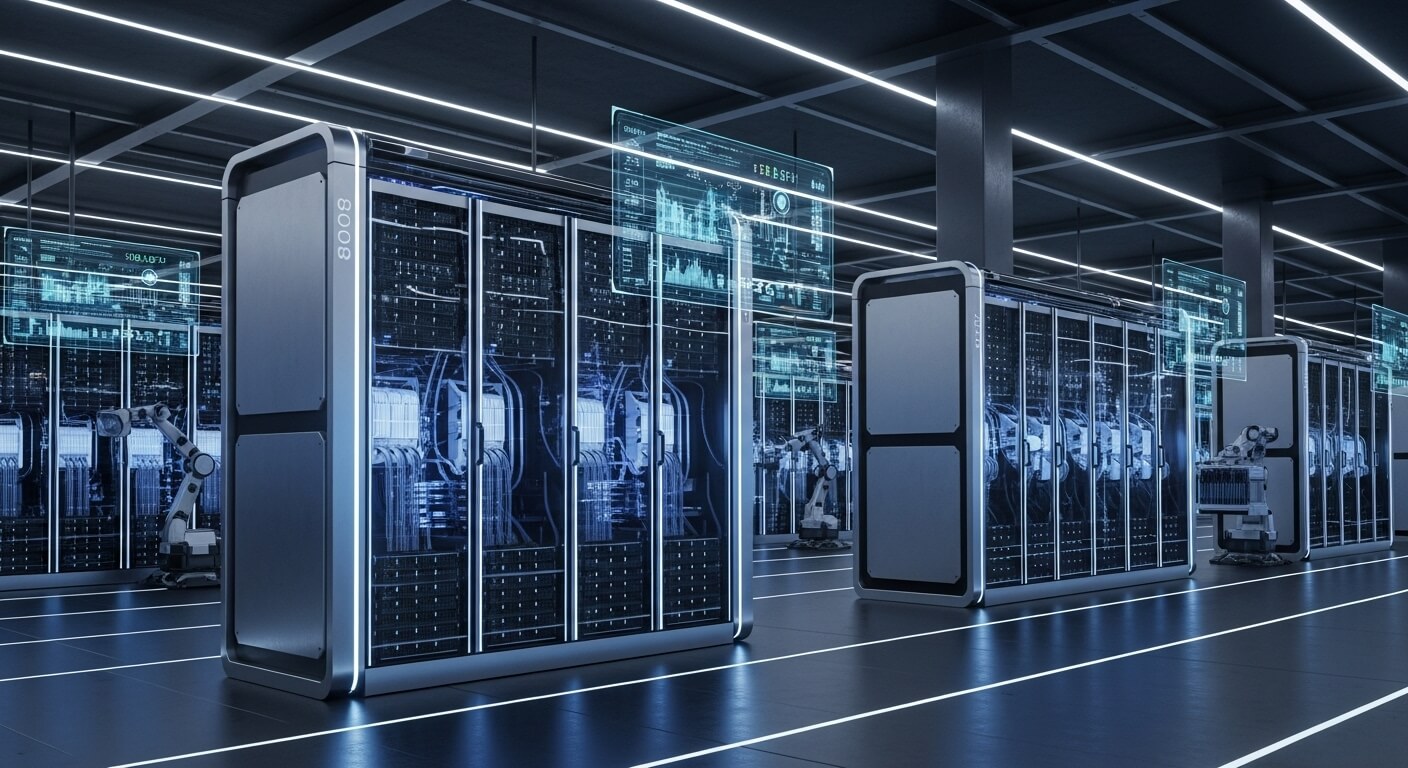
Adani Group and Jabil announced plans to form a strategic alliance aimed at creating a vertically integrated manufacturing platform for AI and data center infrastructure in India. The initiative would combine Adani’s infrastructure, energy, logistics, and data center assets with Jabil’s engineering and manufacturing expertise to support the growing demand for AI-ready data center hardware worldwide.
The proposed platform would focus on large-scale production of liquid-cooled AI racks, servers, storage systems, and networking equipment for hyperscalers, colocation providers, and enterprise data center operators. The companies said they intend to establish multi-gigawatt manufacturing capacity in India while also producing supporting infrastructure such as Power Distribution Units (PDUs), Coolant Distribution Units (CDUs), transformers, switchgear, bus bars, and thermal management systems. The goal is to provide a comprehensive hardware ecosystem spanning both white-space and gray-space data center infrastructure.
The announcement comes as India accelerates investments in AI infrastructure, cloud services, and domestic data center capacity. Adani cited its previously announced commitment to develop 5 GW of green-energy-powered, AI-ready data centers by 2035, while Jabil highlighted its experience supporting hyperscale deployments and recent acquisitions in power and thermal management technologies. The companies said they are currently working toward definitive agreements and operational frameworks for the alliance.
• Proposed manufacturing scope includes liquid-cooled AI racks, servers, storage, and networking platforms.
• Platform would also manufacture power distribution, cooling, and electrical infrastructure components.
• Target customers include hyperscalers, colocation operators, and enterprise data center providers.
• Adani has committed to developing 5 GW of AI-ready data center capacity powered by renewable energy.
• Jabil reported fiscal 2025 revenue of approximately $29.8 billion and recently expanded its power and thermal management capabilities through acquisitions.
“The world is entering an Intelligence Revolution more profound than any previous Industrial Revolution. Nations that master the symmetry between energy and compute will shape the next decade,” said Gautam Adani, Chairman of Adani Group.
🌐 Analysis
This announcement is notable because it extends beyond data center construction into the manufacturing supply chain that supports AI infrastructure. Most countries seeking a role in the AI economy focus on deploying compute capacity, while the Adani-Jabil initiative targets domestic production of AI racks, power systems, cooling equipment, and networking infrastructure. If executed, the platform could position India as a manufacturing base for AI infrastructure exports in addition to serving local demand.
The proposal also reflects growing industry emphasis on vertically integrated AI infrastructure. Hyperscalers increasingly require tightly coupled solutions spanning power delivery, liquid cooling, rack integration, networking, and compute. Jabil has expanded its capabilities in these areas through acquisitions such as Hanley Energy and Mikros Technologies, while Adani controls substantial energy, logistics, and data center assets. The combination mirrors broader efforts by companies including NVIDIA, Vertiv, Schneider Electric, Eaton, and Flex to offer more integrated AI infrastructure solutions as data center deployments scale globally.
| Company Profile: Jabil | |
|---|---|
| Headquarters | St. Petersburg, Florida, USA |
| CEO | Mike Dastoor |
| Founded | 1966 |
| FY2025 Revenue | $29.8 billion |
| Core Expertise | Advanced manufacturing, engineering services, supply chain management, electronics manufacturing services (EMS) |
| AI Infrastructure Focus | AI rack integration, liquid cooling systems, power infrastructure, server manufacturing, networking systems |
| Recent Acquisitions | Hanley Energy Group, Mikros Technologies |
| Key Markets | AI InfrastructureCloudNetworkingIndustrialHealthcare |
| Global Footprint | More than 100 manufacturing and engineering sites worldwide |