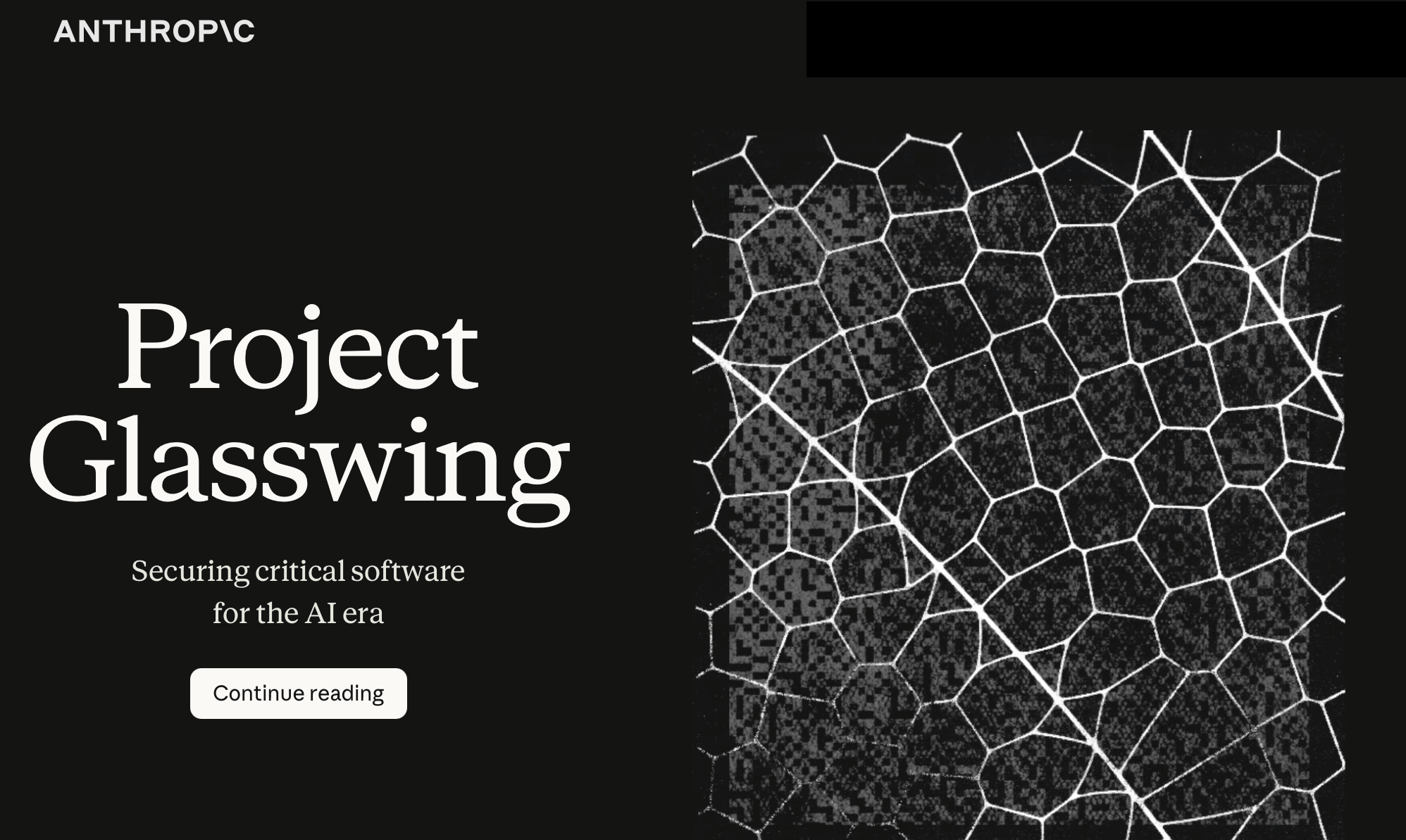
Anthropic unveiled Project Glasswing, a broad industry initiative bringing together major technology and security leaders—including Amazon Web Services, Microsoft, Google, NVIDIA, Cisco, Broadcom, Apple, CrowdStrike, Palo Alto Networks, JPMorganChase, and the Linux Foundation—to address a rapidly emerging class of AI-driven cybersecurity risks. The effort is anchored around Anthropic’s unreleased frontier model, Claude Mythos Preview, which demonstrates advanced capabilities in identifying and exploiting software vulnerabilities at a level approaching or exceeding top human experts.
The initiative reflects a growing concern across the industry: AI systems are now capable of autonomously discovering critical software flaws, including zero-day vulnerabilities embedded in widely deployed infrastructure. Anthropic reports that Mythos Preview has already identified thousands of high-severity issues across major operating systems, web browsers, and foundational software stacks—some of which persisted undetected for decades despite extensive testing and review.
Project Glasswing aims to shift these capabilities decisively toward defense. Participating organizations will deploy the model across internal codebases, open-source projects, and critical infrastructure systems to proactively identify and remediate vulnerabilities. Anthropic is committing up to $100 million in usage credits for the initiative, along with $4 million in direct funding to open-source security efforts, including contributions to the Apache Software Foundation and Linux Foundation–backed projects.
Key Points
- Coalition includes leading hyperscalers, semiconductor vendors, financial institutions, and cybersecurity firms
- Claude Mythos Preview demonstrates autonomous vulnerability discovery and exploit generation
- Thousands of zero-day vulnerabilities identified, including in Linux kernel, FFmpeg, and OpenBSD
- Anthropic commits $100M in credits and $4M in open-source security funding
- Model significantly outperforms prior systems on benchmarks such as CyberGym (83.1% vs. 66.6%)
- Initiative focuses on defensive use cases: vulnerability detection, penetration testing, and secure development
- Public report on findings and best practices expected within 90 days
Claude Mythos Preview has already surfaced notable vulnerabilities, including a 27-year-old flaw in OpenBSD that could enable remote system crashes, a long-standing bug in FFmpeg undetected after millions of automated test executions, and chained exploits in the Linux kernel that allowed privilege escalation to full system control. Many of these vulnerabilities have now been disclosed and patched in coordination with maintainers.
“Our foundational work with these models has shown we can identify and fix security vulnerabilities across hardware and software at a pace and scale previously impossible. That is a profound shift, and a clear signal that the old ways of hardening systems are no longer sufficient,” said Anthony Grieco, SVP & Chief Security & Trust Officer at Cisco.
Participating organizations report early success applying Mythos Preview to real-world environments. AWS is integrating the model into security operations across critical codebases, while Microsoft validated improvements using its CTI-REALM benchmark. CrowdStrike and Palo Alto Networks highlighted the shrinking window between vulnerability discovery and exploitation—from months to minutes—underscoring the urgency of deploying AI defensively.
The initiative also expands access to more than 40 additional organizations responsible for maintaining critical software infrastructure, with a particular emphasis on open-source ecosystems that underpin much of the global technology stack.
https://www.anthropic.com/glasswing
Analysis
🌐 Project Glasswing marks a structural shift in cybersecurity—from reactive patching toward AI-driven, continuous vulnerability discovery at scale. The key inflection point is not just improved tooling, but the asymmetry introduced by frontier models: the same capabilities that empower defenders can dramatically accelerate attackers.
For infrastructure operators and hyperscalers, this reinforces the need to integrate AI-native security into the software development lifecycle, rather than treating security as a post-deployment function. The emphasis on open-source ecosystems is particularly notable, given their outsized role in modern supply chains and their historical under-resourcing in security.
From an industry standpoint, Glasswing resembles an early-stage “defensive consortium” model—similar in spirit to coordinated vulnerability disclosure frameworks, but scaled for the AI era. The involvement of major cloud platforms (AWS, Google Cloud, Microsoft Azure) also signals where these capabilities will ultimately be operationalized: embedded directly into developer workflows and cloud-native security platforms.
The unresolved issue is governance. Anthropic explicitly points to the potential need for an independent, third-party body to coordinate long-term efforts. As frontier models continue to improve, the balance between accessibility, safety, and national security considerations will become increasingly central—especially as governments begin to formalize policy responses to AI-driven cyber capabilities.