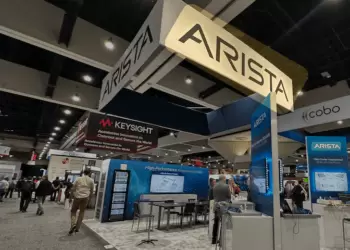

Arista Networks introduced a family of multi-function leaf and spine platforms powered by Barefoot Networks’ Tofino series of P4-programmable Ethernet switch chips.
 The new Arista 7170 Series switches, which run the Arista EOS (Extensible Operating System) SDK, can boost server performance by offloading Hypervisor vSwitch networking functions such as tunnel termination, security policy enforcement and address translation onto the leaf switch, allowing more work to be accomplished by the compute pool, saving equipment costs and lowering power and cooling.
The 7170 Series is available in two configurations to address both leaf and spine roles:
- The 2U 7170-64C supports up to 64 ports of 100G or 12.8Tbps, with up to 5Bpps of packet forwarding and a fully shared packet buffer.
- The 7170-32C is a compact 1U with 32 ports of 100G and the same range of profiles.
The 7170 Series is available now, with a choice of EOS Profiles. Additional profiles will be released over time, with the security and telemetry profiles planned for August 2018. Pricing starts at $1200/100G port for the 64 x 100G system.
“With the Arista 7170 Series and EOS we are able to offer new and interesting features that leverage the flexible pipeline of the 7170 Series. At the same time, we took advantage of the programmability to increase the scale of many existing features for tunnel encapsulation, filtering, traffic analysis and address translation,” said Hugh Holbrook, Vice President, Software Engineering for Arista Networks.
“With Tofino, Barefoot has proven that programmability can be delivered without compromise on performance and I believe that future switch chips will be fully programmable – there is no reason not to. It allows protocols to be lifted up and out of hardware into software. Arista’s first Tofino based platforms do exactly that, using P4 to deliver customized profiles to their customers. Programmable switches take differentiation in the market to a whole new level. This is going to get interesting.” said Nick McKeown, Chief Scientist and Co-Founder at Barefoot Networks.
Alibaba, AT&T, Baidu, Tencent adopt Barefoot forwarding plane
Barefoot Networks, a provider of advanced, high speed switching technology, announced significant market momentum driven by growing demand for its programmable forwarding plane technology.
Barefoot’s 6.5 Tbit/s Tofino switch, which is claimed to be the fastest and P4-programmable switch chip, has been sampling to customers since the fourth quarter of 2016. The company noted that its technology is being adopted by large enterprises and telecommunications providers to increase network performance and efficiency through leveraging programmable forwarding plane technology.
Barefoot stated that it has recently worked with AT&T and SnapRoute to deliver what it believes is the first real-time path and latency visualisation. Utilising Tofino and In-band Network Telemetry (INT), AT&T was able to gain deep insight into the network down to packet-level for the first time to help to address bottlenecks caused by path or latency variation.
Barefoot noted it took 6 weeks to develop the visualisation capability before it was deployed into AT&T’s production environment carrying live customer traffic over a Washington DC to San Francisco link.
 In addition, major Internet companies Alibaba, Baidu and Tencent have used Tofino and P4 to address challenges in their networks. Barefoot noted that the demands of mega-scale data centres are growing to support new applications and services, while legacy fixed-function switching technology is not sufficiently flexible and so they are using Barefoot to develop custom forwarding planes. The companies are therefore able to adopt load balancing, DDoS protection and INT features without affecting performance.
Barefoot has also expanded its ecosystem via partnerships with equipment manufacturers based in Asia. To date, the company has announced go-to-market partnerships with Edgecore Networks, WNC, H3C, Ruijie and ZTE. These partnerships are designed to enable Barefoot to meet growing demand for programmable networking across a range of network environments.
- Barefoot Networks, based in Palo Alto, California, exited stealth and unveiled its user-programmable Tofino switch chip in June 2016. Founded in 2013, Barefoot is backed by investors including Andreessen Horowitz, Lightspeed Venture Partners and Sequoia Capital. The company has raised approximately $155 million in five funding rounds, most recently raising $23 million in November 2016 in a round led by Alibaba and Tencent.