Cisco Outlines AI Is Strategy as AI Moves into Production
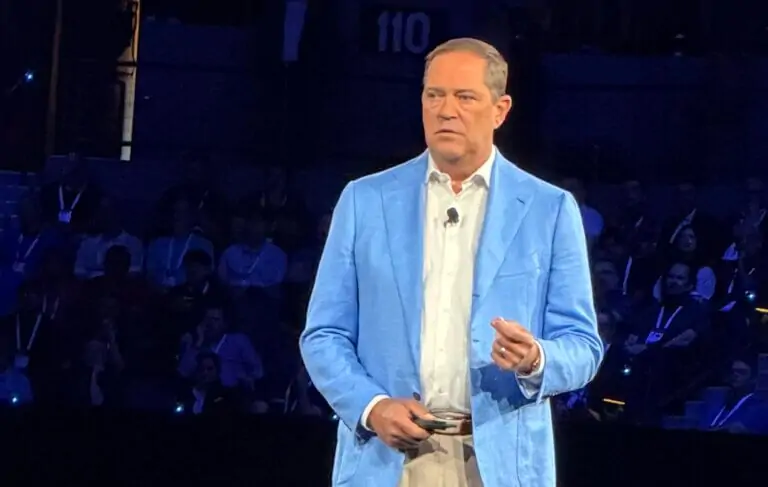
Cisco used its AI Summit to frame what it sees as the next phase of artificial intelligence, as enterprises shift from experimentation toward large-scale production deployments. Speaking at the event, Jeetu Patel, Cisco’s President and Chief Product Officer, said AI adoption is accelerating beyond chatbots and generative interfaces toward agentic systems, distributed inference, and physical AI, placing new demands on infrastructure, security, and operations.
Patel outlined three structural constraints shaping AI deployment today. The first is infrastructure, driven by shortages in power, compute, network bandwidth, memory, and data center capacity. He said Cisco is investing billions to expand its role in AI infrastructure, starting with networking silicon and extending through systems, optics, and software. The second constraint is trust, which Patel described as a prerequisite for AI adoption rather than a tradeoff with productivity. He argued that organizations will not deploy AI systems they do not trust, making security foundational to AI deployment. The third constraint is a data gap, as publicly available human-generated training data plateaus and synthetic and machine-generated data grow rapidly, particularly as AI agents operate continuously.
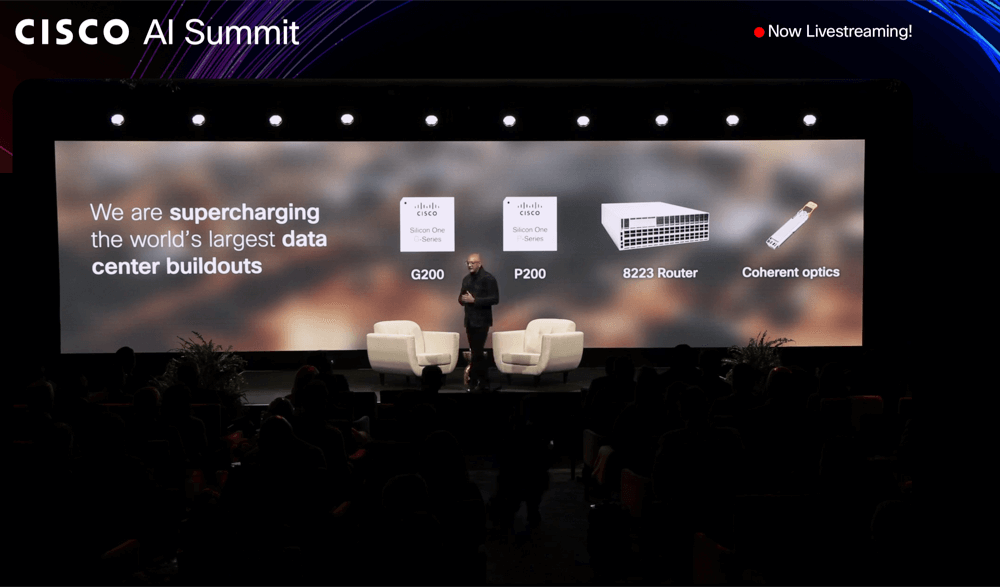
Cisco positioned itself as a full-stack supplier for AI infrastructure, spanning data center, wide-area, and edge environments. Patel highlighted Cisco’s Silicon One roadmap, including the G200 chip for scale-out AI clusters within data centers and a newer architecture designed to interconnect AI data centers across long distances. He said Cisco’s B200 silicon and the Cisco 8223 router target “scale-across” AI architectures, enabling clusters distributed over hundreds of kilometers to operate coherently. Patel also emphasized the growing role of coherent optics as copper approaches physical limits. Beyond the data center, Cisco is extending AI inference to the enterprise edge, enabling latency-sensitive workloads to run closer to users rather than relying solely on centralized infrastructure.
- Cisco sees 2026 as a transition year from AI experimentation to production, particularly for agentic AI applications
- The company identifies three adoption constraints: infrastructure capacity, trust and security, and training data availability
- Silicon One G200 targets scale-out AI networking inside data centers
- Cisco’s B200 silicon and 8223 router target distributed “scale-across” AI clusters spanning multiple sites
- Cisco is expanding AI inference to the enterprise edge to support low-latency use cases
- AI security is positioned as foundational, not optional, for enterprise adoption
- Cisco is developing agent-based operations to reduce complexity and automate remediation across AI infrastructure
“We’re starting to see companies like CBS and NEC deploy AI Defense to secure AI itself, not just use AI for cyber defense,” Patel said.