Cisco reported record fiscal Q3 2026 revenue of $15.8 billion, up 12% year over year, as product demand accelerated across networking, campus refresh, data center switching, and hyperscale AI infrastructure. GAAP EPS rose 37% to $0.85, while non-GAAP EPS increased 10% to $1.06. Product revenue grew 17%, led by Networking revenue of $8.8 billion, up 25%.
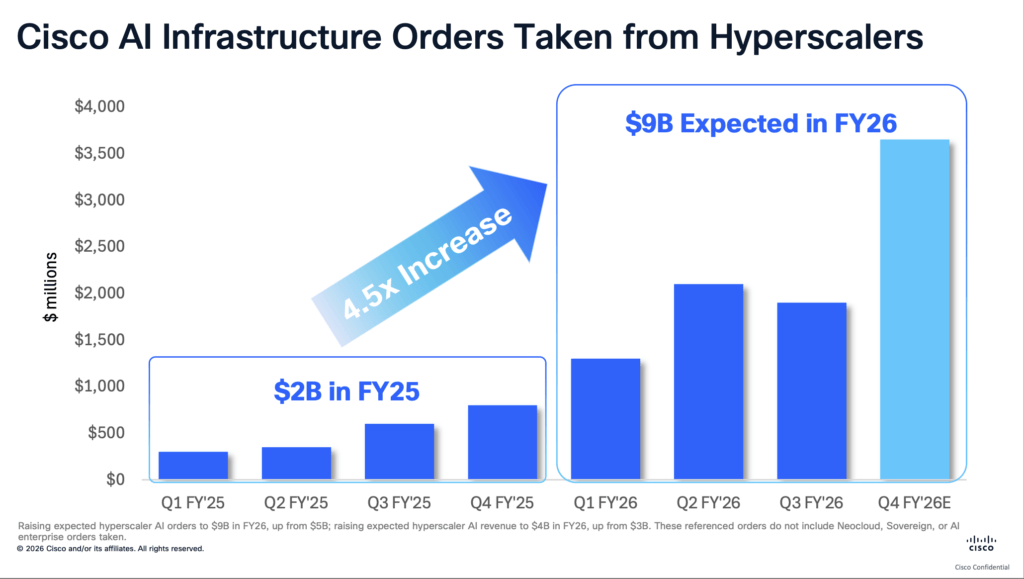
Cisco said total product orders rose 35% year over year, or 19% excluding hyperscalers. Networking product orders grew more than 50%, campus networking orders increased more than 25%, and data center switching orders rose more than 40%. The company also raised its AI infrastructure outlook, citing $5.3 billion of hyperscaler orders year to date and lifting expected FY26 AI infrastructure orders to $9 billion, up from its prior $5 billion forecast. Cisco also raised expected FY26 AI infrastructure revenue to $4 billion, up from $3 billion.
For Q4 FY26, Cisco guided revenue of $16.7 billion to $16.9 billion and non-GAAP EPS of $1.16 to $1.18. For full-year FY26, Cisco now expects revenue of $62.8 billion to $63.0 billion and non-GAAP EPS of $4.27 to $4.29. The company also disclosed a restructuring plan tied to investment priorities including silicon, optics, security, and AI, with pre-tax charges of up to $1 billion expected across Q4 FY26 and FY27.
• Q3 FY26 revenue: $15.8 billion, up 12% year over year
• GAAP net income: $3.4 billion, up 35%
• GAAP EPS: $0.85, up 37%
• Non-GAAP net income: $4.2 billion, up 10%
• Non-GAAP EPS: $1.06, up 10%
• Product revenue: $12.1 billion, up 17%
• Services revenue: $3.7 billion, down 1%
• Networking revenue: $8.8 billion, up 25%
• Security revenue: $2.0 billion, flat year over year
• Collaboration revenue: $1.0 billion, down 1%
• Observability revenue: $269 million, up 3%
• Total product orders: up 35%; up 19% excluding hyperscalers
• Networking product orders: up more than 50%
• Campus networking orders: up more than 25%
• Data center switching orders: up more than 40%
• Hyperscaler AI infrastructure orders: $5.3 billion year to date
• FY26 AI infrastructure order outlook: raised to $9 billion
• FY26 AI infrastructure revenue outlook: raised to $4 billion
• Quarterly dividend: $0.42 per common share, payable July 22, 2026
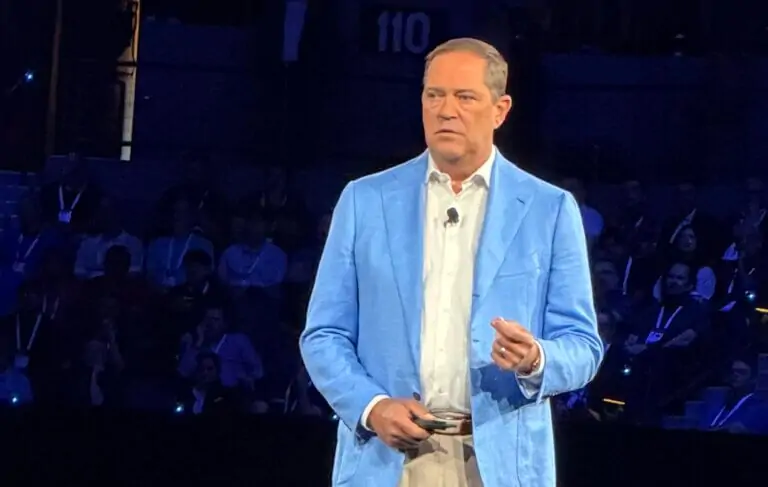
“Cisco delivered record quarterly revenue in Q3 and we saw very strong, broad-based demand for our products, demonstrating the relevance of our technology for connecting and securing AI,” said Chuck Robbins, chair and CEO of Cisco. “Cisco is well-positioned as the critical infrastructure for the AI era, building on our technology leadership and customer trust, while innovating at the speed and scale that our dynamic world demands.”
Summary of Key Points from Cisco’s Investor Call
• Cisco announced a restructuring plan tied to faster investment in silicon, optics, security, and AI. Management said the plan is “not savings driven,” but a resource realignment from a position of strength. Cisco expects up to $1 billion in pre-tax charges, including about $450 million in Q4 FY26 and the remainder in FY27.
• Management said AI infrastructure growth should continue into FY27. CFO Mark Patterson said Cisco could recognize at least $6 billion of AI hyperscale revenue in FY27, compared with about $4 billion expected in FY26.
• Cisco said Silicon One gives it more control over the AI infrastructure supply chain, including wafers, substrates, assembly, and test. Management said silicon supply is secured through calendar 2026, with negotiations underway for 2027.
• Cisco said it saw no meaningful order cancellations or “decommissions” during the quarter, despite tighter supply conditions across parts of the industry.
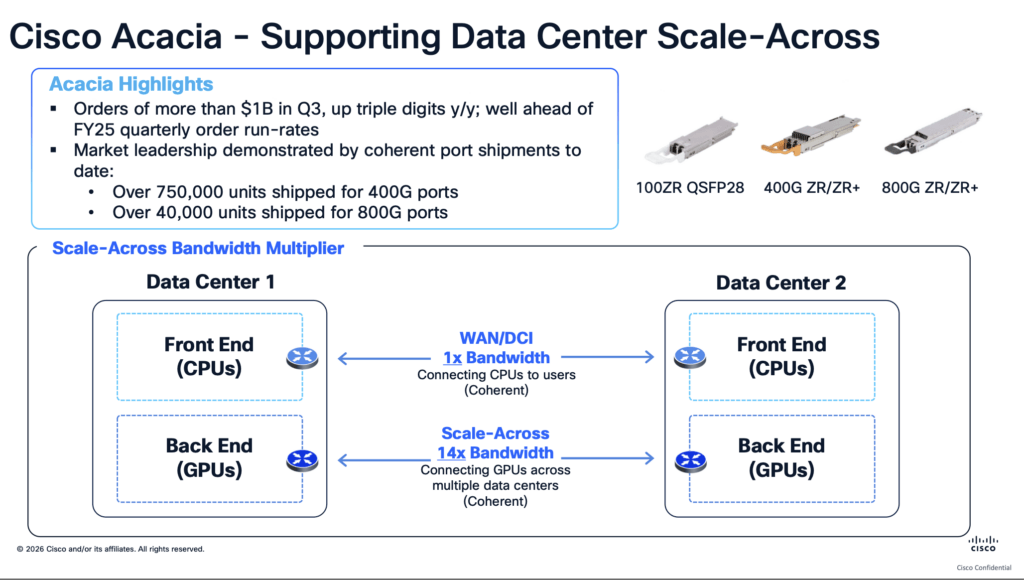
• Acacia optics emerged as one of the strongest demand signals. Cisco said Acacia booked more than $1 billion in Q3 orders and is on track to grow more than 200% year over year in FY26.
• Cisco disclosed five new hyperscaler design wins in Q3: two in optics and three in systems. The systems wins included the first two for its Silicon One P200-powered system for scale-across applications and one Silicon One G200-powered system for scale-out.
• Cisco said it won a third hyperscaler P200 scale-across design win early in Q4. Management said scale-across revenue is not yet material and should begin contributing more meaningfully in FY27.
• AI orders from neocloud, sovereign cloud, and enterprise customers totaled about $300 million in Q3 and approximately $900 million year to date. Cisco said the pipeline for high-performance AI infrastructure across those customers is about $3 billion.
• Enterprise AI demand appears to be moving from planning into network upgrades. Cisco said Nexus switch orders tagged for AI deployments rose almost 50% sequentially in Q3.
• Management pushed back on concerns that enterprise demand was mainly pull-forward activity. Cisco said some pull-forward likely occurred, but described it as modest, citing healthy Q4 pipeline trends and limited evidence of abnormal early ordering.
• Price increases contributed about 4 to 5 percentage points to non-webscale order growth. Cisco said the increases apply to hardware, not software, and target areas with higher memory exposure.
• Memory remains a margin headwind, but Cisco said gross margins have stabilized. The company cited more than 20 memory-reduction programs, DDR4-to-DDR5 conversion work, tighter quote windows, price increases, and strategic inventory commitments.
• Cisco said inventory and advance purchase commitments increased $6.7 billion in the past 90 days and $11.6 billion year over year as the company secures supply across silicon, substrates, memory, photonics, PCBs, and power.
• Campus modernization remains a major demand theme. Cisco said enterprise customers are preparing for AI-driven traffic growth, inferencing, agentic applications, and stronger cybersecurity requirements.
• Wireless demand accelerated, with Wi-Fi 7 representing about half of Cisco’s wireless mix in Q3. Management framed this as part of a broader campus and branch modernization cycle.
• Cisco’s Unified Edge platform gained traction, including one enterprise deal for more than 1,200 units. Cisco positioned the platform for running AI applications closer to where data is generated.
• Industrial IoT had its strongest quarter, with management linking demand to manufacturing onshoring, physical AI, agentic AI, and rising network traffic.
• Security remains mixed. New and refreshed security products grew double digits in orders, but legacy portfolio declines and Splunk’s cloud transition continued to weigh on reported growth.
• Splunk’s move from on-premises deals to cloud subscriptions remains a near-term revenue drag. Cisco said the FY27 impact depends on whether the cloud mix stabilizes and the company begins to lap tougher comparisons.
• Cisco said its internal AI assistant, Circuit, now sees broad employee adoption and more than 8 million quarterly interactions. Management said the tool combines public AI models with Cisco proprietary data and supports functions such as sales content generation.
• Management tied Anthropic’s Claude Mythos cybersecurity work and Project Glasswing to infrastructure refresh potential, noting customer concern around unpatched and end-of-support technology. Cisco said it saw little direct Mythos-related order impact in Q3, but that could change.
🌐 Analysis: Cisco’s results show that AI infrastructure demand is moving beyond isolated hyperscaler wins and into a broader networking cycle that includes campus refresh, data center switching, optics, silicon, and security. The raised AI infrastructure outlook places Cisco more directly into the AI networking supplier discussion alongside Arista, Broadcom, Marvell, NVIDIA, and optical ecosystem players serving high-scale GPU cluster deployments.