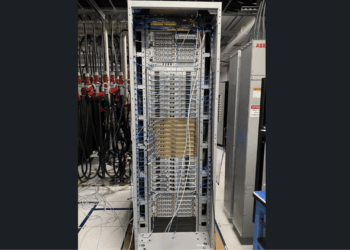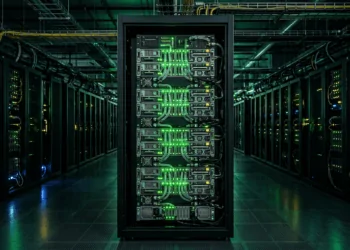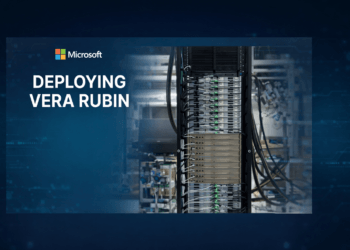
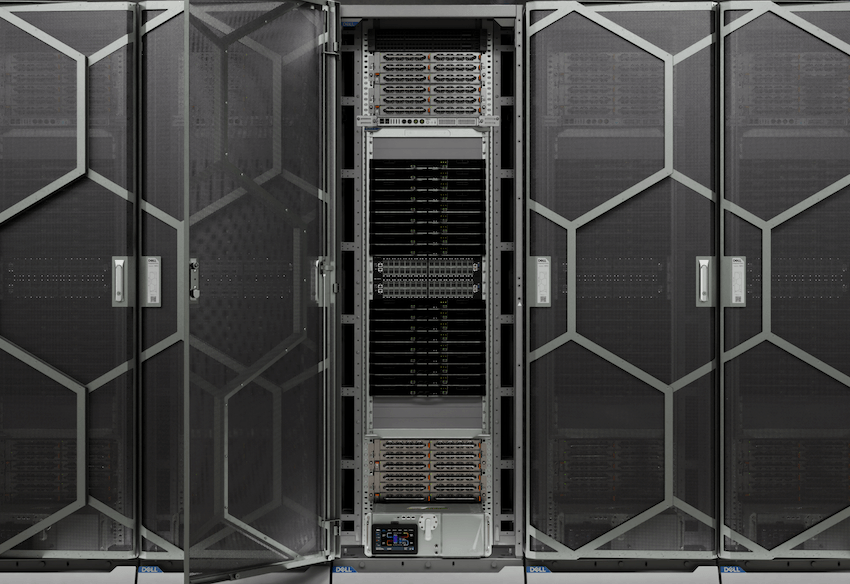
NVIDIA’s Vera Rubin architecture is beginning to move from roadmap to reality. Dell Technologies unveiled a new PowerEdge XE8812 platform that brings Vera Rubin NVL4 into a rack-scale AI system supporting up to 144 GPUs, marking a significant step in the industry’s transition to the next generation of AI infrastructure.
The liquid-cooled PowerEdge XE8812 expands Dell’s AI Factory with NVIDIA portfolio and delivers substantial increases in compute density, memory capacity, and energy efficiency compared with prior-generation systems. The platform is designed for AI training, inference, HPC simulation, and scientific computing workloads that increasingly demand hundreds of GPUs operating as a unified system.
Built on an ORv3 rack architecture and supporting more than 300 kW of power, the XE8812 reflects the growing shift toward factory-integrated AI infrastructure. Rather than assembling individual servers into clusters, organizations are increasingly deploying complete rack-scale systems optimized for power, cooling, networking, and management from day one.
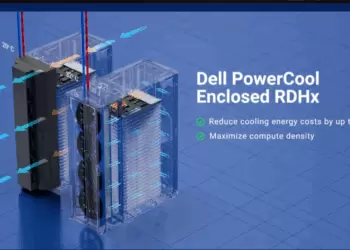
Dell said the fanless PowerEdge XE8812 uses 100% direct liquid cooling across both CPUs and GPUs and incorporates NVIDIA Vera Rubin NVL4 architecture. Compared with the prior generation, the system increases CPU core counts from 144 to 176 while adding more host memory, GPU memory, and compute capacity. Dell said the platform provides 50% more memory per socket and GPU compared with the previous generation, enabling larger AI models and scientific simulations to remain entirely in memory.
The company also emphasized operational simplicity and deployment speed. The PowerEdge XE8812 integrates with Dell’s iDRAC, OpenManage Enterprise, and Dell Integrated Rack Controller software platforms, providing rack-level monitoring, telemetry, automated leak detection, and lifecycle management. Dell said its factory-integrated PowerRack systems can reduce deployment complexity and enable production-ready AI infrastructure to be installed and operational in just over six hours.
Dell highlighted growing momentum for its Dell AI Factory with NVIDIA initiative, citing more than 5,000 customers worldwide. Examples include the upcoming Doudna supercomputer at Lawrence Berkeley National Laboratory, which will use PowerEdge XE8812 servers with NVIDIA Vera Rubin NVL4 and NVIDIA Quantum-X800 InfiniBand networking; InstaDeep’s Kyber AI supercomputer in France; genomics research at the Wellcome Sanger Institute in the United Kingdom; and Monash University’s MAVERIC AI system in Australia.
• PowerEdge XE8812 incorporates NVIDIA Vera Rubin NVL4 architecture
• Supports up to 144 GPUs per rack
• Delivers more than 300 kW of rack power capacity
• Uses 100% direct liquid cooling for CPUs and GPUs
• Based on the ORv3 open rack standard
• Increases CPU core counts from 144 to 176 compared with the prior generation
• Provides 50% more memory per socket and GPU
• Designed for AI training, inference, HPC simulation, genomics, and scientific computing
• Dell reports more than 5,000 Dell AI Factory customers globally
• General availability is expected in early 2027
“The institutions doing the world’s most important research like decoding the human genome, modeling the energy systems of the future and building the sovereign AI infrastructure that nations depend on deserve infrastructure that matches the ambition of their work,” said Arun Narayanan, Senior Vice President, Compute and Networking at Dell Technologies.
🌐 Analysis: The PowerEdge XE8812 provides one of the first detailed looks at how NVIDIA’s Vera Rubin generation will be deployed in production environments. The transition from Blackwell to Rubin is not simply a GPU upgrade; it drives changes across power delivery, cooling, memory architecture, rack design, and networking. As AI clusters scale into the hundreds of thousands of accelerators, infrastructure vendors increasingly compete on their ability to integrate complete rack-scale systems rather than standalone servers.
🌐 Analysis: Dell’s emphasis on ORv3 rack standards, direct liquid cooling, and factory-integrated deployment aligns with broader trends across the AI infrastructure industry. Competitors including HPE, Supermicro, Lenovo, and ODM suppliers are also moving toward highly integrated liquid-cooled platforms built around NVIDIA Rubin, AMD Instinct, and future accelerator architectures. The result is a shift toward AI infrastructure delivered as a complete system, where power, cooling, networking, and compute are engineered together from the outset.
What’s New with NVIDIA Vera Rubin? Key architectural advances driving the next generation of AI infrastructure • Updated June 2026 | |
| Process Technology | Moves from Blackwell’s custom TSMC 4NP process to a true TSMC N3 (3nm) manufacturing node, improving transistor density and energy efficiency. |
| Transistor Count | 336 billion transistors per Rubin GPU package, up from 208 billion in Blackwell — a 61% increase in silicon complexity. |
| Advanced Packaging | Uses a dual-reticle compute die architecture combined with advanced TSMC CoWoS-L packaging technology to scale compute, memory, and interconnect density. |
| HBM4 Transition | Rubin becomes NVIDIA’s first platform to adopt HBM4, moving beyond Blackwell Ultra’s HBM3e memory technology. |
| Memory Bandwidth | 22 TB/s per GPU package, approximately 2.75x higher than Blackwell’s 8 TB/s. This directly addresses memory bottlenecks associated with large-context AI inference and KV-cache operations. |
| HBM Capacity | Supports 288 GB of HBM4 across an 8-stack configuration using 12-Hi and 16-Hi memory stacks. |
| New Vera CPU | Features an 88-core custom NVIDIA CPU based on Olympus Armv9 cores, delivering 176 threads and optimized for AI and HPC workloads. |
| CPU Memory System | Integrated LPDDR5X subsystem provides up to 1.2 TB/s of memory bandwidth and as much as 1.5 TB of addressable CPU memory. |
| CPU-GPU Link | NVLink-C2C interconnect delivers up to 1.8 TB/s between the Vera CPU and Rubin GPU. |
| NVLink 6 | Doubles scale-up bandwidth to 3.6 TB/s bidirectional per GPU. A fully configured NVL72 rack delivers approximately 260 TB/s of aggregate internal bandwidth. |
| Scale-Out Networking | ConnectX-9 SuperNIC and BlueField-4 DPU architecture support up to 1.6 Tbps of networking bandwidth per GPU for large-scale AI fabrics. |
| Silicon Photonics | Spectrum Ethernet platforms introduce support for co-packaged optics (CPO), integrating silicon photonics directly into networking infrastructure to reduce power consumption at scale. |
| Inference Performance | 50 PFLOPS NVFP4 per GPU package using NVIDIA’s Transformer Engine optimized FP4 precision format. |
| Training Performance | 35 PFLOPS NVFP4 for dense training workloads. |
| Rack-Level AI Scale | A Rubin NVL72 system can deliver approximately 3.6 Exaflops of AI inference performance. |
| Native HPC Capability | Provides native FP64 support and up to 5 Petaflops of FP64 performance per rack, enabling traditional scientific computing and AI workloads to run on the same infrastructure. |
| Industry Significance | Rubin is not simply a GPU refresh. It introduces a new rack-scale architecture that simultaneously advances semiconductor technology, memory systems, networking fabrics, liquid cooling, and AI compute density—setting the foundation for the next generation of AI factories. |