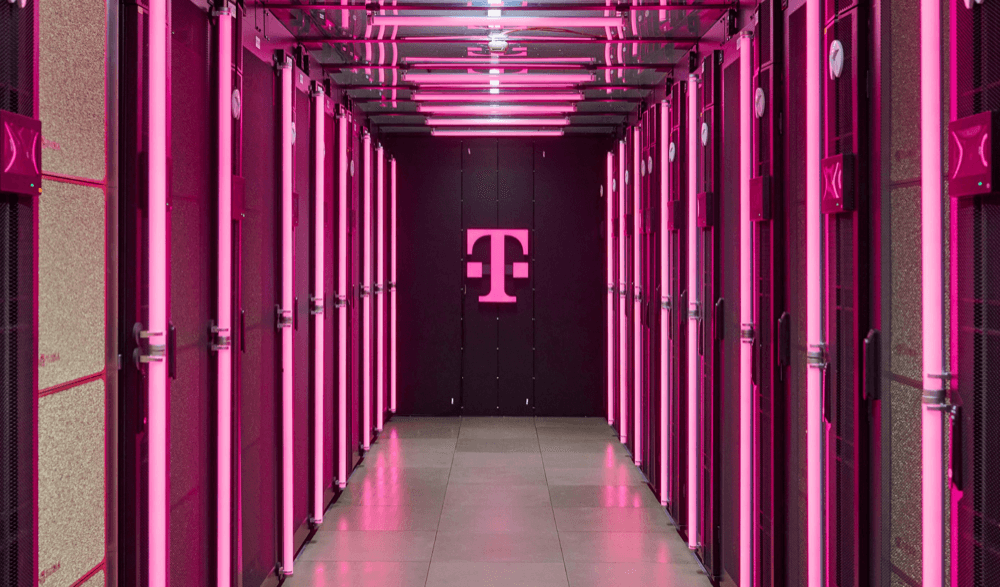
Germany’s first industrial AI factory officially entered operation in Munich, marking one of Europe’s largest sovereign AI infrastructure deployments. Led by Deutsche Telekom, the new Industrial AI Cloud in Munich’s Tucherpark provides high-performance, Germany-hosted compute for enterprises, research institutions, startups, and the public sector, with a focus on data sovereignty, security, and industrial workloads.
Built over six months with NVIDIA and data-center partner Polarise, the facility integrates nearly 10,000 NVIDIA Blackwell-generation GPUs, including DGX B200 systems and RTX PRO Server GPUs. The platform delivers up to 0.5 ExaFLOPS of AI compute and is already operating at more than one-third utilization, with early customers including Munich-based robotics firm Agile Robots and engineering simulation specialist PhysicsX.
The AI factory underpins the so-called “Deutschland Stack,” a sovereign AI and cloud framework jointly advanced by Deutsche Telekom and SAP. Telekom subsidiary T-Systems supplies the infrastructure and platform layer, while SAP contributes its Business Technology Platform and enterprise AI applications. In parallel, Siemens is deploying its SIMCENTER simulation portfolio and digital-twin software on the Industrial AI Cloud, enabling GPU-accelerated simulations, AI copilots, and industrial digital-twin workflows for manufacturers, including small and medium-sized enterprises.
- Location: Munich (Tucherpark), Germany
- Infrastructure: ~10,000 NVIDIA Blackwell GPUs; DGX B200 and RTX PRO Server systems
- Performance: Up to 0.5 ExaFLOPS AI compute
- Use cases: Industrial AI, digital twins, robotics, simulation, public-sector and enterprise AI
- Sovereignty: Operated on German soil with strict data-protection and security controls
- Sustainability: 100% renewable energy, water-based cooling using the Eisbach, waste-heat reuse for district heating
- Ecosystem: Industry partners, startups, research institutions, and public-sector users
- Flagship project: SOOFI (Sovereign Open-Source Foundation Models), targeting a ~100-billion-parameter European LLM trained and operated entirely in Europe
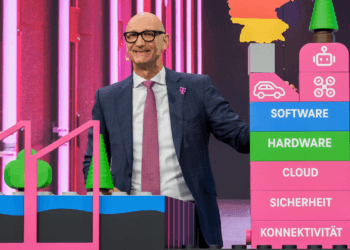
“Many can talk. Deutsche Telekom acts. We are investing in AI, in Germany as a business location and in Europe. Our AI factory in Munich is the basis for innovative business models, for industry, start-ups and the government – and for sovereignty,” said Tim Höttges, CEO of Deutsche Telekom.
🌐 Analysis
The launch positions Deutsche Telekom as a central infrastructure provider for Europe’s push toward sovereign AI, at a time when governments and industrial players seek alternatives to hyperscale, non-European cloud platforms. The combination of Blackwell-class GPUs, industrial software from Siemens, and enterprise platforms from SAP highlights a trend toward vertically integrated, industry-focused AI clouds designed to move beyond pilots into production. Comparable efforts across Europe increasingly emphasize domestic data centers, renewable power, and open-source foundation models, as seen in projects such as SOOFI, which aim to anchor large-scale AI development within European regulatory and language contexts.