
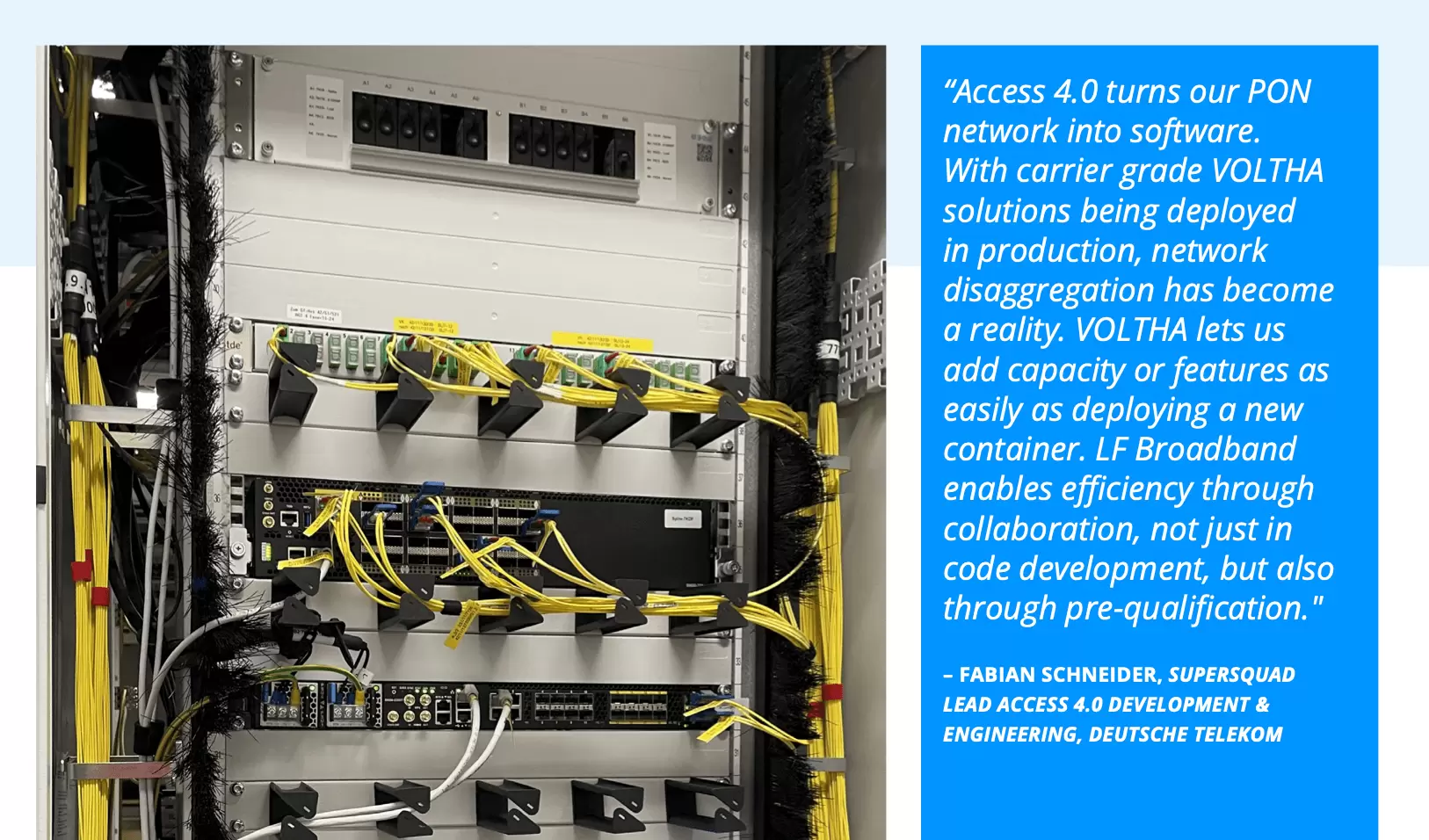
Deutsche Telekom has successfully deployed the VOLTHA open source platform to modernize its fixed-access network under the Access 4.0 program. The initiative, aimed at reducing vendor lock-in and increasing automation, enables DT to integrate both legacy and new optical line terminal (OLT) equipment within a single software-defined architecture. VOLTHA (Virtual OLT Hardware Abstraction) now bridges the gap between DT’s existing OLTs and its OSS/BSS systems, creating a disaggregated environment that simplifies operations and promotes vendor diversity.
Before Access 4.0, DT’s broadband network was composed of fragmented, proprietary PON domains, each requiring separate OSS/BSS integrations. With VOLTHA now acting as a hardware-agnostic layer, legacy OLTs can be upgraded with new firmware and re-registered into the unified SDN-based system during regular maintenance windows—eliminating truck rolls and preserving customer settings. DT deployed VOLTHA and its associated services as Kubernetes microservices at central office locations, running on x86 clusters alongside leaf/spine fabrics and standard compute nodes.
The integration has yielded measurable benefits including reduced capital costs, zero-touch provisioning via DT’s POD Access Orchestrator (PAO), and faster service activation cycles. The open architecture also encourages multi-vendor participation, with suppliers aligning their roadmaps to VOLTHA releases. DT calls the solution “carrier-grade” and plans to extend Access 4.0 to support next-gen PON technologies and align with BBF standards such as TR-383 and TR-385.
• DT’s Access 4.0 introduces open, disaggregated fixed-access network architecture using VOLTHA
• Supports existing and new OLTs via firmware updates—no rip-and-replace needed
• Zero-touch provisioning and automated onboarding workflows reduce operational overhead
• VOLTHA deployed as Kubernetes microservices at central office sites
• DT’s long-term strategy includes standards alignment and vendor-neutral innovation
“This solution has reached what we call ‘carrier-grade quality and stability’ and is now ready for large-scale production,” according to Deutsche Telekom.
- VOLTHA (Virtual OLT Hardware Abstraction) is an open source software framework designed to abstract and virtualize Passive Optical Network (PON) access hardware, enabling operators to disaggregate legacy and next-generation Optical Line Terminals (OLTs) from their proprietary control systems. The project originated in 2016 under the Open Networking Foundation (ONF) as part of its CORD (Central Office Re-architected as a Datacenter) initiative, with the goal of bringing cloud-native principles and software-defined networking (SDN) to the broadband access layer. VOLTHA provides a unified, programmable interface between OLTs and upstream OSS/BSS systems, supporting both legacy and white-box platforms through modular adapters. Over time, it has evolved into a mature, carrier-grade solution adopted by major telcos, including Deutsche Telekom, to enable multi-vendor interoperability, automation, and cost-effective network transformation in brownfield environments.