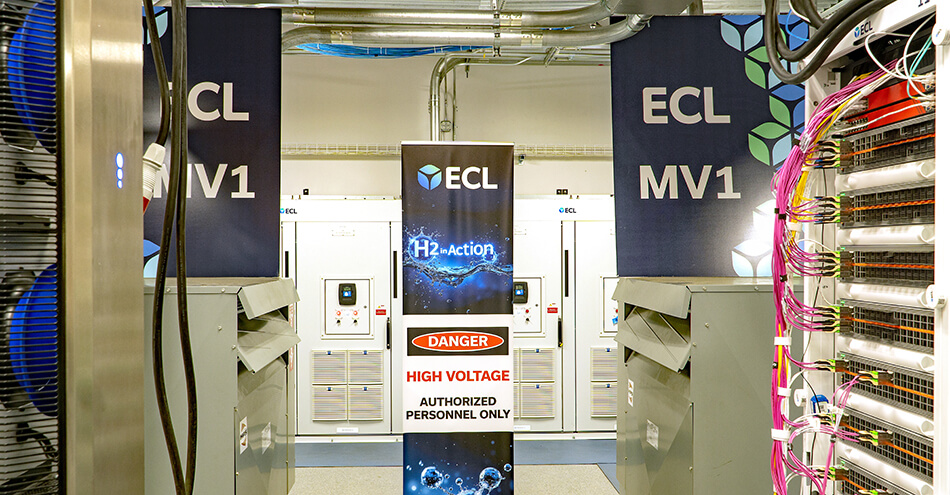
ECL, a Mountain View-based developer of modular data center infrastructure, introduced CSC-1, a 35MW facility in Santa Clara designed to address acute power constraints facing AI deployments in Northern California. The site leverages the company’s FlexGrid architecture to integrate on-grid electricity, hydrogen fuel cells, and natural gas into a unified, behind-the-meter power system. The announcement comes as projections from S&P Global indicate U.S. data center electricity demand will more than double from 61.8 GW in 2025 to 134.4 GW by 2030, while Bloomberg reports that roughly half of planned U.S. data center projects this year face delays or cancellations due to power availability.
CSC-1 supports rack densities ranging from 75 kW to 270 kW at launch and uses a phased deployment model, beginning with an initial 2.5MW footprint that expands to full capacity as demand grows. ECL reports that its FlexGrid architecture can deliver sub-1.15 PUE by orchestrating multiple power inputs and optimizing cooling through direct-to-chip, air, and hydrogen by-product water systems. The platform also integrates ECL Lightning, a real-time control system that dynamically adjusts power generation, cooling, and rack-level operations. The design targets Tier III-level reliability while enabling faster time-to-service compared to traditional grid-dependent builds.
ECL positions CSC-1 as a response to prolonged grid interconnection delays in Silicon Valley, where securing utility power has become a primary bottleneck for new AI infrastructure. By deploying modular power blocks behind the meter, the company allows operators to begin AI training and inference workloads within months rather than waiting years for grid approvals. The approach also incorporates hydrogen-based generation, where water by-products can be reused in cooling systems, reducing reliance on freshwater resources in drought-prone regions such as California.
- 35MW total capacity, phased from an initial 2.5MW deployment
- Rack densities from 75 kW to 270 kW at launch
- FlexGrid architecture integrates grid power, natural gas, and hydrogen fuel cells
- Sub-1.15 PUE using hybrid cooling (direct-to-chip, air, hydrogen by-product water)
- ECL Lightning platform enables real-time control of power and cooling systems
- Designed for Tier III-level reliability with behind-the-meter deployment model
“A 35MW facility delivered in Santa Clara in under a year would have been unthinkable through traditional grid-connected development. Every major AI operator in the Bay Area is facing years-long interconnection delays against rapidly growing AI demand. By phasing growth through modular power blocks, ECL aligns infrastructure deployment with actual demand rather than forcing customers to overbuild or wait.”
🌐 Analysis
ECL’s FlexGrid model reflects a broader industry shift toward energy-integrated data center design, where power generation becomes a core architectural layer rather than an external dependency. Hyperscalers and colocation providers increasingly explore on-site generation, including fuel cells and small modular power systems, to bypass grid constraints and accelerate deployment timelines.