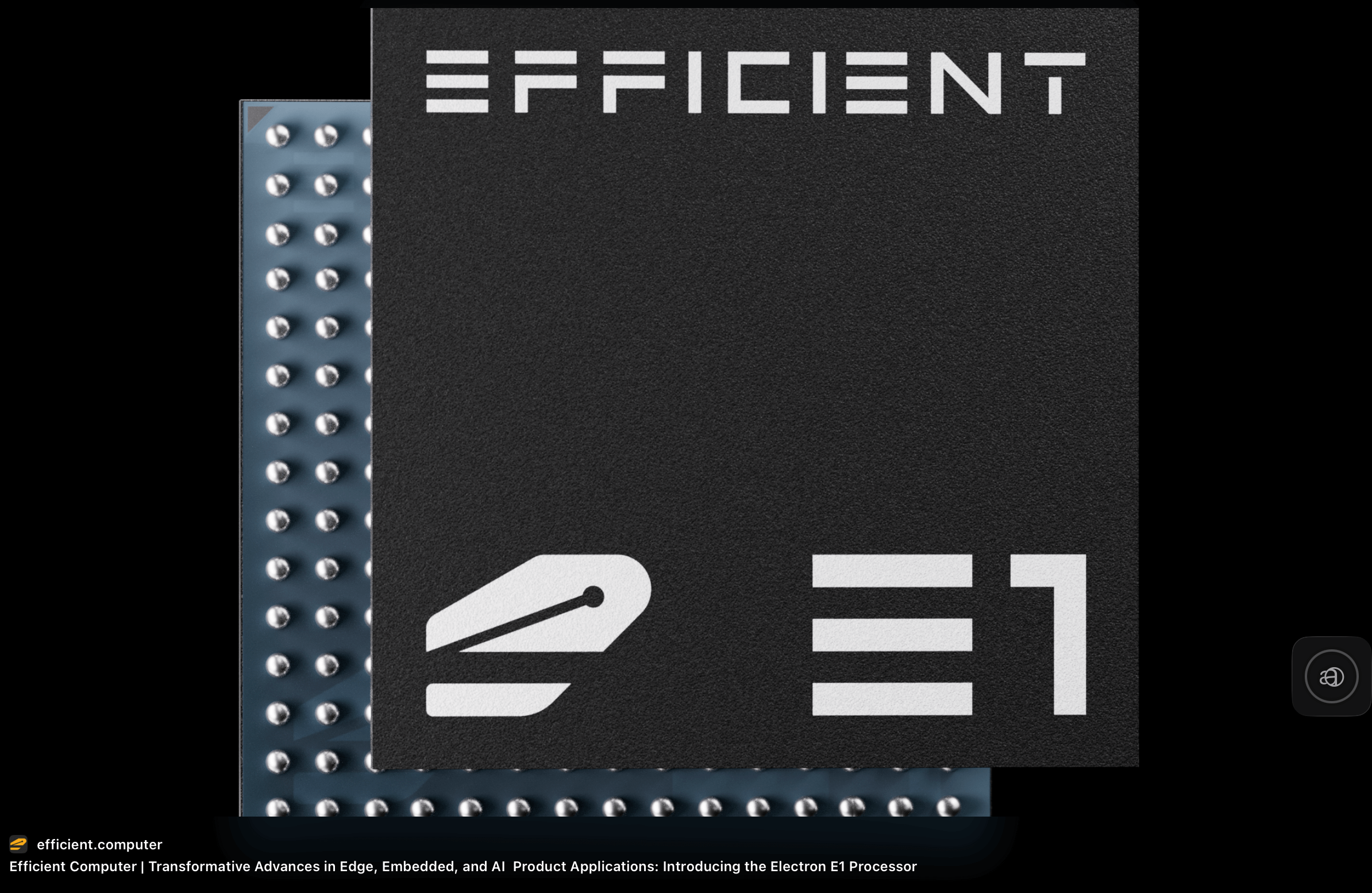
Efficient Computer centers its strategy on the Electron E1 processor, built on what it calls the Efficient Fabric architecture. The company describes the design as a spatial dataflow architecture that minimizes data movement and architectural overhead common in conventional CPUs and GPUs. Efficient targets general-purpose programmability for AI, signal processing, and control workloads, aiming to deliver higher performance per watt without relying on fixed-function accelerators. The architecture seeks to support embedded and edge deployments where power, thermal limits, and battery life constrain traditional compute platforms.
The company positions its vertically integrated hardware and software stack for use cases ranging from infrastructure automation and industrial wearables to aerospace and defense systems. Investors framed the funding as a bet on energy efficiency as a limiting factor in AI deployment, particularly as intelligence shifts from centralized cloud environments into distributed physical systems. The new capital will support commercialization efforts and the expansion of Efficient’s intellectual property portfolio across edge and infrastructure markets.
• $60 million Series A led by Triatomic Capital; total funding reaches $76 million
• Investors include Eclipse, Union Square Ventures, Overlap Holdings, Box Group, RTX Ventures, Toyota Ventures, and Overmatch Ventures
• Flagship product: Electron E1 processor built on Efficient Fabric spatial dataflow architecture
• Targets AI, signal processing, and control workloads in energy-constrained environments
• Focused on embedded, edge, and infrastructure deployments
• Plans to scale engineering, developer ecosystem, and IP portfolio
“The industry has responded to rising energy costs by layering many fixed-function accelerators into a typical SoC,” said Brandon Lucia, CEO and co-founder of Efficient Computer. “Efficient was built around a different idea: that the most durable path forward is a truly general-purpose architecture that can evolve with software over time, while providing market-leading energy efficiency for a range of critical intelligence use cases.”
🌐 Analysis: Efficient Computer enters a competitive landscape where startups and established semiconductor vendors pursue domain-specific accelerators to address AI’s power constraints. Its emphasis on a programmable spatial dataflow architecture aligns with broader industry efforts to reduce data movement and improve performance per watt, themes also visible in edge AI silicon from major MCU and SoC vendors.
If Efficient can demonstrate measurable performance-per-watt advantages across diverse workloads, it could carve out a position in embedded AI and control systems, particularly as enterprises push intelligence closer to sensors and physical infrastructure. Execution will hinge on software tooling maturity and developer adoption, areas that historically determine whether new architectures gain sustained traction.
🌐 We’re tracking the latest developments in networking silicon. Follow our ongoing coverage at: https://convergedigest.com/category/semiconductors/
🌐 We’re launching the “Data Center Networking for AI” series on NextGenInfra.io and inviting companies building real solutions—silicon, optics, fabrics, switches, software, orchestration—to share their views on video and in our expert report. To get involved, send a note to [email protected] or [email protected].