• Home
  • About
  • Events Calendar
  • Blueprint Guidelines
  • Privacy Policy
  • Manage Email Delivery
  • NextGenInfra.io
  • buzzwords
  • Archives
  • Milestones
  • On This Day
  • Video Search
Converge Digest
Wednesday, July 15, 2026
  • Home
  • About
  • Events Calendar
  • Blueprint Guidelines
  • Privacy Policy
  • Manage Email Delivery
  • NextGenInfra.io
  • buzzwords
  • Archives
  • Milestones
  • On This Day
  • Video Search
No Result
View All Result
Converge Digest
No Result
View All Result

Home » Facebook’s Terragraph Accelerates WiGig for City Access

Facebook’s Terragraph Accelerates WiGig for City Access

April 13, 2016
in All
A A

Facebook took the wraps off of two terrestrial connectivity technologies for fast wireless access.

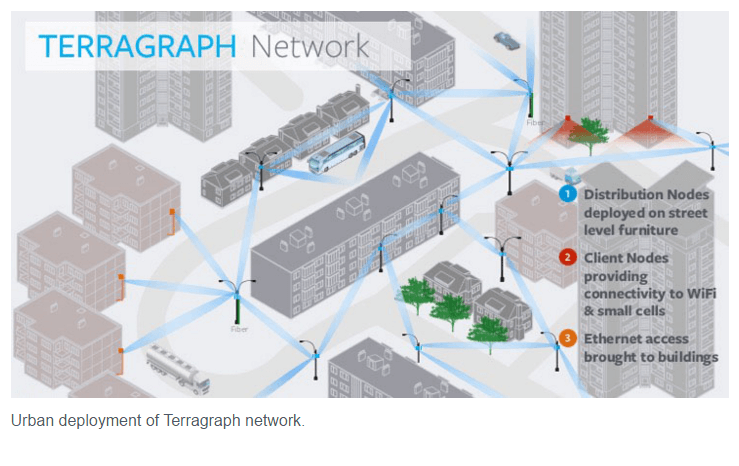
Terragraph is a 60 GHz, multi-node wireless system for dense urban areas and that uses radios based on the WiGig standard. Facebook said Terragraph will deliver gigabits of data capacity. IPv6-only Terragraph nodes will be placed at 200m intervals. Terragraph will incorporate commercial off-the-shelf components and aim for high-volume, low-cost production. Facebook noted that up to 7 GHz of bandwidth is available in the unlicensed 60 GHz band in many countries.  U.S. regulators are considering expanding this to a total of 14 GHz.

Facebook Terragraph will also leverage an SDN-like cloud compute controller and a new modular routing protocol that Facebook optimized for fast route convergence and failure detection. The architecture also tweaks the MAC layer to solve shortcomings of TCP/IP over a wireless link. The company says the TDMA-TDD MAC layers delivers up to 6x improvement in network efficiency while being more predictable than the existing Wi-Fi/WiGig standard.

Terragraph is already in operation at the Facebook campus in Menlo Park, California, where it delivers 1.05 Gbps bidirectional (2.1 Gbps total throughput per distribution node) in P2P mode, up to 250 meters away. A wider trial is planned for San Jose, California.

Facebook also released details on Project ARIES, a transmission technology that is a) spectrally efficient and allows for higher throughput in even the smallest bandwidths, and b) energy efficient, allowing for extended coverage range.

The proof-of-concept system features a base station with 96 antennas and can support 24 streams simultaneously over the same radio spectrum. Researchers have demonstrated 71 bps/Hz of spectral efficiency. The target is aiming for an unprecedented 100+ bps/Hz of spectral efficiency. Facebook said ARIES is an embodiment of Massive MIMO — by using “spatial multiplexing,” the antenna array at the base station can serve a multiplicity of autonomous user terminals on the same time-frequency resource. This opens up possibilities such as resource sharing as an alternative not only to the need for spectrum licensing.

Facebook already has an ARIES testbed delivering 10x spectral and energy efficiency gains in point to multi-point deployments.


https://code.facebook.com/posts/1072680049445290/

Tags: Blueprint columnsFacebookWiGig
ShareTweetShareSummarizeSummarize
Previous Post

MEF Sets Ethernet Interconnect Point Agreement for Carriers

Next Post

AT&T Mobility Workers Endorse Contract

Staff

Staff

Related Posts

Blueprints

Blueprint: Brazil looks to municipal Wi-Fi 6E

February 21, 2023
All

Blueprint: Building wholesale networks with OTN

December 20, 2022
All

Oracle opens cloud region in Chicago

December 20, 2022
All

BT trials C-RAN in Leeds

December 19, 2022
All

T-Mobile builds cloud native 5G converged core with Cisco

December 15, 2022
All

Meta halts data center expansion construction in Denmark

December 15, 2022
Next Post

AT&T Mobility Workers Endorse Contract

Please login to join discussion

Categories

  • 5G / 6G / Wi-Fi
  • AI Infrastructure
  • All
  • Automotive Networking
  • Blueprints
  • Clouds and Carriers
  • Corporate Strategies
  • CPO
  • Data Centers
  • Enterprise
  • Explainer
  • Feature
  • Hot Start-ups
  • Last Mile / Middle Mile
  • Legal / Regulatory
  • Optical
  • Optical I/O
  • Pluggable Optics
  • Quantum
  • Research
  • Security
  • Semiconductors
  • Silicon Photonics
  • Space Networking & Orbital Data Centers
  • Subsea
  • Sustainability
  • Video
  • Webinars
Converge Digest

A private dossier for networking and telecoms

Follow Us

  • Home
  • About
  • Events Calendar
  • Blueprint Guidelines
  • Privacy Policy
  • Manage Email Delivery
  • NextGenInfra.io
  • buzzwords
  • Archives
  • Milestones
  • On This Day
  • Video Search

© 2026 Converge Digest - A private dossier for networking and telecoms.

No Result
View All Result
  • Home
  • About
  • Events Calendar
  • Blueprint Guidelines
  • Privacy Policy
  • Manage Email Delivery
  • NextGenInfra.io
  • buzzwords
  • Archives
  • Milestones
  • On This Day
  • Video Search

© 2026 Converge Digest - A private dossier for networking and telecoms.

This website uses cookies. By continuing to use this website you are giving consent to cookies being used. Visit our Privacy and Cookie Policy.
Go to mobile version