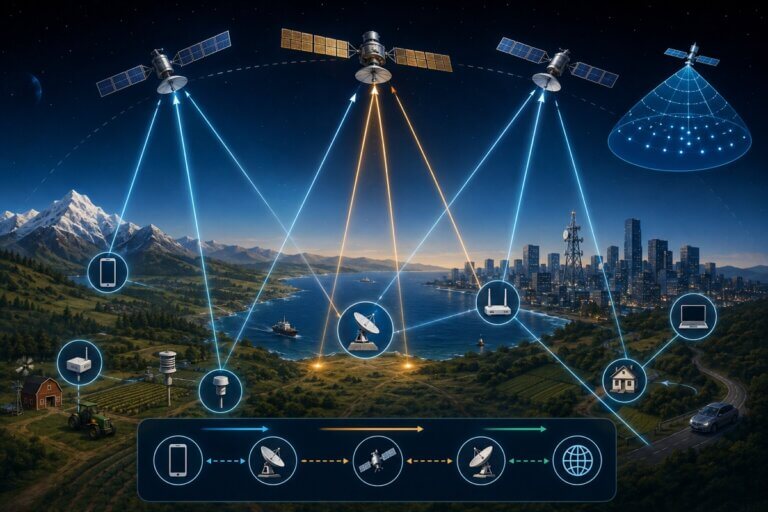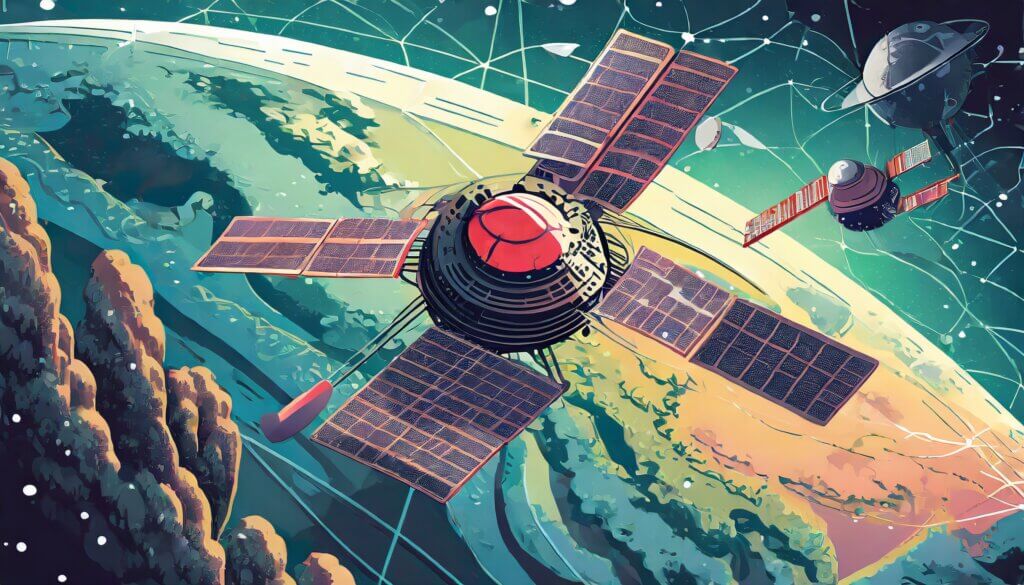
The FCC adopted a new regulatory framework that aims to advance collaborations between satellite operators and terrestrial service providers to offer ubiquitous connectivity directly to consumer handsets using spectrum previously allocated only to terrestrial service. The new regulations bolster supplemental coverage from space, or SCS, which will enable consumers in areas not covered by terrestrial networks to be connected using their existing devices via satellite-based communications.
Specifically, the FCC has updated the United States Table of Frequency Allocations to enable satellite communications in frequencies previously dedicated solely to terrestrial services. This change permits two-way, secondary mobile-satellite service operations in specific spectrum bands lacking primary, rigid-use legacy holders, whether federal or non-federal. For these selected bands, satellite communication services (SCS) are approved only in instances where all terrestrial license holders within a distinct geographical area collectively agree to lease their spectrum rights to a satellite operator. This operator’s part 25 license will then include these frequencies and outline the specific geographical area where the SCS will be provided.
The FCC also highlighted the importance of the work carried out by the 3rd Generation Partnership Project (3GPP) in developing wireless standards, especially concerning the partnership between satellite operators and terrestrial service providers. While earlier solutions adhered to 3GPP standards from before Release 17, it was Release 17 that first introduced features aimed at efficiently facilitating operations of non-terrestrial networks (NTN), incorporating feedback from industry stakeholders. This was a significant step in incorporating satellite technology into the global development of 5G systems. These standards provided for satellite access via New Radio (NR) in Frequency Range 1, targeting handsets and Very Small Aperture Terminals, alongside access for the narrowband Internet of Things and Long-Term Evolution Machine-Type Communication for satellite-based enhanced machine-type communication. Furthermore, 3GPP Release 18 expanded NTN support into Frequency Range 2, including operations in the Ku-band and introducing improvements for better coverage, seamless service continuity, and smoother mobility between non-terrestrial and terrestrial networks. More recently, 3GPP has decided to propose a 5G NR satellite access Radio Interface Terminal to the International Mobile Telecommunications-2020 (IMT-2020), marking another advance in integrating satellite capabilities into next-generation wireless systems.
FCC Chairwoman Jessica Rosenworcel writes: “We are fast heading to a world where next-generation wireless networks will connect everyone and everything around us. They will open up possibilities for communications that we cannot even fully imagine today. But we will not be successful in our effort to make this always-on connectivity available everywhere if we limit ourselves to using only one technology. We are going to need it all—fiber networks, licensed terrestrial wireless systems, next-generation unlicensed technology, and satellite broadband. But if we do this right, these networks will seamlessly interact in a way that is invisible to the user. We won’t need to think about what network, where, and what services are available. Connections will just work everywhere, all the time.”