MediaTek used Computex 2026 to highlight a broader strategy that extends well beyond consumer devices, unveiling new optical interconnect technologies for AI data centers while deepening its partnerships with NVIDIA across AI PCs and automotive platforms. The company demonstrated a MicroLED-based optical communications architecture designed to address growing bandwidth, power, and scalability challenges in next-generation AI clusters.
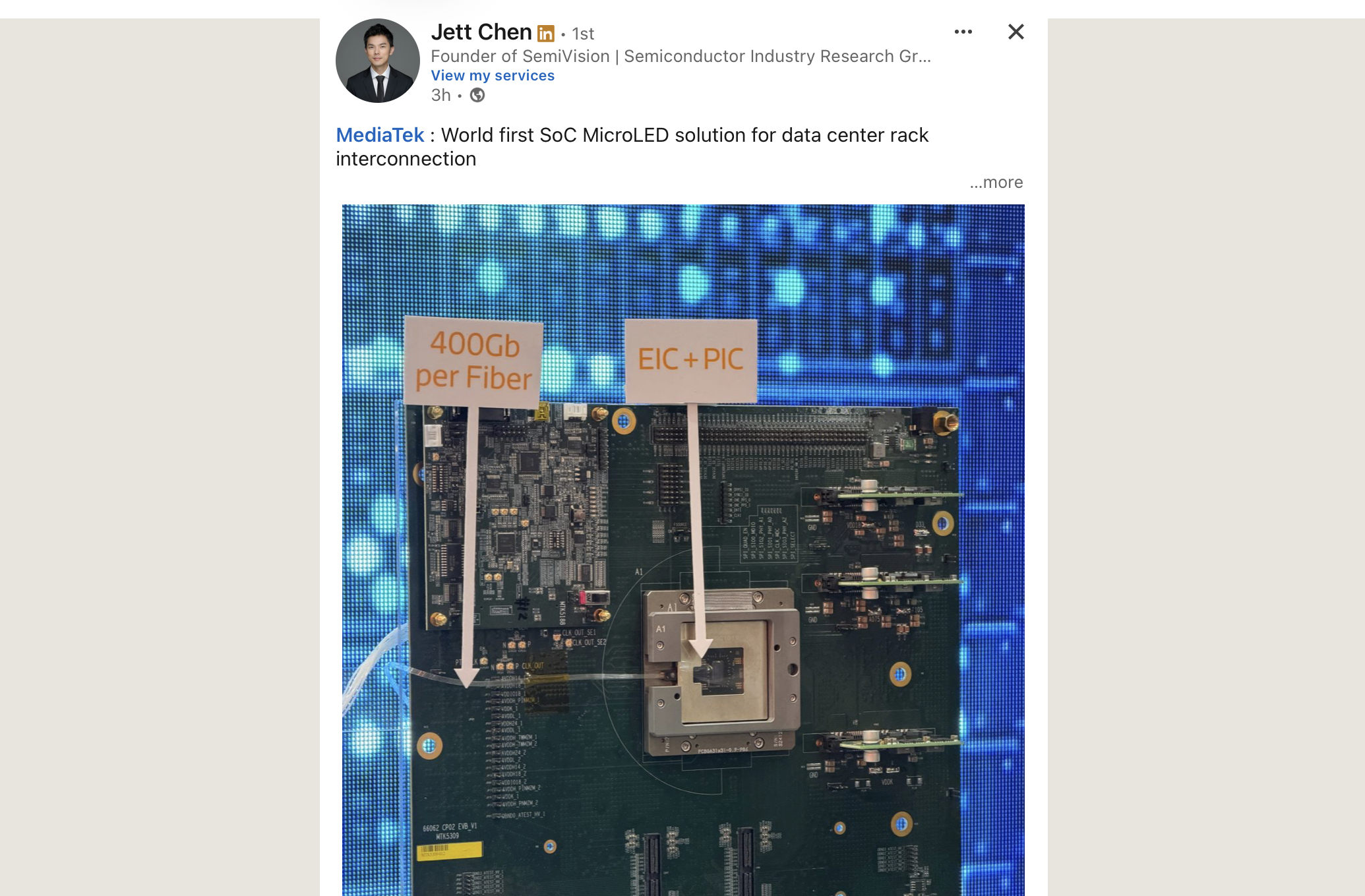
At the center of the announcement is MediaTek’s Data Center Solutions (DCS) portfolio, which spans custom ASICs, XPUs, advanced packaging, high-speed interconnects, and rack-level AI infrastructure. The company showcased Co-Packaged Optics (CPO) technology capable of delivering up to 400Gbps per fiber and demonstrated a MicroLED-based Active Optical Cable (AOC) architecture developed in collaboration with Microsoft Research’s MOSAIC project. MediaTek said the technology integrates MicroLED emitters directly into CMOS transceivers, reducing power consumption by 50% compared with conventional optical interconnect approaches while maintaining compatibility with existing infrastructure. The company said the architecture can also be applied to CPO and Near-Packaged Optics (NPO) designs for future AI systems.
Unlike traditional optical links that rely on high-speed lanes and DSP-intensive PAM4 signaling, the MicroLED approach uses hundreds of parallel low-speed optical channels. MediaTek said this “wide-and-slow” architecture eliminates the need for complex DSPs while enabling higher bandwidth density, lower latency, and improved energy efficiency. The company demonstrated support for 400Gbps optical links today, with a roadmap extending toward 800Gbps, 1.6Tbps, and 3.2Tbps AI interconnects.
Demonstrated MicroLED-based optical interconnect technology for AI data centers.
Showcased Co-Packaged Optics supporting up to 400Gbps per fiber.
Claimed 50% lower power consumption than conventional VCSEL-based Active Optical Cables.
Developed technology in collaboration with Microsoft Research’s MOSAIC project.
Positioned the architecture for future 800Gbps, 1.6Tbps, and 3.2Tbps AI clusters.
Supports both Active Optical Cables, CPO, and Near-Packaged Optics deployments.
MediaTek also highlighted its expanding relationship with NVIDIA. At Computex, the companies demonstrated the NVIDIA DGX Spark platform, built on the NVIDIA GB10 Grace Blackwell Superchip. The system combines a 20-core CPU and Blackwell GPU delivering up to 1 PetaFLOP of AI performance with unified LPDDR5X memory for local AI model execution and agentic AI workloads.
In automotive applications, MediaTek showcased its Dimensity AX C-X1 smart cockpit platform, which integrates NVIDIA AI and graphics technologies to support multimodal AI assistants, hybrid edge-cloud computing, and advanced human-machine interfaces. The company also demonstrated its Dimensity AX MT2739 telematics platform, which supports 3GPP Release 18 5G NR-NTN satellite communications and satellite video calling capabilities.
Additional demonstrations included Wi-Fi 8, 6G interoperability technologies, AI-enhanced networking platforms, fixed wireless access systems, AI-powered IoT applications, and edge computing solutions designed to support agentic AI deployments from cloud to device.
“By delivering diverse platforms that provide extreme computing power to devices, advancing data center technologies, and driving seamless communication, we hold a distinct advantage in Agentic AI that spans from edge to cloud,” said Joe Chen, President of MediaTek.
🌐 Analysis: MediaTek’s optical interconnect announcement represents one of the more unconventional approaches emerging in the race to scale AI infrastructure. While most industry investment has focused on silicon photonics, co-packaged optics, and advanced DSP technologies from companies such as Broadcom, Marvell Technology, and NVIDIA, MediaTek is exploring whether highly parallel MicroLED-based optical links can reduce power consumption and complexity as AI clusters grow toward millions of accelerators.
🌐 Analysis: The announcement also signals MediaTek’s broader ambitions in AI infrastructure. Historically known for mobile and consumer silicon, the company is increasingly positioning itself across data center ASICs, AI connectivity, edge computing, automotive platforms, Wi-Fi 8, and 6G technologies. Its collaboration with Microsoft Research on optical interconnects and its expanding role within NVIDIA’s ecosystem suggest a strategy aimed at capturing opportunities across the entire AI infrastructure stack.
🌐 We’re tracking the latest developments in networking silicon. Follow our ongoing coverage at: https://convergedigest.com/category/semiconductors/
MicroLED Optical Interconnects: The “Wide-and-Slow” Approach
Instead of pushing a few optical lanes to extreme speeds, microLED interconnects use many lower-speed optical channels in parallel. The goal is to reduce power, simplify signal processing, and scale bandwidth for AI data center fabrics.
| Traditional Narrow-and-Fast Links | Wide-and-Slow MicroLED Links |
|---|---|
| Few optical lanes | Hundreds of optical lanes |
| Very high speed per lane (100G to 200G+) | Lower speed per lane (1G to 10G) |
| Relies on complex DSPs, equalization, and error correction | Reduces or eliminates the need for power-hungry DSPs |
| Bandwidth scales by increasing lane speed | Bandwidth scales by increasing lane count |
| Higher electrical loss and thermal load at extreme data rates | Lower power per bit and improved thermal efficiency |
| Optimized for today’s high-speed pluggable optics | Designed for dense optical I/O near CPUs, GPUs, XPUs, and switches |
Simple Bandwidth Comparison
Narrow-and-Fast: 8 lanes × 50 Gbps = 400 Gbps
Wide-and-Slow: 400 lanes × 1 Gbps = 400 Gbps
| AI Cluster Challenge | MicroLED Interconnect Response |
|---|---|
| DSP power consumption | Use lower-speed parallel channels to simplify signal processing |
| Short-reach copper limits | Move more links to optical media inside and between racks |
| Thermal constraints near accelerators | Reduce power consumption per transmitted bit directly on the host packaging |
| Exploding east-west traffic | Scale aggregate bandwidth through ultra-dense spatial optical parallelism |
In short: Wide-and-slow optical I/O trades extreme single-lane speed for massive spatial parallelism, aiming to deliver next-generation cluster bandwidth with lower power and simpler backend electronics.
MediaTek Corporate Profile
MediaTek is a Taiwan-based fabless semiconductor provider expanding from its high-volume smartphone, connectivity, and consumer roots into data center infrastructure, custom silicon ASICs, and specialized optical interconnects.
| Company | MediaTek Inc. |
| Headquarters | Hsinchu, Taiwan |
| Founded / Model | 1997 | Fabless semiconductor design |
| Stock Listing | Taiwan Stock Exchange: 2454 |
| Leadership | Ming-Kai Tsai (Chairman), Rick Tsai (Vice Chairman & CEO), Joe Chen (President) |
| Annual Reach | Powers more than 2 billion connected endpoint devices annually |
| FY24 Financials | Revenue: NT$530.59B | Net Income: NT$107.14B |
| Product Families | Dimensity (Mobile/Auto), Filogic (Wi-Fi/Broadband), Pentonic (Smart TV), Genio (IoT), Kompanio (Compute) |
AI Infrastructure & Data Center Strategy
| Data Center Unit | Formally scaling its Data Center Solutions (DCS) portfolio around custom ASICs, workload-specific XPUs, and specialized rack-level communication plumbing. |
| Advanced Packaging | Maintains flexible physical validation pipelines across multiple foundry nodes, supporting both TSMC CoWoS and Intel EMIB ecosystems. |
| Optical Interconnect | Showcased monolithic CMOS transceivers featuring heterogeneous MicroLED pixel bonding, pushing 400Gbps per fiber bundle with an active roadmap heading toward 3.2Tbps scaling. |
| NVIDIA Alliance | Deepening cross-industry execution with NVIDIA across client platforms (RTX Spark Superchip), automotive (Dimensity AX cockpit architectures), and custom NVLink-fused ASIC silicon. |
Emerging Technology Matrix
| Domain | MediaTek Strategic Focus |
|---|---|
| AI PCs & Edge Compute | Hardware acceleration for on-device generative models, complex NPU execution pipelines, and local agentic AI execution. |
| Automotive Platforms | Dimensity Auto and 3nm Dimensity AX platforms driving localized multi-screen HMI, in-cabin LLMs, and physical security reflexes. |
| Wi-Fi & Broadband | Filogic deployment targeting Wi-Fi 7 and emerging Wi-Fi 8 standards, highlighting AI-driven Active Queue Management (AQM) for latency reduction. |
| 6G & Satellite | Live interoperability validation of 3GPP Release 18 5G NR-NTN sub-systems alongside advanced collaborative MIMO scheduling. |
Market Context & Outlook
| The Transition | Moving intentionally upmarket. By augmenting high-volume consumer silicon revenue with high-margin AI infrastructure architectures, MediaTek is expanding its total addressable market. |
| Competitive Arena | Directly contesting edge boundaries with Qualcomm, while simultaneously building high-speed packaging and interconnect alternatives that cross paths with Broadcom, Marvell, and cloud ASIC teams. |
The Bottom Line: MediaTek’s long-term play hinges on edge-to-cloud continuity—leveraging its consumer market dominance to fund the physical hardware pipelines, advanced packaging, and optical fabrics demanded by hyperscale data centers.