• Home
  • About
  • Events Calendar
  • Blueprint Guidelines
  • Privacy Policy
  • Manage Email Delivery
  • NextGenInfra.io
No Result
View All Result
Converge Digest
Tuesday, June 2, 2026
  • Home
  • About
  • Events Calendar
  • Blueprint Guidelines
  • Privacy Policy
  • Manage Email Delivery
  • NextGenInfra.io
No Result
View All Result
Converge Digest
No Result
View All Result

Home » Google collaborates on Intel’s ASIC-based infrastructure processor

Google collaborates on Intel’s ASIC-based infrastructure processor

October 28, 2021
in All
A A

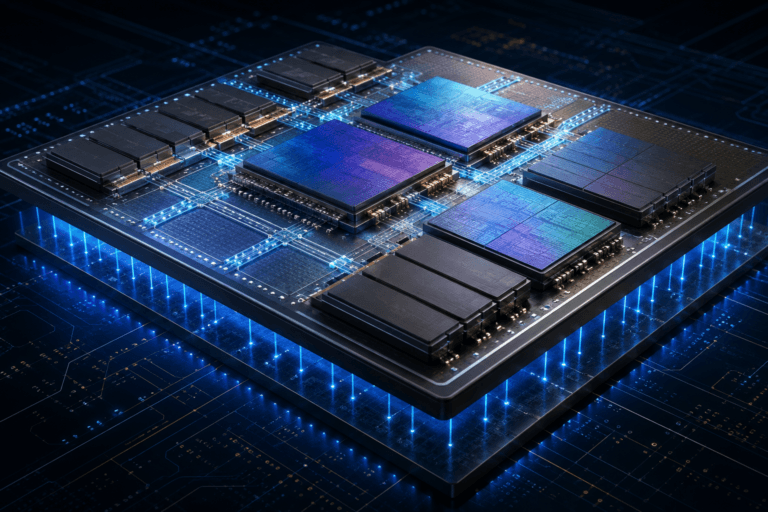
Intel and Google Cloud announced a deep collaboration to develop an ASIC P4-programmable infrastructure processing unit (IPU).

Code-named “Mount Evans,” this open solution supports open source standards, including an infrastructure programmer development kit (IPDK) to simplify developer access to the technology in Google Cloud data centers. 

Machine learning, large-scale data processing and analytics, media processing, and high-performance computing are all workloads that can benefit from the IPU. Another key design ambition is to separate infrastructure management functions from client workloads, thereby ensuring true bare-metal performance. Google and Intel also agreed to collaborate on open standards for transport and on P4 for programmable packet processing.

Intel said its goal is to enable developers to create an end-to-end programmable network based on Intel Xeon Scalable processors and next-generation Intel Xeon D processors, IPUs, and its new, P4-programmable Intel Tofino intelligent fabric processor (IFP) switch.

AT&T, supported by an established ecosystem of solution providers, will use Intel as a silicon provider for deployment of its forthcoming virtualized radio access network (vRAN), giving it the flexibility to bring automation and cloud-like capabilities into its network, along with optimizations for performance, cost and operational efficiency.

An archived webcast of the Intel Innovation 2021 event is posted.

Discussion of the IPU between Intel CEO Pat Gelsinger and Google Fellow Amin Vahdat begins around 1:37:00 

https://www.intel.com/content/www/us/en/newsroom/news/innovation-event-livestream-replay.html#gs.essztu

Intel rolls FPGA-based Infrastructure Processing Unit (IPU)

Thursday, June 17, 2021  DPU, Intel  

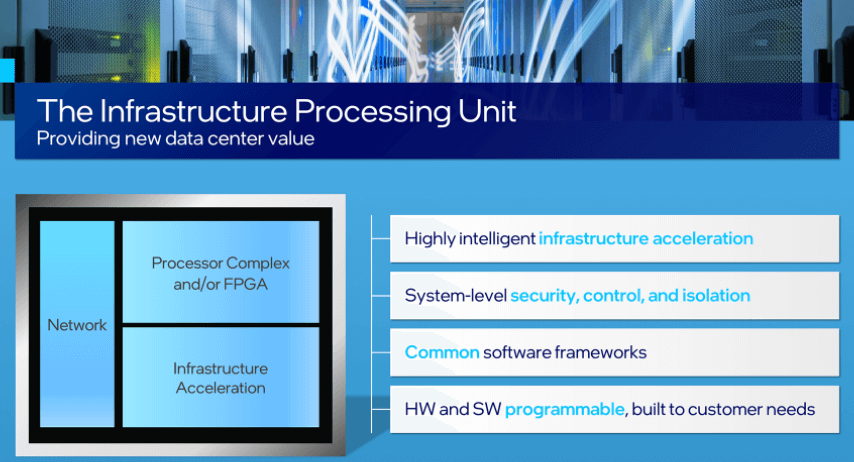
Intel outlined its vision for the infrastructure processing unit (IPU), a programmable network device that intelligently manages system-level infrastructure resources by securely accelerating those functions in a data center.In a video, Guido Appenzeller, chief technology officer with Intel’s Data Platforms Group says the idea is to cleanly separate the processing of client workloads from workloads of the cloud service provider.

Intel cites several advantages for an IPU architecture. First, cloud service providers will be able to process their workloads very efficiently on silicon designed for the tasks. The cloud service provider will be able to rent out 100% of available CPU resources to the clients. The clients are now able to fully control the CPUs including with their own hypervisors. In addition, local disk storage can be enhanced or replaced with virtual storage connected to the network. The first instances of Intel’s FPGA-based IPU platforms are already shipping. Intel will be rolling out additional FPGA-based IPUs and integrated ASICs as well. “As a result of Intel’s collaboration with a majority of hyperscalers, Intel is already the volume leader in the IPU market with our Xeon-D, FPGA and Ethernet components,” said Patty Kummrow, vice president in the Data Platforms Group and general manager of Ethernet Products Group at Intel. “The first of Intel’s FPGA-based IPU platforms are deployed at multiple cloud service providers and our first ASIC IPU is under test.”

https://youtu.be/ahChxDyl8t4

https://www.intel.com/content/www/us/en/newsroom/news/infrastructure-processing-unit-data-center.html

Tags: Blueprint columnsGoogleIntel
ShareTweetShareSummarizeSummarize
Previous Post

12th Gen Intel Core brings DDR5, PCIe 5.0, Wi-Fi 6E, Thunderbolt 4

Next Post

A10 Networks hits Q3 sales of $65.4 million, up 15% year-over-year

Staff

Staff

Related Posts

Subsea

Google and Telstra Partner on Australian Fibre and Subsea Infrastructure for the AI Era

June 2, 2026
Financials

Intel Appoints Client Computing Chief and CTO

May 4, 2026
Financials

Google Cloud Hits $20B Quarter, Fueled by AI Infrastructure Boom

April 29, 2026
All

Intel Q1 2026: AI Drives 22% Data Center Growth, Foundry Revenue Up

April 23, 2026
Semiconductors

Google Unveils 8th-Gen TPUs, AI Hypercomputer with Million-Scale Clusters

April 22, 2026
Semiconductors

Intel, Google Expand AI Infrastructure Pact Around Xeon and Custom IPUs

April 9, 2026
Next Post

A10 Networks hits Q3 sales of $65.4 million, up 15% year-over-year

Please login to join discussion

Categories

  • 5G / 6G / Wi-Fi
  • AI Infrastructure
  • All
  • Automotive Networking
  • Blueprints
  • Clouds and Carriers
  • Data Centers
  • Enterprise
  • Explainer
  • Feature
  • Financials
  • Last Mile / Middle Mile
  • Legal / Regulatory
  • Optical
  • Quantum
  • Research
  • Security
  • Semiconductors
  • Space
  • Start-ups
  • Subsea
  • Sustainability
  • Video
  • Webinars

Archives

Tags

5G All AT&T Australia AWS Blueprint columns BroadbandWireless Broadcom China Ciena Cisco Data Centers Dell'Oro Ericsson FCC Financial Financials Huawei Infinera Intel Japan Juniper Last Mile Last Mille LTE Mergers and Acquisitions Mobile NFV Nokia Optical Packet Systems PacketVoice People Regulatory Satellite SDN Service Providers Silicon Silicon Valley StandardsWatch Storage TTP UK Verizon Wi-Fi
Converge Digest

A private dossier for networking and telecoms

Follow Us

  • Home
  • About
  • Events Calendar
  • Blueprint Guidelines
  • Privacy Policy
  • Manage Email Delivery
  • NextGenInfra.io

© 2026 Converge Digest - A private dossier for networking and telecoms.

No Result
View All Result
  • Home
  • About
  • Events Calendar
  • Blueprint Guidelines
  • Privacy Policy
  • Manage Email Delivery
  • NextGenInfra.io

© 2026 Converge Digest - A private dossier for networking and telecoms.

This website uses cookies. By continuing to use this website you are giving consent to cookies being used. Visit our Privacy and Cookie Policy.
Go to mobile version