• Home
  • Events Calendar
  • Blueprint Guidelines
  • Privacy Policy
  • Subscribe to Daily Newsletter
  • NextGenInfra.io
No Result
View All Result
Converge Digest
Saturday, May 23, 2026
  • Home
  • Events Calendar
  • Blueprint Guidelines
  • Privacy Policy
  • Subscribe to Daily Newsletter
  • NextGenInfra.io
No Result
View All Result
Converge Digest
No Result
View All Result

Home » HPE Spaceborne Computer-2 brings edge to ISS

HPE Spaceborne Computer-2 brings edge to ISS

April 4, 2022
in All
A A

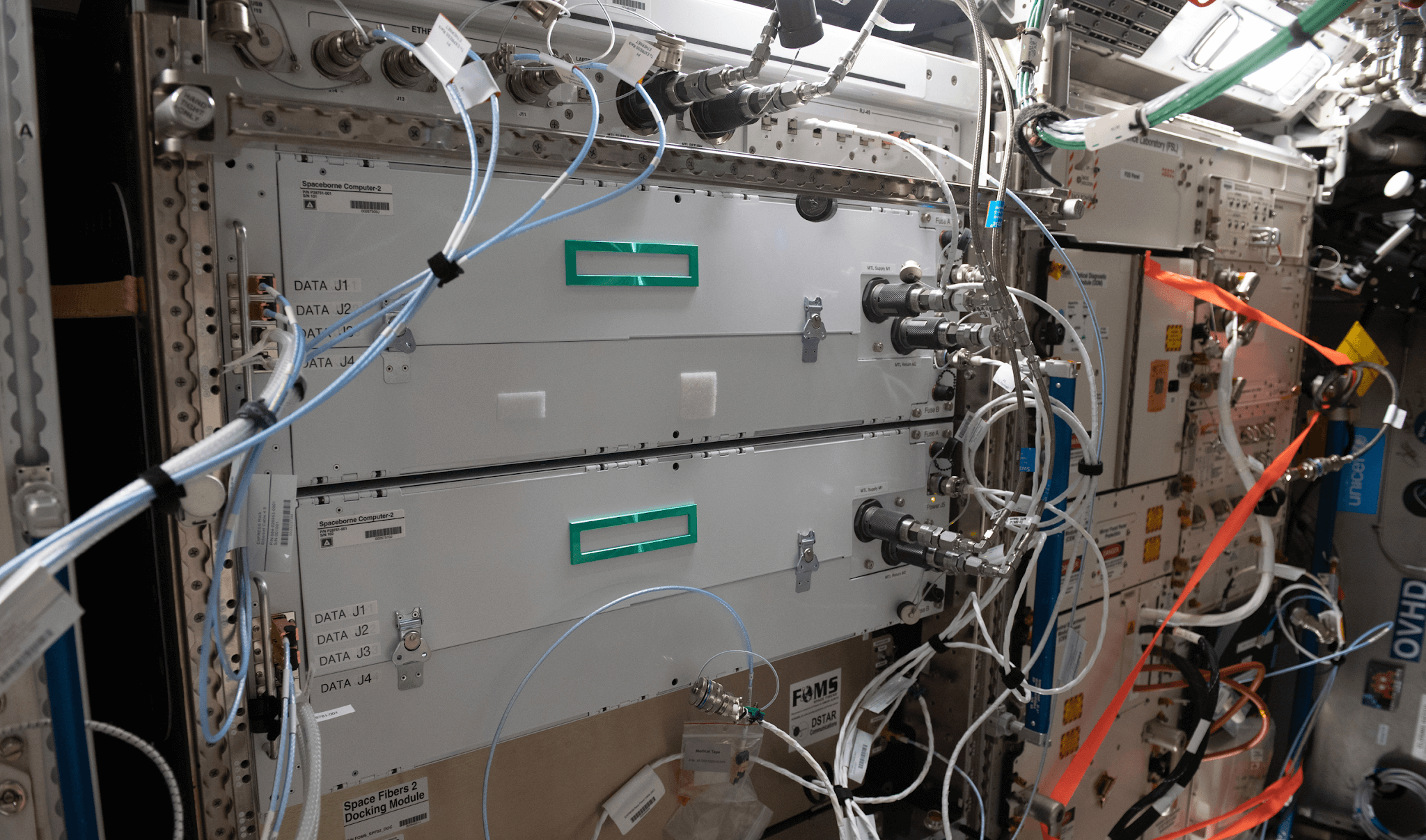
The HPE Spaceborne Computer-2 (SBC-2), which is deployed on the International Space Station (ISS), has successfully completed 24 research experiments requiring real-time data processing. These experiments spanned uses cases supporting healthcare, image processing, natural disaster recovery, 3D printing, 5G, and solutions enabled by artificial intelligence.

HPE launched Spaceborne Computer-2, in collaboration with the ISS National Laboratory, to space in February 2021 and was installed on the ISS in May 2021. The solution is comprised of HPE’s edge computing solutions, the HPE Edgeline Converged EL4000 Edge system, which provides a rugged and compact system designed to perform in harsher edge environments, such as space, and the HPE ProLiant DL360 server, an industry-standard server, for additional high-performing capabilities to target a range of workloads, including edge, HPC, AI, etc.

The edge computing capabilities delivered through SBC-2 also have the potential to enable astronauts and space explorers to send data to Earth, whether to be further analyzed or used in another way, at a radically compressed size and faster speed. Previously, 1.8 GB of raw DNA sequence data took an average time of 12.2 hours just to download to Earth for initial processing. With SBC-2, researchers onboard the space station processed that same data in six minutes to gather meaningful insights, compressed it to 92 KB and sent it to Earth in just two seconds, representing a 20,000X speed-up.

“By introducing edge computing and AI capabilities to the International Space Station with Spaceborne Computer-2, we have helped foster a growing, collaborative research community that shares a common goal to make scientific and engineering breakthroughs that benefit humankind, on space and here on Earth,” said Dr. Mark Fernandez, principal investigator, Spaceborne Computer-2, at HPE. “We are proud of this ongoing work, which has already resulted in 24 completed experiments, from various organizations, demonstrating new possibilities for space exploration and milestones for humanity.”

https://www.hpe.com/us/en/compute/hpc/supercomputing/spaceborne.html

Tags: Blueprint columnsHPEMECSpace
ShareTweetShareSummarizeSummarize
Previous Post

Private investment firm acquires LightRiver

Next Post

Keysight intros 120 Giga Baud Bit Error Ratio Test (BERT)

Staff

Staff

Related Posts

Enterprise

HPE Pushes Agentic AIOps with Self-Driving Network Actions

May 6, 2026
Security

AI-Driven: Security & Autonomous Troubleshooting

March 31, 2026
Security

HPE Rolls Out SRX400 Firewalls and AI Security Stack

March 24, 2026
Enterprise

HPE Brings Edge AI and Fault-Tolerant Core Systems to Retail 

January 12, 2026
Financials

HPE Cites Surging AI Infrastructure Momentum and Networking Growth

December 4, 2025
All

HPE’s New Networking Stack for AI, 102.4T Data Center Switch,  1.6T Edge Router

December 3, 2025
Next Post

Keysight intros 120 Giga Baud Bit Error Ratio Test (BERT)

Please login to join discussion

Categories

  • 5G / 6G / Wi-Fi
  • AI Infrastructure
  • All
  • Automotive Networking
  • Blueprints
  • Clouds and Carriers
  • Data Centers
  • Enterprise
  • Explainer
  • Feature
  • Financials
  • Last Mile / Middle Mile
  • Legal / Regulatory
  • Optical
  • Quantum
  • Research
  • Security
  • Semiconductors
  • Space
  • Start-ups
  • Subsea
  • Sustainability
  • Video
  • Webinars

Archives

Tags

5G All AT&T Australia AWS Blueprint columns BroadbandWireless Broadcom China Ciena Cisco Data Centers Dell'Oro Ericsson FCC Financial Financials Huawei Infinera Intel Japan Juniper Last Mile Last Mille LTE Mergers and Acquisitions Mobile NFV Nokia Optical Packet Systems PacketVoice People Regulatory Satellite SDN Service Providers Silicon Silicon Valley StandardsWatch Storage TTP UK Verizon Wi-Fi
Converge Digest

A private dossier for networking and telecoms

Follow Us

  • Home
  • Events Calendar
  • Blueprint Guidelines
  • Privacy Policy
  • Subscribe to Daily Newsletter
  • NextGenInfra.io

© 2026 Converge Digest - A private dossier for networking and telecoms.

No Result
View All Result
  • Home
  • Events Calendar
  • Blueprint Guidelines
  • Privacy Policy
  • Subscribe to Daily Newsletter
  • NextGenInfra.io

© 2026 Converge Digest - A private dossier for networking and telecoms.

This website uses cookies. By continuing to use this website you are giving consent to cookies being used. Visit our Privacy and Cookie Policy.
Go to mobile version