Huawei Cloud introduced a new “Agentic Infra” architecture and a broad portfolio of AI infrastructure, model development, and agent orchestration products at its INSPIRE 2026 conference in Shanghai. The company positioned Agentic Infra as a foundation for enterprise-scale agentic AI, combining unified compute scheduling, large-scale AI clusters, memory-centric infrastructure, and security controls designed for autonomous AI agents. Huawei Cloud also launched new industry-focused AI zones spanning healthcare, manufacturing, robotics, and scientific computing.
At the core of the announcement is Huawei Cloud’s AI Cluster Service (AICS), which uses the company’s UnifiedBus (UB) networking architecture to support AI clusters with more than 100,000 accelerator cards and up to 200 EFLOPS of aggregate compute capacity. Huawei said the platform can achieve token-generation latency below 10 milliseconds and throughput of 5 million tokens per second across 1,000 cards. Additional infrastructure components include Agentic Memory Storage (AMS), which creates petabyte-scale memory pools for long-running AI workloads, and VolcanoNext, a unified scheduling engine that manages both conventional cloud workloads and AI jobs while improving infrastructure utilization by more than 30%.
Huawei also introduced ModelArtsNext, a new-generation model training and inference platform that incorporates reinforcement learning services, confidential inference, model routing, and model management capabilities. The company launched AgentArts, an enterprise-grade agent platform designed for production deployment of AI agents, along with the open-source openJiuwen framework and AgentArts Orchard portal for automated agent development and deployment. Huawei expanded its Industry AI Foundry with dedicated zones for Smart Healthcare, Embodied AI, Smart Manufacturing, and Scientific Computing, while also announcing an AI Model Partner Program that includes more than 20 model providers such as DeepSeek, Zhipu AI, MiniMax, Baidu, and iFLYTEK.
• Agentic Infra introduces a unified architecture for AI training, inference, memory, scheduling, and agent runtime services.
• AICS supports clusters exceeding 100,000 AI accelerators with up to 200 EFLOPS of aggregate compute capacity.
• Agentic Memory Storage creates PB-scale memory pools and supports tiered KV-cache architectures for long-running agent workloads.
• VolcanoNext unifies scheduling for general-purpose and AI workloads, with Huawei claiming more than 30% higher resource utilization.
• ModelArtsNext adds reinforcement learning as a service (RLaaS), confidential inference, model routing, and model lifecycle management.
• AgentArts focuses on enterprise deployment of AI agents, while openJiuwen provides an open-source implementation sharing more than 90% of the enterprise platform kernel.
• Huawei launched new Industry AI Foundry zones focused on healthcare, robotics, manufacturing, and scientific computing.
• The AI Model Partner Program includes more than 20 Chinese model developers and AI ecosystem partners.
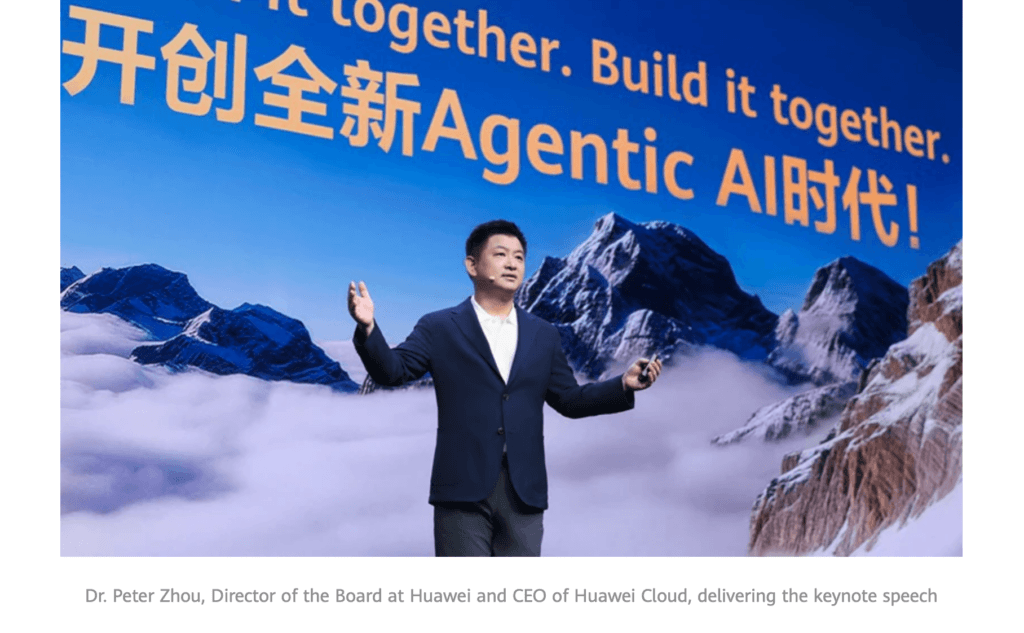
“Moving forward, Huawei Cloud will drive software-hardware synergistic innovation to build the foundation for enterprise-grade AI innovation, working alongside global customers, partners, and developers to usher in a brand-new era of Agentic AI,” said Dr. Peter Zhou, Director of the Board at Huawei and CEO of Huawei Cloud.
🌐 Analysis: Join the club. Huawei’s announcement reflects the industry shift toward infrastructure designed specifically for agentic AI workloads. Major cloud providers including Microsoft, Amazon Web Services, and Google Cloud are similarly building agent orchestration frameworks, AI development platforms, and inference optimization services. Huawei’s differentiation centers on tight integration between its AI hardware, cloud infrastructure, memory architecture, and agent runtime environment.
This development reflects the intensifying geopolitical decoupling within the global artificial intelligence stack. While American hyperscalers build their agentic platforms atop an ecosystem heavily anchored by Nvidia hardware, US export restrictions have forced China to construct a parallel, completely sovereign computing plane. Huawei’s Agentic Infra represents a mature “domestic stack” approach, optimizing localized Ascend processors and native software architectures like UnifiedBus and VolcanoNext to bypass external hardware dependencies. Rather than competing internationally on raw cutting-edge chip fabrication, Huawei is focusing heavily on systems engineering and hardware-software vertical integration. This blueprint aims to convince domestic enterprises, state-backed entities, and regional ecosystems like DeepSeek and Zhipu AI that China’s independent AI infrastructure can deliver competitive, production-grade productivity entirely within its own sovereign boundaries.