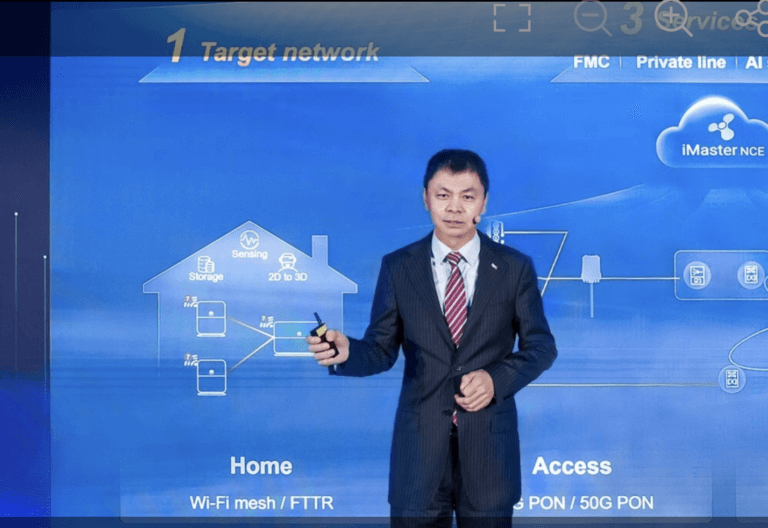
Huawei used the TM Forum DTW 2026 conference last week in Copenhagen to outline an architectural framework for accelerating the deployment of Highly Autonomous Networks (AN). Speaking at the event, Yang Chaobin, Executive Vice President and CEO of Huawei’s ICT Business Group, said communications service providers (CSPs) have reached a strategic consensus on deploying autonomous networks, but now face operational challenges related to multi-vendor environments, legacy infrastructure, and increasingly complex AI-driven operations.
Yang proposed an approach based on “Layered Intelligence and Open Collaboration.” Under the model, time-sensitive functions such as fault self-healing and service experience optimization execute autonomously within individual network domains, enabling second- or minute-level closed-loop control. Higher network layers focus on longer-term policy management, global resource orchestration, and cross-domain coordination. Huawei argues this architecture reduces integration complexity by abstracting differences between multiple network generations and vendor implementations while enabling more scalable AI-driven automation.
A central element of the proposal is adoption of the A2A-T (Agent-to-Agent Telecommunications) standard, which Huawei described as a common communications framework for AI agents operating across network layers and operational systems. Yang called on operators, vendors, standards bodies, and the broader ecosystem to collaborate on open-source implementations of the A2A-T protocol and related standards to accelerate production deployment of Highly Autonomous Networks.
• Huawei says approximately 100 industry organizations have signed the Autonomous Networks Manifesto.
• Around 30 communications service providers have published Autonomous Network blueprints and launched implementation programs.
• Huawei identifies heterogeneous multi-vendor environments, multiple generations of network infrastructure, and inter-system AI agent communication as major deployment challenges.
• The proposed layered architecture distributes real-time intelligence to domain controllers while reserving cross-domain orchestration for higher management layers.
• Huawei believes standardized AI agent communication can simplify interoperability across OSS, network domains, and automation platforms.
• The company called for broader industry collaboration on open-source implementations and standards surrounding the A2A-T interface.
“Deploying Highly Autonomous Networks has become a strategic consensus among mainstream CSPs around the world,” said Yang Chaobin. “The industry should adhere to the approach for Layered Intelligence and Open Collaboration… and adopt the unified A2A-T standard to streamline cross-layer collaboration.”
🌐 Analysis
Huawei continues to position Autonomous Networks as one of the defining operational architectures for AI-enabled telecommunications. Rather than focusing solely on generative AI, the company is emphasizing distributed intelligence, domain-level automation, and standardized multi-agent orchestration—areas that align closely with ongoing work across TM Forum, ETSI, and operator-led autonomous network initiatives. The proposed separation between real-time domain intelligence and higher-level orchestration also reflects broader architectural trends emerging in cloud-native network operations.